

Latest InSights
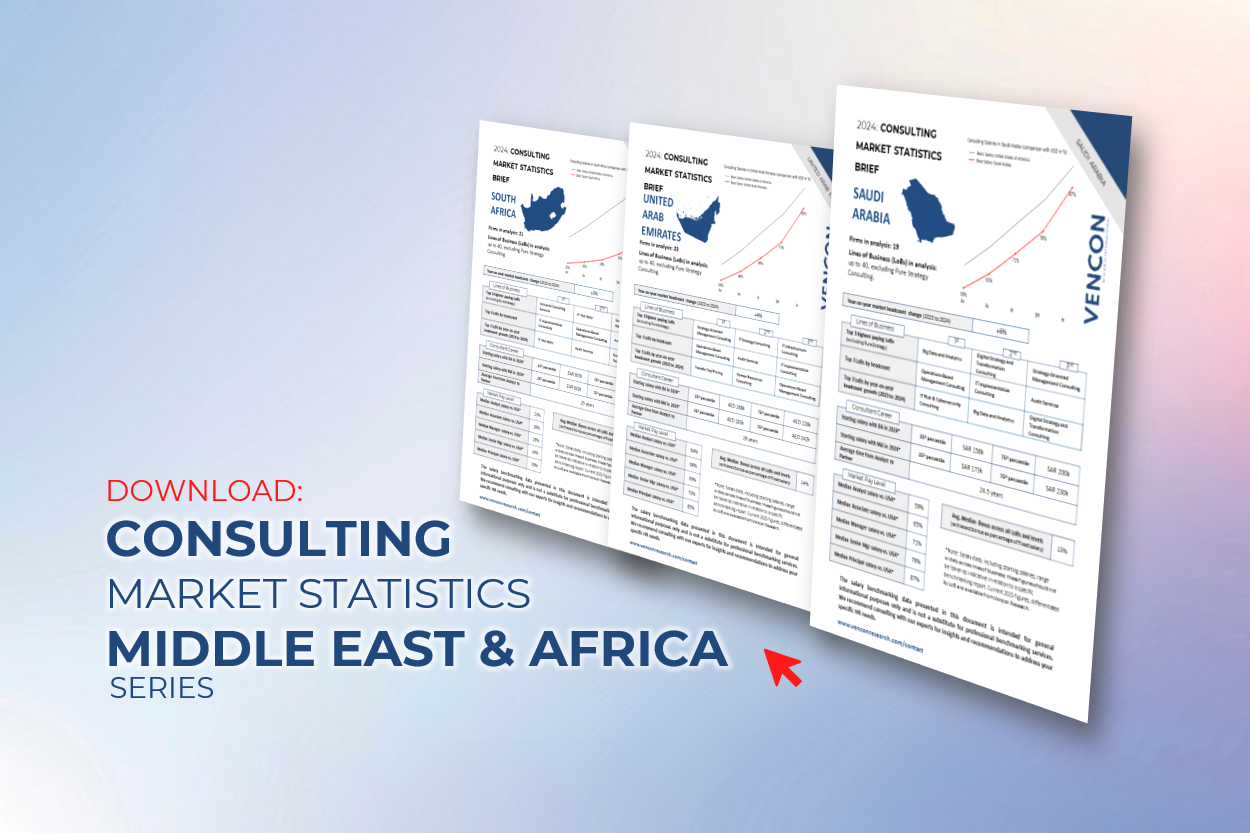
Download: Middle East & Africa Consulting Market HR Insights 2024-2025
This series of briefs consolidates essential HR indicators for the consulting sector across three markets in the Middle East and Africa: the United Arab Emirates, Saudi Arabia, and South Africa. It provides a comparative view of compensation positioning, workforce structure, career progression, and service line dynamics across the region.

AI Consulting in Practice: Insight & Transformation vs. Implementation & Managed Services
By Mik Bodnar - Business Development
As AI has matured from isolated pilots to enterprise-wide deployment, it has become a central pillar of business change. Consulting firms including Accenture, Deloitte, McKinsey, Bain, EY, KPMG, PwC, IBM, Infosys, TCS, Wipro, and Oliver Wyman have expanded AI-related offerings in response to sustained client demand.
Across firms, these services tend to fall into two broad categories: Insight & Transformation and Implementation & Managed Services. Together, they reflect the strategic and operational sides of AI adoption—defining both what AI should deliver and how it is embedded at scale.
AI Consulting: Insight & Transformation
Definition This segment focuses on setting direction. It covers strategy, governance, ethics, industry perspectives, and workforce change.
Core question What should AI mean for our business?
Strategic AI Consulting
Strategic AI Consulting helps organizations identify where AI can create material value and how it fits into broader operating and growth models. McKinsey’s QuantumBlack unit, for example, supports clients in prioritising high-impact use cases and building adoption roadmaps that extend beyond pilots.
AI Governance, Risk & Ethics
Governance and risk services establish guardrails for responsible AI use, addressing compliance, transparency, and ethical considerations. Deloitte’s Trustworthy AI framework illustrates how firms help clients balance innovation with regulatory scrutiny and reputational risk.
Industry-Specific AI Strategy
AI strategies are increasingly tailored by sector. EY, for instance, advises financial institutions on AI-driven fraud detection while ensuring alignment with regulatory requirements and model risk standards.
Workforce Transformation
Workforce-focused services prepare organisations for AI-enabled ways of working. This includes role redesign, reskilling, and change management. Bain’s work with retailers on AI-supported inventory and demand planning highlights the emphasis on human–AI collaboration rather than automation alone.
AI Consulting: Implementation & Managed Services
Definition This segment focuses on execution—deploying, operating, and scaling AI in day-to-day environments.
Core question How do we make AI work consistently in practice?
AI Implementation & Integration
Implementation services cover the deployment of AI platforms, models, and automation into existing processes. Accenture’s AI Studio, for example, supports the integration of generative AI into customer service functions to improve responsiveness and personalisation.
AI Product & Solution Development
Here, consultants design and build bespoke AI applications, such as predictive analytics tools or domain-specific generative AI solutions. IBM’s work with healthcare providers on clinical data analysis illustrates this product-oriented approach.
Managed AI Services
Managed services focus on ongoing performance, monitoring, and optimisation. Infosys provides managed AI operations for manufacturing clients, ensuring predictive maintenance models remain accurate as conditions and data change.
Data & Cloud Enablement for AI
AI at scale depends on modern data and cloud foundations. TCS supports organisations in migrating legacy systems to cloud environments, enabling more advanced analytics and model deployment.
Why AI Consulting Matters for Firms and Talent Leaders
AI consulting has become a core practice area, combining strategic advisory work with deep technical execution. Yet growth in this space is constrained by talent availability. Demand for consultants who can bridge business context and advanced analytics continues to exceed supply.
For HR and compensation leaders, access to reliable market data on AI consulting roles is therefore critical. Salary benchmarks support competitive pay structures, internal equity, and retention—particularly as firms compete not only with peers but also with technology companies and startups. Without clear market reference points, consulting firms risk losing scarce AI talent just as these capabilities become central to client value delivery.
AI transformation places new demands on roles, skills, and pay structures. Vencon Research provides HR advisory services alongside compensation benchmarking to help consulting firms make data-backed workforce and pay decisions.
Middle East Consulting: Talent Market and Compensation Insights
By Andy Klose - Associate Partner
The consulting industry in the Middle East, particularly in the United Arab Emirates (UAE) and in the Kingdom of Saudi Arabia (KSA), has experienced a period of rapid growth post-COVID-19. However, recent economic shifts – especially budget cuts in Saudi Arabia’s public sector – have significantly affected management consulting companies operating in the region. While consulting companies in both the UAE and KSA continue to seek sustainable growth, they are facing challenges related to talent acquisition, retention, and compensation structures. This paper explores the key trends in the consulting industry, with a focus on their impact on the talent market and firm operations.
Saudi Arabia: The Epicentre of Consulting Demand
The Kingdom of Saudi Arabia remains the most significant market for consulting services in the region, particularly within its semi-public and government sectors. Many consulting companies have built their business models around serving Saudi clients, and the recent budget cuts have had a profound impact:
- Demand for consulting services has declined across various government projects.
- Most consulting companies have seen their growth slow down, with only a few maintaining the pace of previous years.
- Achieving ambitious revenue and profitability targets has become increasingly difficult for consulting companies.
Despite these challenges, Saudi Arabia remains a crucial market, and consulting companies are adjusting their strategies to adapt to the new landscape.
Increasing Sophistication of Clients and Changing Project Expectations
Clients in the region, from both the private and the public sector, are evolving in their approach to consulting services, which may have an impact on how consulting companies operate and compete:
Key Trends in Client Expectations
- Higher Sophistication: Clients demand deeper expertise and more tailored solutions from consulting companies (including more expertise with regards to the needs of SMEs).
- Longer Project Timelines: Consulting projects are taking longer to execute as clients scrutinize deliverables more closely.
- Shift Toward Smaller Firms: More clients in the region seem to be open to working with boutique consulting companies instead of relying solely on big brand names, creating additional competitive pressure from below.
- Implementation-Focused Consulting: Clients require more than just PowerPoint presentations; they need consulting companies with strong execution and operational expertise.
- Capability Building: Clients seek support in developing internal skills and knowledge instead of continuously outsourcing these capabilities to external consultants.
Implications for Consulting Firms
To succeed in this evolving environment, consulting companies should:
- Strengthen their ability to execute strategies beyond “pure” strategy or advisory work.
- Invest in training programs that help their clients develop in-house expertise.
- Offer practical, hands-on solutions rather than theoretical recommendations.
- Differentiate themselves through specialized expertise rather than relying solely on brand recognition.
Talent Market Pressures in the UAE
Unlike the KSA, the UAE consulting market is facing an overheating talent market with:
- Stagnant Compensation: Consulting salaries are said to have “maxed out”, making it difficult to keep increasing financial incentives as in the recent past. One consulting firm reported that a 5-8% pay increase for every promotion is no longer sustainable from a cost perspective.
- Employee benefits Under Review: As a result of these cost pressures, benefits were mentioned to be a “key differentiating factor” to be increasingly cost effective.
- Rising Cost of Living: The higher cost of living in Dubai and Abu Dhabi is putting pressure on consulting companies to increase allowances, which in turn is affecting profitability. In particular, the cost of accommodation was cited as a critical factor, with the rent for a two-bedroom apartment now as high as a villa with a garden would have been a few years ago. The cost of international schools has also risen significantly.
- Layoffs and Hiring Freezes: Some consulting companies have stopped and delayed hiring or even laid off staff to control costs and improve margins. It was mentioned that firms were more rigorous in their recent performance evaluations than in previous years, letting go of underperformers.
- Shift in Hiring Strategies: Also, some consulting companies are becoming more selective, hiring specialized talent for client or project-based needs rather than generalist consultants. Hiring for IT-related consulting services and subject matter expertise remains at high levels.
The result is a strategic shift in workforce allocation, with more firms opting to place or to hire consultants in the KSA instead of the UAE, where local talent is increasingly available. Also, it was said several times that consulting firms are focussing in the near term more on enhancing their benefits packages as the main differentiator in the talent market.
Evolving Workforce Strategies in Saudi Arabia
The Kingdom of Saudi Arabia has seen a notable improvement in the availability of junior consulting talent. Consulting companies that have invested in strong graduate and internship programs are benefiting from a steady pipeline of entry-level consultants. However, the mid-to-senior level talent pool remains highly competitive:
- Government Sector Competition: While there is no shortage of well-educated Saudi labour, many mid-to-senior-level consultants are being poached by government entities offering attractive compensation packages, leading to high attrition rates. Beyond better pay, many professionals are drawn to government roles for a better work-life balance.
- Localization Pressures: Saudi clients, particularly in the public sector, increasingly prioritize local hires and cultural alignment. This includes:
- Fluency in Arabic.
- Understanding of Saudi business customs.
- Strong local networks for business development.
To address these challenges, some consulting companies are taking innovative approaches to hiring senior-level talent:
- Hiring Senior Consulting Staff from Outside Consulting: Some firms are bringing in senior candidates from industry roles in the hope that they can provide valuable client connections. However, failure rates seem to be high, often due to a lack of sales acumen and consulting expertise.
- Increasing Local Presence: Consulting companies are pressured to have “troops on the ground” to compete for major government contracts. The Saudi government requires firms to demonstrate a local commitment, including adherence to Saudization quotas (40% of staff being Saudi nationals).
Compensation and Workforce Mobility Challenges
As consulting companies adapt to the evolving landscape, compensation strategies are also changing:
- High Costs for Senior Expats: The shortage of mid- to senior-level talent has forced consulting companies to rely on expatriates. However, relocating expats from the UAE to the KSA is expensive, as Saudi Arabia is still considered a “hardship location” from an expat's perspective. And it was said that hiring an expat to work in the KSA would cost 1.25 times more than hiring a Saudi national.
- Reduced Willingness to Relocate: Several international consulting companies noted that they receive many applications for relocation to the UAE from other countries. Once in the UAE, expats are also more inclined to stay, as one firm put it, “This is the highest paying region (in addition to no income tax and a comfortable lifestyle). Everybody wants to come and nobody wants to leave”.
- Dual Contracts for Expats: To mitigate costs, some consulting companies employ dual contract structures:
- A significant portion of the salary is paid in the UAE, where the consultant’s family resides.
- A smaller portion is paid in Saudi Arabia, where the consultant works for 3-4 days per week.
- Alternative Talent Pools: Some consulting companies have started flying in consulting staff from lower-cost countries from Egypt, Jordan, and Lebanon. However, this approach presents challenges such as:
- Visa and work permit complexities.
- Additional allowances required for travel and accommodation.
- Higher attrition rates due to (longer) travel chore and equality concerns.
The Future of Consulting in the Middle East
The Middle East consulting industry is undergoing a transformation driven by economic shifts, talent dynamics, and localization requirements. Consulting companies may adapt their strategies to remain competitive by:
- Investing in Local Talent Pipelines: Strengthening internship and graduate programs to develop homegrown consulting talent.
- Balancing Compensation and Cost Management: Rethinking expat pay structures and leveraging innovative mobility solutions like dual contracts.
- Enhancing Local Market Access: Hiring (senior) professionals with deep local connections while ensuring they have the necessary consulting skills and sales acumen.
- Optimizing Workforce Deployment: Using a mix of onshore, nearshore, and offshore talent to manage costs while maintaining service quality.
- Aligning with Client Expectations: Adapting to client demands for:
- More implementation-driven consulting.
- Stronger internal capability-building efforts.
- IT-related consulting services and subject matter expertise.
- Broader acceptance of smaller consulting firms as credible advisors.
- By proactively addressing these challenges, consulting firms can position themselves for sustained success in both the UAE and KSA markets.
We would be pleased to assist you with any additional inquiries or questions you may have.
Andy Klose is an Associate Partner at Vencon Research International and heads the firm’s consulting unit.
Vencon Research International is a leading provider of compensation benchmarking and research as well as of compensation and performance-related consulting services for professional service firms, especially for audit and tax, management consulting, and IT services firms. Vencon Research International provides services to a full range of clients in more than 75 countries worldwide and is proud to name more than 85% of the world’s major consulting and/or professional services firm its clients.

Consulting Faces Intensified Talent Competition from Tech and Finance
By Mik Bodnar - Business Development
Consulting firms are facing unprecedented competition for talent as tech companies and financial institutions lure top candidates with lucrative packages. Entry-level analysts, digital specialists, and data experts are increasingly weighing opportunities outside consulting, forcing firms to rethink compensation, career development, and workplace flexibility to attract and retain the best professionals.
Rising Salaries Reflect Market Pressure
The competition for talent between consulting firms and the tech and financial services sectors has intensified in recent years. Vencon Research data shows that consulting salaries, particularly for entry-level analysts and specialist roles, are being adjusted upward to remain competitive with the lucrative packages offered by technology companies and investment banks.
While consulting firms traditionally attracted graduates with the promise of diverse project exposure and rapid career progression, they now face direct competition for the same pool of quantitative thinkers, digital strategists, and subject matter experts who are equally sought after in fintech, data science, and corporate strategy roles. Boutique consultancies, unable to match the largest firms or banks on base pay, are differentiating through culture, flexibility, and work-life balance, positioning themselves as attractive alternatives for professionals seeking purpose and autonomy.
Roles Most Affected by Talent Mobility
The roles most likely to transition from consulting into tech and finance are entry-level analysts and mid-level managers with specialized expertise in areas like data analytics, cybersecurity, and financial modeling. Senior partners and managing directors, by contrast, tend to remain within consulting due to the unique equity and client-ownership structures of the profession.
Recruitment trends highlight how consulting, finance, and tech are converging on similar talent pools. We see this trend relfected in demand for benchmarking across sectors. Consulting firms are expected to increase full-time and internship hiring in 2025 after a slowdown in 2024, reflecting renewed demand for advisory services. Finance firms, meanwhile, are rethinking recruitment by broadening strategies to digital platforms and specialized networks to attract candidates with both technical and ESG expertise. Tech companies continue to lead in skills-based hiring, with focus on critical skills such as AI, data analytics, and cybersecurity, but consulting firms are also investing heavily in these candidates.
Across industries, flexible work arrangements and strong employer branding are now essential to attract candidates, with hybrid and flexible models becoming decisive factors in recruitment success.
Global Talent Hubs Intensify Competition
Geographically, the competition is most pronounced in global talent hubs such as the United States, the United Kingdom, Germany, and Singapore, where consulting firms, banks, and tech giants all recruit from the same elite universities and professional networks. In these markets, the challenge for consulting firms is not only to match compensation benchmarks but also to craft a compelling narrative of career development and cultural differentiation that resonates with a new generation of professionals.
Beyond pay, consulting firms can deploy non-financial levers such as hybrid work models, sabbatical programs, and transparent promotion criteria to appeal to talent who value stability and culture as much as compensation. Thus benefits packages are increasingly in focus, and we see a corresponding uptick in benchmarking for these non-financial rewards.
Compensation Remains a Central Battleground
Ultimately, compensation remains a central battleground. Tech and finance firms often lead with higher base salaries, equity participation, and performance bonuses, while consulting firms emphasize structured career paths, training, and international mobility. Strategies for consulting firms include raising entry-level packages to prevent attrition to tech startups or offering retention bonuses for mid-level managers with digital expertise.
For consulting HR leaders, the implication is clear: To compete effectively, market data must be used to identify critical pay gaps, selectively adjust pay scales for critical roles, and emphasize non-financial differentiators such as culture, flexibility, and career development. Partnering with a specialized benchmarking provider like Vencon Research can ensure your firm attracts and retains the right talent while staying ahead of industry trends.

Shifting Patterns in Global Consulting Demand: A Benchmarking Analysis
By Gunjan Kalwani and Noel Tetteh - Data Integrity
Vencon Research’s proprietary compensation benchmarking data reveals a decisive shift in the consulting landscape. While five core Lines of Business (LoBs); Strategic Consulting (SCF), Management Consulting & Advisory (CON), Human Resources Consulting (HRC), Corporate Finance & Transactional Services (CFT), and IT Consulting (ITC) continue to define value creation globally, the highest growth is now concentrated outside traditional hubs.
This report identifies the emerging markets where national ambition is generating multi-year, project-driven demand, presenting a strategic expansion opportunity for firms with global ambitions.
Established Markets: Consistent Demand Profiles
Out of the 40+ LoBs Vencon Research tracks across 70+ countries, distinct regional specialties emerge.
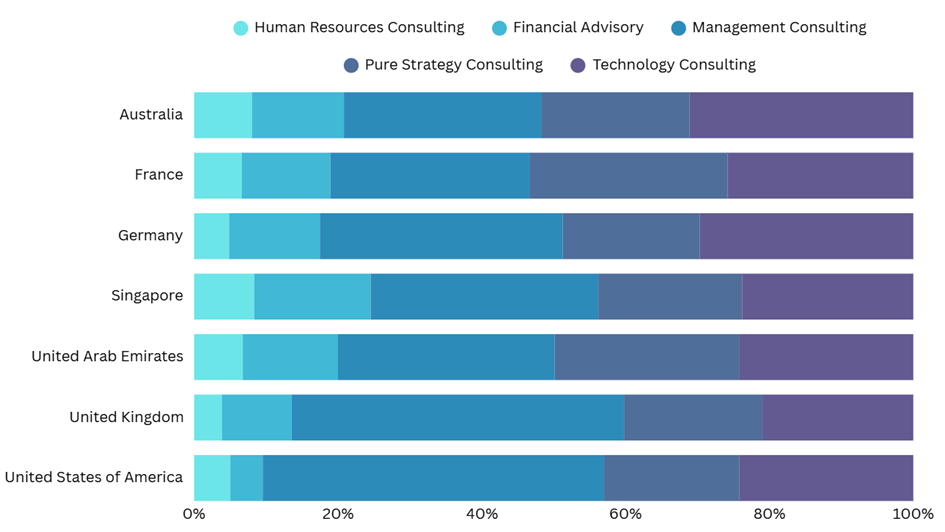
These mature markets show stable demand, with each maintaining a consistent profile:
United States of America & United Kingdom: Dominance in high-level Strategic consulting and Management advisory.
Germany: Strong Management consulting, complemented by robust Technology and industrial advisory.
Singapore: A focus on Management and Operational consulting (OPO), aligned with its role as a financial hub.
United Arab Emirates: Prioritizes Strategic and Management consulting (CON) in line with its ‘We the UAE 2031’ vision.
Australia: Driven by digital transformation, demanding both Technology and Strategic consulting.
France: Uniquely balanced demand across all service areas.
Growth Markets: Expanding Demand Across Core Services
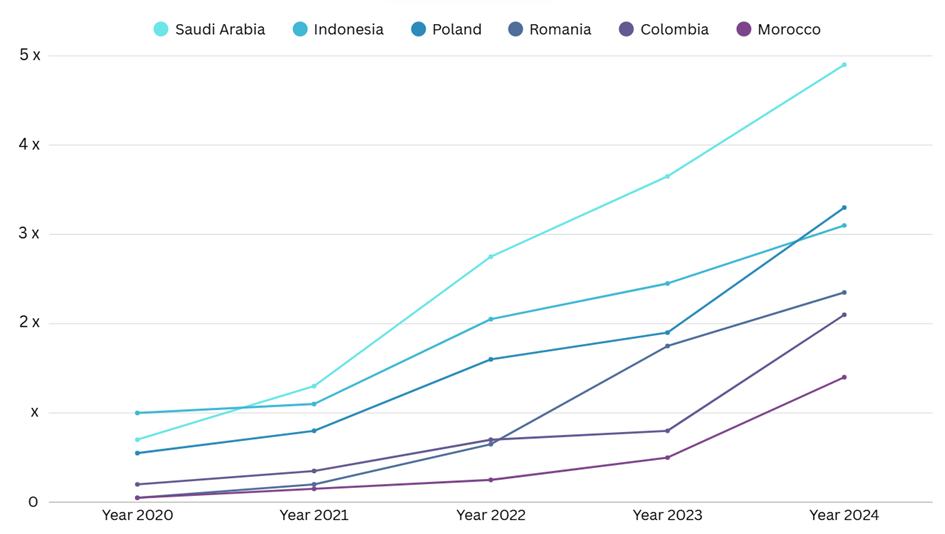
Our Market Engagement Index (MEI) below shows a fundamental reallocation of consulting resources. Strategic focus on key emerging markets has more than doubled since 2020. These are not fleeting opportunities but stable, long-term gateways to their regions, characterized by sustained, double-digit growth across core LoBs.
Country-Level Analysis: Markets with Rising Demand
Saudi Arabia
Key Driver: Saudi Arabia’s ‘Vision 2030’ transition from strategy to execution.
LoB Impact: Demand has shifted from SCF for giga-projects planning to a rise in OPO for implementation and ITC for digital infrastructure. HRC growth remains steady, driven by talent competition and regulation.
Poland & Romania
Key Drivers: Poland’s €60 billion EU recovery fund; Romania’s $1.3 billion tech sector.
LoB Impact: BDA and Digital Strategy projects have more than doubled. ITC growth has exceeded 150%, fuelled by smart city and cybersecurity mandates. SCF and CFT have grown significantly as local companies have matured and deal activity has nearly tripled.
Morocco
Key Driver: The "Digital Morocco 2030" strategy and 2030 World Cup preparations.
LoB Impact: The entire CON segment is growing, split between OPS for strategic advisory on cloud and AI, and OPO for the physical execution of 5G rollout and digital infrastructure.
Colombia
Key Drivers: A thriving fintech sector, exemplified by the successful launch of the Bre-B payment system, and a focus on green energy.
LoB Impact: Sustained growth in ITC from digitalization, complemented by rising CON demand for ESG transitions. A 55% surge in international hiring (Deel) is creating new needs in HRC for global workforce integration.
Indonesia
Key Drivers: The $32.7B Nusantara capital city, a $146B digital economy, and a $172B initiative to restructure and modernize state-owned enterprises.
LoB Impact: Our MEI shows rising demand across the board:
- SCF, DIG, BDA: For new city planning and digital economy strategy.
- ITC: For cloud and cybersecurity infrastructure.
- HRC, DIG, ITC: Driven by the formalization of 62 million SMEs.
- SCF, CON, BDA: For green finance and ESG linked to the 2060 net-zero goal.
Implications for Consulting Firms
The data mandates a strategic response. To remain competitive, consulting firms must:
- Recognize the Shift: The growth of these emerging hubs marks a fundamental reorientation of the global consulting market.
- Pivot Resources Strategically: To compete, firms must deliberately reallocate focus and investment to these regions.
- Establish a Local Presence: Build a strong physical presence in these markets.
- Invest in Local Talent: Prioritize the recruitment and development of in-region expertise to ensure relevance and execution.
- Specialize in High-Demand Services: Build deep, specialized capacity in the core service lines driving growth: DIG, BDA, ITC, OPO.
Growth Markets
The market is sending a clear signal. We are seeing a fundamental shift in where the real growth is happening for consulting firms. The most consistent and sustained demand is no longer confined to the traditional hubs, but is anchored in markets where national development agendas and national ambitions are generating multi-year project pipelines. For consulting firms looking to build a lasting advantage, these regions represent an opportunity not to be missed.
Benchmarking demand is key to growth. Vencon Research identifies the markets and service lines driving sustained consulting opportunities, giving your firm the insights needed to focus resources and capture high-growth regions.


Benchmarking Data that Works
In order to make informed decisions about compensation packages in your field, you need the latest data at
your fingertips.