

Latest InSights

Dedicated Data Mapping Is What Makes Benchmarking Work
By Yao Tang - Client Solutions
Benchmarking compensation in professional services is rarely a simple plug-and-play exercise. The data that firms submit is inherently varied, and without careful mapping, salary benchmarks quickly lose their value.
At Vencon Research, we devote a great deal of effort during the survey process to understanding the context, internal terminology and policy structures of every participating firm. Our priority is not only to collect numbers, but to normalise them, so that every data point in our reports represents a true like-for-like comparison.
Why hands-on mapping matters: the example of target bonus
Target bonus appears to be a straightforward field, yet there is no universal definition of it across the industry.

- Different meanings. For one firm, the target is the maximum bonus permitted under policy. For another, it is the typical payout for a mid-range performer.
- Different structures. Many firms have no formal target bonus at all. Bonuses are instead decided on a discretionary basis.
If a survey collects target figures without exploring these differences, the resulting market averages are distorted and misleading.
The same principle applies to job levels
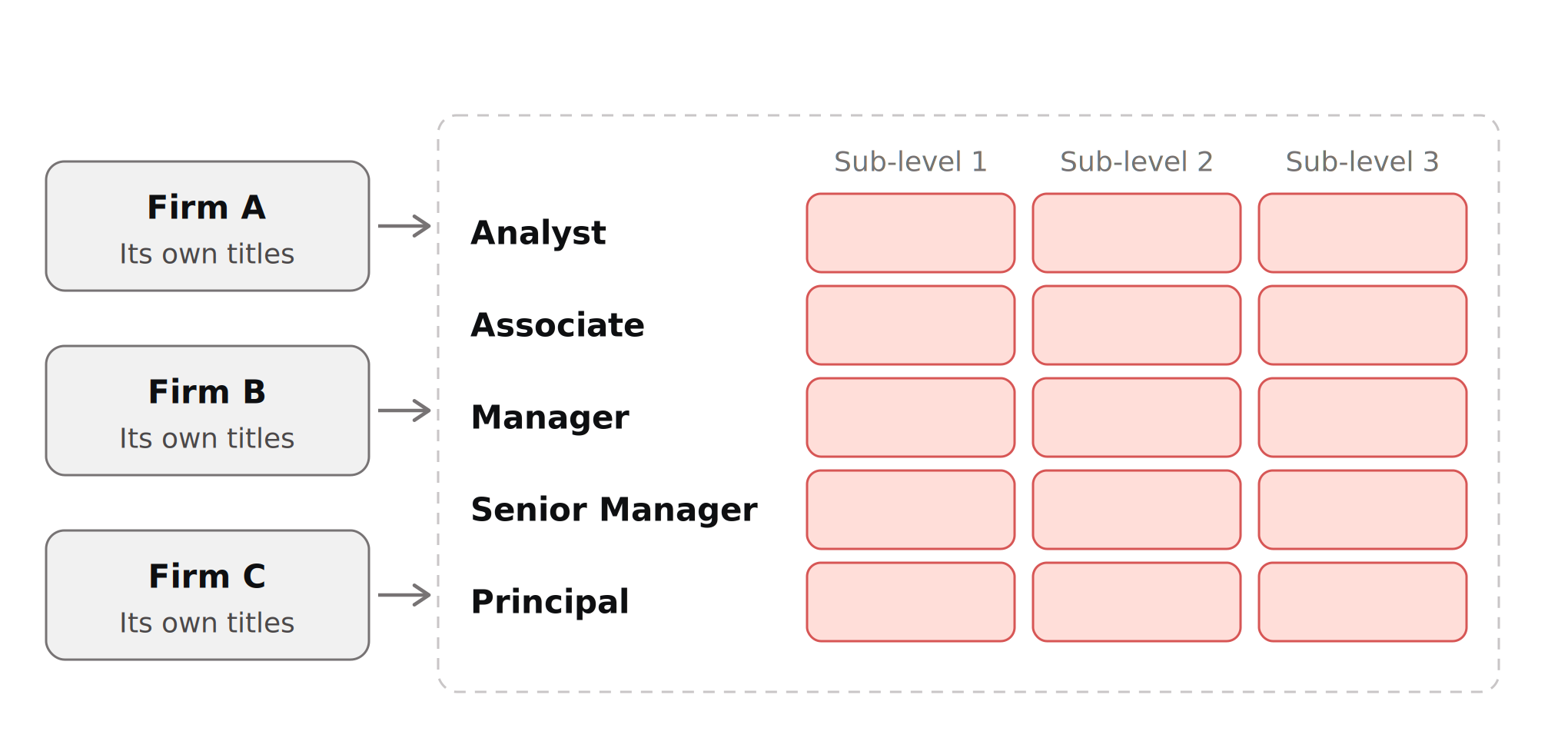
Firms use their own job titles and their own number of grades, so a title at one firm may sit at a different level at another. In our surveys, we map real-world roles onto five generic levels: Analyst, Associate, Manager, Senior Manager and Principal. Each level has three sub-levels, so that every role is compared with its true equivalent at other firms rather than matched by title alone.
How we ensure consistency
During data collection, we work directly with each participant to review its internal policies, definitions and scope. We apply this review to every element of the data, not only to the fields that are known to cause difficulty.

- Uniform criteria. We apply standardised Vencon definitions and mapping criteria across all participants, so that variations in internal naming or policy mechanics do not affect the dataset.
- Guidance on categorisation. We guide client teams on exactly how to categorise their data, reconciling the differences between discretionary pools, formulaic targets and realised payouts.
- Two perspectives. To give a complete factual picture, we capture both target expectations and actual realised cash, across two full sets of data covering the current year and the previous year.

Behind every reliable benchmark is a time-intensive mapping process. By doing this work, we aim to ensure that Total Rewards leaders can trust the data and make confident, defensible compensation decisions.
Have you ever encountered market data that did not feel like a true like-for-like comparison? We would be interested to hear how your team approaches these differences, and how you translate broad market trends into your local compensation structures. Get in touch here.
Vencon Research provides compensation benchmarking for consulting firms across 75+ country markets, covering AI-related and other specialist consulting skills. Contact us to learn more about our compensation surveys and benchmarking data.
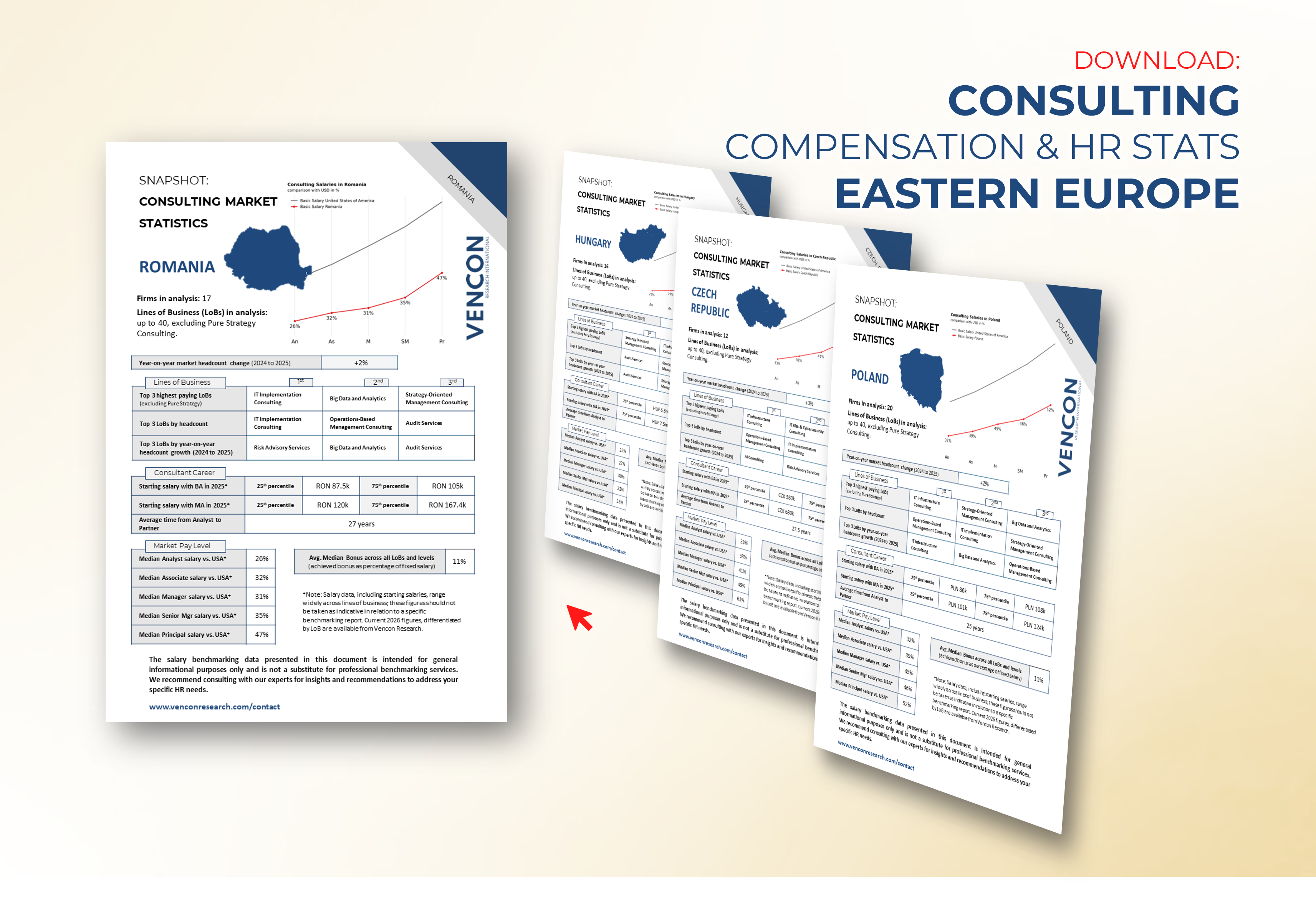
Download: 2026 Eastern Europe Consulting Market HR Statistics
Key HR indicators for the consulting industry
This collection of market statistics briefs highlights key consulting market statistics across four countries in the Eastern Europe region: Czech Republic, Hungary, Romania, and Poland. It offers insights into various key factors, such as the highest paying lines of businesses, market growth, starting salaries, career progression, and market pay level.
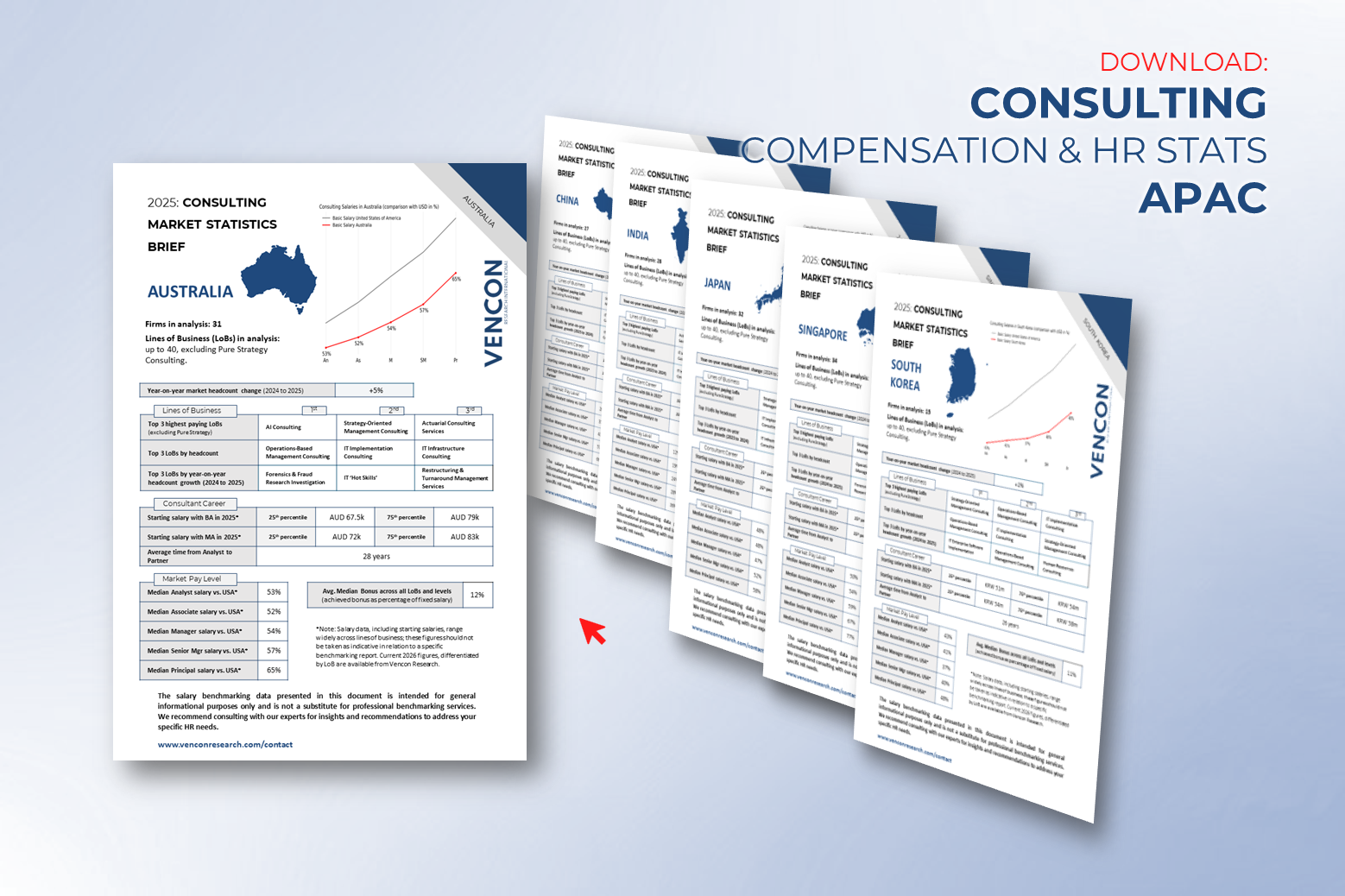
Download: 2026 APAC Consulting Market HR Statistics
Key HR indicators for the consulting industry
This collection of market statistics briefs highlights key consulting market statistics across six countries in the Asia-Pacific (APAC) region: Australia, China, India, Japan, Singapore, and South Korea. It offers insights into various key factors, such as the highest paying lines of businesses, market growth, starting salaries, career progression, and market pay level.
AI Talent Compensation in Consulting: Beyond the Salary Headlines
By Shukhrat Iskandarov - Client Solutions Manager
If you follow discussions about AI hiring, it's easy to conclude that the market has become a pure salary race.
Stories about multi-million-dollar compensation packages for elite AI researchers receive a great deal of attention. They are real, but they describe a very small part of the global talent market.
For consulting firms, the more relevant question is different: what AI capabilities create value for clients, and how should firms reward those capabilities in a sustainable way?
That distinction matters. Most consulting firms are not competing for a handful of frontier AI researchers. They are competing for professionals who can help clients apply AI effectively in real business settings.
Demand for AI Skills Has Changed Hiring Priorities
AI has moved from experimentation to implementation. Consulting clients increasingly expect support with areas such as generative AI adoption, process automation, analytics modernization, responsible AI governance, and AI-enabled operating models.
This has increased demand for consultants who combine technical understanding with industry knowledge and client-facing skills.
Recent labor market research shows that demand for developers with AI-related skills has grown far faster than demand for traditional software development skills, and AI capabilities now appear in a significant share of technical job postings. The direction of travel is clear: AI skills have become a mainstream hiring consideration rather than a niche specialty.
For consulting firms, however, demand alone does not determine compensation.
AI Is Not a Single Skill
One of the most common mistakes in AI hiring is treating all AI experience as equivalent.
A consultant who has helped clients deploy AI solutions into production, manage model performance, redesign business processes, and establish governance frameworks brings a very different level of value from someone who has only experimented with AI tools.
In consulting, the strongest performers are usually those who can answer three questions clearly:
- What problem is being solved?
- How will the AI solution improve the client's business?
- What risks, costs, and implementation challenges need to be managed?
Technical knowledge matters, but client impact matters more.
Compensation Is About More Than Base Salary
Base salary remains important, but consulting firms increasingly compete on the overall employment proposition.
Experienced AI consultants often look for:
- access to meaningful client work,
- opportunities to build new capabilities,
- exposure to senior decision-makers,
- clear career progression,
- flexibility in where and how they work, and
- participation in high-impact transformation programs.
As a result, total compensation may include performance bonuses, profit sharing, equity participation in some firms, learning support, and accelerated promotion opportunities.
The mix varies significantly by firm type. A technology-focused consulting boutique may emphasize growth opportunities and variable pay, while a large global consulting firm may compete more on brand, career development, international mobility, and the scale of client engagements.
The Market Premium Reflects Scarcity
The largest compensation premiums are generally associated with skills that remain relatively scarce.
In consulting, these often include:
- leading enterprise AI transformations,
- integrating AI into core business processes,
- designing responsible AI frameworks,
- managing AI-related regulatory and risk issues,
- building AI operating models, and
- translating technical capabilities into measurable business outcomes.
The premium is not for having "AI" on a résumé. It is for having a track record of helping clients achieve results.
Geography Still Matters
AI compensation is not a single global market.
A senior AI consultant in New York, London, or San Francisco may command a very different package from a consultant with a similar title in another country. Differences in client demand, talent supply, billing rates, and cost structures continue to influence compensation levels.
This is why consulting firms need market-specific benchmarking rather than headline figures drawn from a few high-profile technology companies.
At Vencon Research, our consulting compensation benchmarking work covers more than 75 countries, 500+ consulting firms, and over 650,000 consulting professionals worldwide. The data consistently shows that AI-related premiums vary materially by geography, consulting segment, and level of seniority.
A More Balanced Market Is Emerging
As AI capabilities become more widespread, compensation is likely to become more differentiated.
A small number of exceptional researchers and technical specialists will continue to attract extraordinary packages. For most consulting professionals, however, long-term market value will depend on a broader combination of capabilities:
- technical literacy,
- commercial judgment,
- industry expertise,
- communication skills,
- change management, and
- delivery experience.
Consulting clients ultimately pay for outcomes, not for familiarity with a particular model or tool.
The Practical Question for Consulting Leaders
For consulting firms, the central challenge is not whether AI talent is expensive. It is whether compensation structures accurately reflect the value that different AI capabilities create for clients and for the firm.
Firms that reward proven client impact, delivery capability, and leadership are more likely to build sustainable AI practices than firms that simply react to headline salary stories.
In that sense, AI compensation in consulting is becoming less about chasing the highest number and more about identifying the capabilities that genuinely strengthen client service and long-term firm performance.
Benchmarking AI-Related Consulting Skills
As AI continues to reshape consulting roles and skill requirements, reliable compensation benchmarks can help firms understand where the market is moving and how their pay compares.
Vencon Research provides compensation benchmarking for consulting firms across 75+ country markets, covering AI-related and other specialist consulting skills. Contact us to learn more about our compensation surveys and benchmarking data.

From Support to Core: The Rise of Delivery Centers in Consulting
By Gunjan Kalwani - Rewards Intelligence & Insights
The consulting industry is constantly evolving in response to changing client needs. Traditionally focused on strategic advice delivered by small, specialized teams, consulting firms are now increasingly responsible for implementing large-scale transformations, building technology platforms, and operating data-driven systems.
At the core of this shift is the expanding role of delivery centers. These are centralized hubs supporting projects through analytics, tech development, research and knowledge management. Once seen primarily as a support function, they are now integral to a consulting firms’ global operating models.
As their role shift, firms are placing greater emphasis on compensation for the delivery center workforce to maintain productivity, competitiveness and scalability.
Redefining the Delivery Center
Delivery centers have evolved from limited support functionality into integrated capability hubs that combine analytics, engineering, research, and knowledge management within a single operating layer. Their remit now extends far beyond slide production or background research.
They play a direct role in hypothesis testing, model development, platform buildout, and increasingly, in client implementation. In parallel, they underpin internal capability building—maintaining knowledge assets, supporting proposal development, and enabling cross-office collaboration at scale.
Firms such as Accenture and the Big Four have long operated global delivery networks and are constantly expanding. Strategy firms such as Boston Consulting Group and Bain & Company have also expanded their capability networks to support more technical and research driven engagements.
Geographically, these networks continue to concentrate in markets such as India, Poland, the Philippines, and Mexico. However, location strategy is becoming more nuanced—balancing cost with specialization, attrition risk, and proximity to key client markets.
From Support Function to Operating Model
The novelty of the delivery center model lies in how it reshapes the economics of consulting.
Historically, leverage was driven by pyramidal team structures within a single geography. Today, leverage is increasingly driven by the interaction between client-facing consultants and distributed capability pools. This creates a dual workforce model: one optimized for client engagement, the other for scalable execution.
This shift introduces new complexities:
- Role fragmentation: Traditional consulting roles are being decomposed into more specialized skill sets (e.g., data engineering, machine learning, UX design).
- Blended team structures: Project teams now span multiple geographies and cost bases, requiring tighter coordination and clearer role definition.
- Different productivity curves: Output is no longer measured purely in billable hours, but in throughput, reusability of assets, and speed of delivery.
In effect, delivery centers are not just supporting consulting work—they are redefining how it is produced.
Compensation Design in a Distributed Workforce
As delivery centers mature into a core part of the consulting operating model, compensation can no longer be managed as a simple extension of traditional consulting pay structures. The underlying workforce is fundamentally different—more specialized, more location-sensitive, and more exposed to external talent markets beyond consulting.
This requires a shift from benchmarking as a periodic exercise to compensation design as an ongoing, structured process.
Two challenges stand out:
- Role definition and comparability Delivery center roles often sit at the intersection of consulting, technology, and operations. Standard job titles rarely map cleanly to external benchmarks. Without precise job matching, compensation decisions risk being anchored to the wrong talent markets, leading to either overpayment or retention challenges.
- Location-sensitive pay structures Geographic arbitrage remains a factor, but it is no longer the sole driver. Talent scarcity, skill depth, and attrition risk vary significantly within and across locations. Effective compensation design needs to reflect these nuances, rather than applying broad location-based discounts.
In this context, benchmarking becomes an input into a broader set of decisions: how roles are structured, how pay bands are defined, and how progression is managed across both consulting and delivery center career paths.
Firms are increasingly using this data to answer more strategic questions—where to build capabilities, which roles to prioritize, and how to maintain a coherent employee value proposition across a globally distributed workforce.
The result is a more deliberate approach to compensation: one that reflects the complexity of the delivery center model rather than forcing it into legacy structures.
Implications for Consulting Firms
The rise of delivery centers introduces a more industrialized layer to consulting—one that requires the same level of rigor in workforce planning as seen in technology or operations-heavy industries.
Firms that treat delivery centers as a homogeneous, cost-driven function risk underinvesting in critical capabilities or mispricing their services. Conversely, those that actively manage these workforces—through precise role definition, targeted benchmarking, and continuous capability assessment—are better positioned to scale without eroding margins.
This is particularly relevant as demand for advanced analytics and AI-related work continues to accelerate. The competition is no longer just between consulting firms, but with technology companies drawing from the same talent pools.
Closing Thought
Delivery centers have moved beyond their original mandate. They are now a defining feature of how consulting firms operate, compete, and grow.
The challenge is no longer whether to build these capabilities, but how to manage them effectively within a global, multi-layered workforce. That requires a more sophisticated approach to benchmarking—one that reflects the reality of hybrid roles, distributed teams, and rapidly evolving skill demands.
Firms that get this right are not just optimizing costs; they are reshaping their delivery model to align with where the industry is heading.
As delivery center models continue to evolve, firms need a clearer understanding of how roles, capabilities, and pay structures compare across markets. Vencon Research supports consulting firms with targeted benchmarking and advisory, helping ensure compensation frameworks reflect the realities of a distributed workforce. Get in touch to discuss how this applies to your organization.
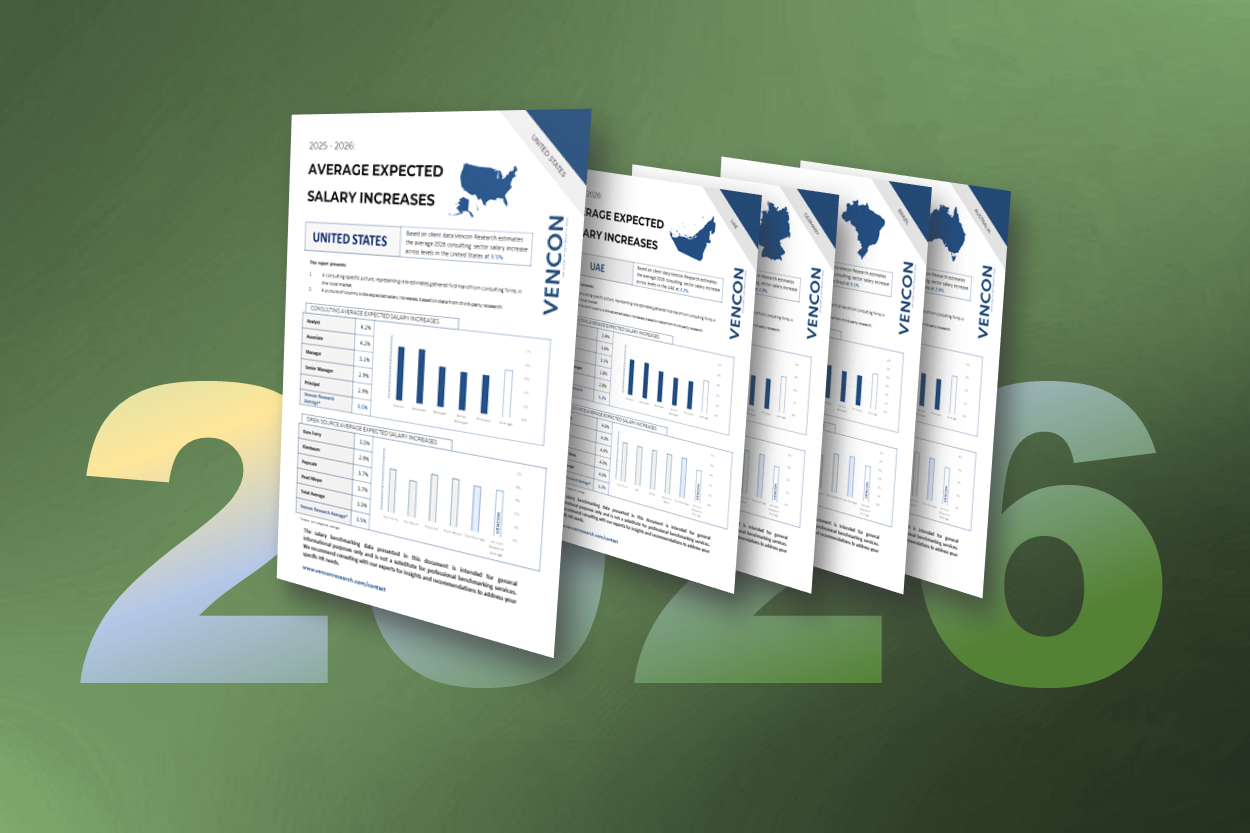
Download: 2026 Expected Salary Increases in the Consulting Industry
2026 Expected Salary Increases in the Consulting Industry
These concise overviews provide:
- A consulting-specific picture, representing real estimates gathered first-hand from consulting firms in the local market.
- A picture of country wide expected salary increases, based on data from third-party research.
Vencon Research conducts compensation benchmarking studies for over 70 countries worldwide. Should you require further information on the summaries included or additional data for different countries, please contact us.


Benchmarking Data that Works
In order to make informed decisions about compensation packages in your field, you need the latest data at
your fingertips.