

Latest InSights
India’s Unique Remuneration Structure: Considerations for Rewards Benchmarking
By Deepali Bist, MBA - Client Solutions
In India, compensation is not constructed as a single consolidated salary figure. It is deliberately segmented into statutory-linked pay, structured allowances, and performance-related incentives. This layered design reflects regulatory requirements, tax considerations, and long-standing market practice.
For consulting firms, where compensation represents the largest operating cost and a central talent lever, benchmarking accuracy depends on more than headline numbers. It depends on whether remuneration components are defined and compared consistently. Selecting and standardising the right elements directly influences the reliability of market positioning conclusions.
Global benchmarking frameworks often rely on simplified compensation categories to enable cross-country reporting. While efficient at scale, these frameworks do not always align with the architecture of Indian pay structures. Without localisation, structurally different packages may be treated as comparable, affecting both external benchmarking and internal band calibration.
At Vencon Research, we observe that benchmarking quality in India is closely linked to how precisely remuneration components are interpreted within the local statutory and market context.
The Architecture of Consulting Compensation in India
In Indian strategy and management consulting firms, compensation typically consists of three principal layers:
- Basic Salary
- Allowances
- Performance Bonus
Each serves a distinct financial and regulatory function.
Basic Salary
Basic salary generally represents around half of fixed compensation. It serves as the statutory anchor for:
- Provident Fund (12% of Basic)
- Gratuity accrual (~4.81% of Basic)
Because these obligations are legally defined, the level and treatment of Basic pay have direct cost and compliance implications. Adjustments to Basic salary do not merely shift internal pay mix — they influence statutory exposure.
Allowances
Allowances typically form the remaining portion of fixed pay and may include House Rent Allowance (HRA) and other special allowances. While sometimes viewed as flexible elements, they are part of fixed cash compensation and materially affect take-home pay outcomes through tax optimisation.
In benchmarking datasets, allowances are occasionally treated inconsistently — particularly where global reporting templates do not distinguish between Basic and total fixed pay.
Performance Bonus
Variable pay is a meaningful component in consulting, particularly at post-MBA and senior levels. Performance bonuses link compensation to individual, team, and firm outcomes, and can represent a substantial share of Total Cash Compensation (TCC).
Employer Statutory Contributions
Employer contributions such as Provident Fund and Gratuity provisions increase Total Cost to Company (CTC) but do not affect immediate take-home pay. For benchmarking purposes, distinguishing between:
- Employee cash compensation, and
- Employer statutory cost
is essential.
Dearness Allowance (DA), while relevant in certain public-sector contexts, is generally not applicable in private-sector consulting firms and should not be assumed to form part of standard structures in this sector.
Why Component Definition Drives Benchmarking Accuracy
Inconsistent definitions of compensation elements can quickly distort market comparisons. A frequent issue arises around the interpretation of “base pay.” Some firms define base as Basic salary only, while others define it as total fixed pay (Basic + Allowances). Without normalisation, benchmarking outputs may misrepresent relative positioning.
Two firms may report different CTC figures while delivering similar employer cost structures and take-home outcomes. Conversely, similar headline figures may conceal materially different:
- Statutory exposure
- Bonus weighting
- Fixed-to-variable pay ratios
Without component-level clarity, these structural differences remain hidden.
Statutory alignment is equally important. If Basic pay is set at an unusually low proportion of fixed compensation, Provident Fund and Gratuity obligations may be understated. Alternatively, including discretionary or non-cash elements within total compensation figures can inflate perceived competitiveness.
These distortions typically arise not from error, but from applying simplified definitions to a market with structural particularities.
The Global–Local Translation Challenge
Multinational consulting firms operating in India often rely on centralised reward frameworks designed for global consistency. These frameworks usually categorise pay into a limited set of universal components — such as:
- Base Salary
- Variable Pay
- Benefits
In the Indian context, however, “Base” is not a single undifferentiated figure. It includes internal layers that carry statutory consequences. Allowances that are integral to fixed pay may be treated as peripheral benefits in global systems. Pension logic applied elsewhere may not align with India’s statutory 12% Provident Fund requirement.
Without translating global templates into Indian compensation architecture, benchmarking comparisons may appear aligned while concealing structural misinterpretation.
Ensuring Market Relevance in Indian Benchmarking
Compensation structures in India are shaped by:
- Tax legislation
- Labour and wage code frameworks
- Statutory contribution rules
- Market-driven take-home pay expectations
Accurate benchmarking therefore requires:
- Clear distinction between Total Cash Compensation (TCC) and broader CTC constructs
- Alignment with statutory definitions for correct employer cost modelling
- Normalisation of Basic, Allowances, and Variable Pay across participating firms
When remuneration elements are standardised appropriately, benchmarking data becomes materially more reliable and comparable across consulting firms.
Vencon Research’s Approach
Vencon Research’s benchmarking framework for consulting firms in India is built around component-level precision.
Compensation data is disaggregated into:
- Basic Salary
- Allowances
- Variable Pay
Employer statutory contributions are aligned with Indian legal definitions, and cash compensation analysis is separated from non-cash benefits benchmarking. All submissions are normalised into a unified Total Cash Compensation model, reducing distortions caused by inconsistent CTC interpretations.
This approach allows both domestic and multinational consulting firms to maintain global reporting consistency while ensuring local accuracy.
Structural Precision Enables Reliable Decisions
In the Indian consulting market, remuneration structure materially influences statutory exposure, employer cost, and perceived competitiveness. Benchmarking that does not account for these structural layers risks drawing conclusions from non-comparable data.
When compensation components are clearly defined, standardised, and normalised, firms gain a more accurate view of their market position and can make better-informed reward decisions.
Vencon Research supports strategy and management consulting firms in aligning global reward frameworks with Indian compensation architecture. If you are reviewing your salary benchmarking approach in India, we would welcome a discussion on how structural normalisation can improve the precision of your market insights.
Expected Salary Increases 2026: Global Consulting Outlook
Analysis by Irina Kvirikadze - Rewards Intelligence & Insights
Research findings from Vencon Research indicate that salary increases in 2026 are expected to be more moderate compared with the high-inflation years of the recent past.
Organizations across the consulting industry are adjusting compensation strategies in response to easing inflation, ongoing economic uncertainty, and structural changes in workforce management such as AI-driven automation. Rather than broad base-salary increases, employers are increasingly emphasizing variable pay, promotion-driven adjustments, and holistic total rewards offerings.
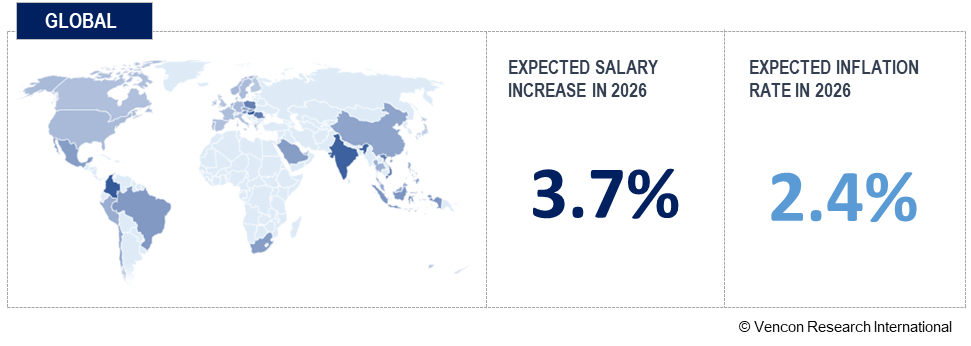
Globally, average salary increases in the consulting industry are projected at 3.7% in 2026, while inflation is expected to stand at 2.4%. This represents a clear slowdown compared with 2025, when salary growth was projected at 4.5%, reflecting a more cautious and targeted approach to pay management.
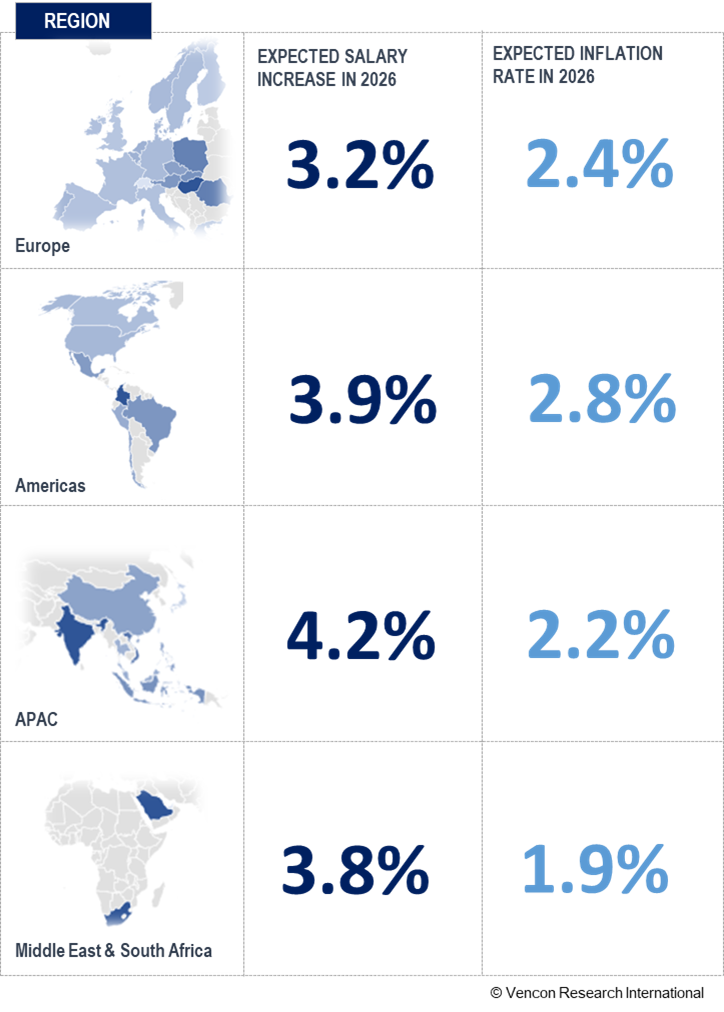
Regionally, the APAC region expects the highest salary increases, at 4.2%, while Europe is likely to see comparatively lower increases at 3.2%. Expected Inflation rates are highest across the Americas at 2.8%.
Expected Salary Growth: Europe
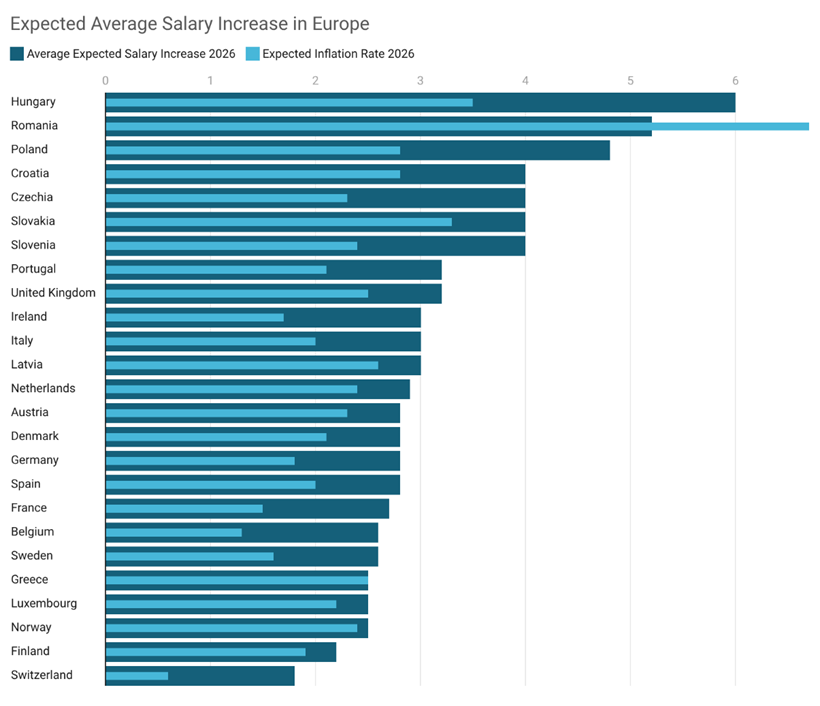
In Europe, salary increases are expected to range from 1.8% to 6%, broadly aligned with inflation levels that vary significantly by country. Core markets such as Germany, France, Spain, and the United Kingdom are projected to see moderate increases between 2.7% and 3.2%, while higher growth is anticipated in parts of Central and Eastern Europe, particularly Hungary and Romania, where inflationary pressures remain elevated.
Expected Salary Growth: Americas
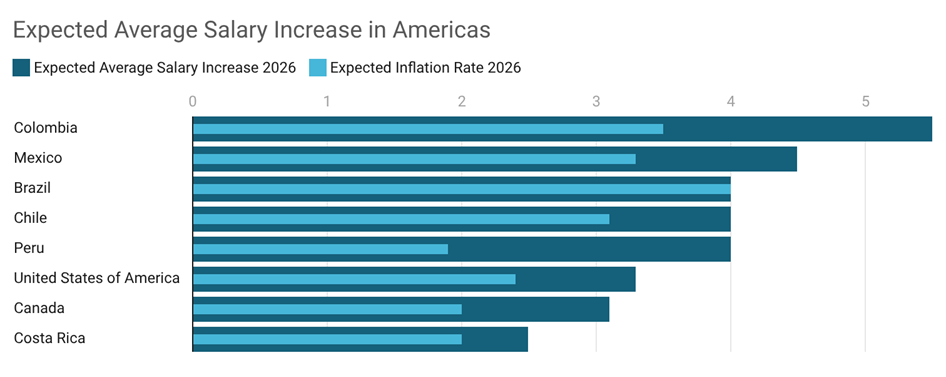
Across the Americas, average salary increases in 2026 are projected at 3.9%. Latin America continues to outpace North America, led by Colombia, Mexico, and Brazil, while salary growth in the United States and Canada is expected to remain moderate at just above 3%. Argentina has been excluded from regional averages due to ongoing inflation volatility.
Expected Salary Growth: APAC and MENA
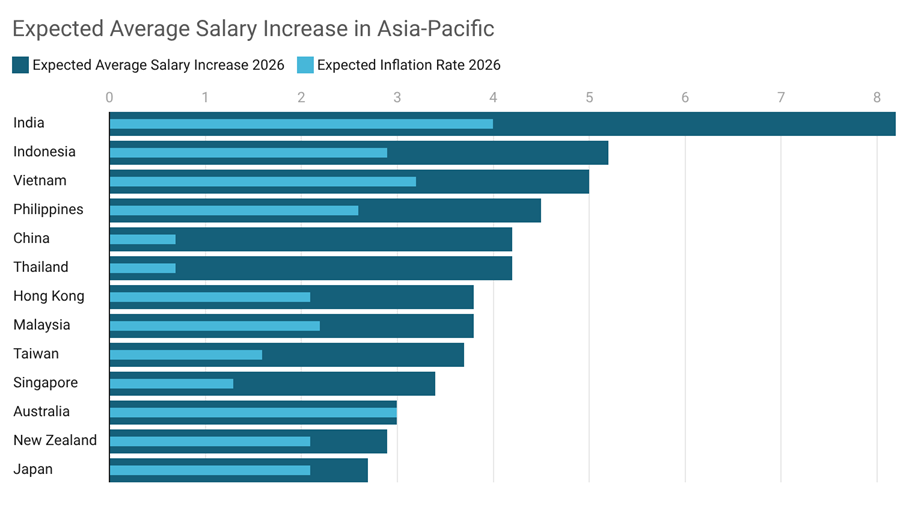
In APAC, salary growth is expected to remain robust and broadly in line with 2025 levels, ranging from 2.7% to 8.2%. India continues to stand out as the strongest growth market globally.
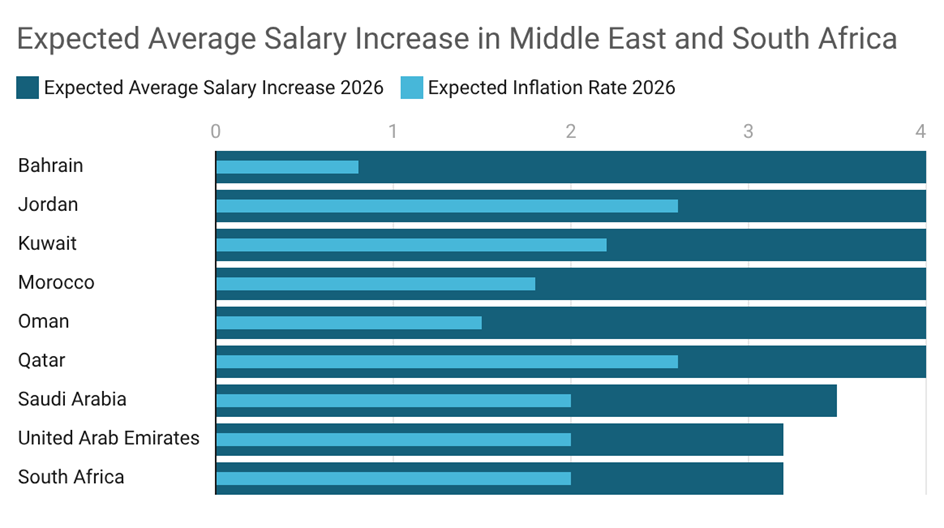
In the Middle East and Africa, salary increases are projected to soften compared with last year, with most major markets clustering around the low-to-mid 3% range.
Overall, the 2026 outlook points to a return to more normalized salary growth, with employers prioritizing flexibility, performance differentiation, and total rewards optimization over uniform pay increases.
Vencon Research provides consulting firms with precise, industry-specific compensation benchmarking, ensuring they stay competitive in a rapidly evolving market. Our research includes further detailed insights into salary increases for 2025 by country, line of business, and career level, helping firms understand pay trends and make informed compensation decisions.
Learn more about how Vencon Research can support your firm’s pay strategy.
HR Trends in Consulting for 2026
As consulting firms plan for 2026, HR leaders face a complex set of pressures. Economic uncertainty, regulatory change, persistent talent shortages and the practical integration of AI are all influencing how consulting firms design roles, manage costs and develop their people.
These challenges are cumulative rather than isolated. Pay and progression decisions are more transparent, workforce models are more varied, and expectations around productivity and performance continue to rise. HR strategy in consulting is increasingly central to sustaining competitiveness and executing business models.
Drawing on Vencon Research’s work with consulting firms globally, alongside selected external research, the following HR trends outline how people strategy in the consulting industry is evolving heading into 2026.
1. Pay Transparency and Regulation as Core HR Priorities in Consulting
Pay transparency is now a central consideration for consulting firms. Regulatory developments, including the EU Pay Transparency Directive and similar initiatives elsewhere, are accelerating the need for clearer pay structures, defined ranges and consistent progression criteria.
In practice, this places pressure on job architecture, levelling and job matching. Vencon Research frequently observes that transparency initiatives expose inconsistencies in role definitions that were previously less visible. For consulting firms operating across multiple geographies, aligning local practices with global frameworks adds further complexity.
As a result, pay transparency is shaping not only reward strategy, but also governance, communication and trust.
2. Workforce Planning in a Low-Growth, High-Volatility Consulting Market
Many consulting firms are entering 2026 with more cautious growth assumptions. Demand remains uneven across sectors and geographies, while cost discipline has become a sustained priority rather than a temporary response.
HR functions are placing greater emphasis on flexible workforce planning, redeployment and internal mobility. Hiring decisions are increasingly guided by near-term demand signals rather than long-range growth forecasts. Vencon Research sees firms investing more time in aligning capacity, skills and cost structures across practices.
Workforce planning is becoming a continuous, data-driven process rather than an annual exercise.
3. AI as a General-Purpose Capability in Consulting Firms
AI is increasingly embedded across consulting roles, grades and practices. By 2026, consultants are expected to use AI-enabled tools for research, analysis, drafting and insight generation as a standard part of their work.
This has implications for HR. Role profiles now assume baseline AI literacy, with differentiation driven by judgment, problem framing and client interaction rather than task execution. Vencon Research observes early incorporation of AI expectations into capability frameworks and performance evaluations.
AI is reshaping what effective consulting work looks like, even where job titles remain unchanged.
4. Evolving Consulting Operating Models Beyond the Pyramid
The traditional consulting pyramid is being supplemented by more diverse talent models. Core consultants increasingly work alongside subject-matter experts, delivery centres, contractors and alliance partners.
This evolution reflects both cost pressures and the growing need for specialised skills. However, it introduces challenges around performance management, engagement and equity. HR processes designed for homogeneous populations are being adapted to support differentiated talent segments without undermining cohesion.
Consulting firms are moving towards more modular and flexible operating models.
5. Rethinking Reward Beyond Utilisation and Billable Hours
Utilisation remains a critical metric in consulting, but it is no longer sufficient alone. As firms invest in intellectual property, platforms and reusable assets, they are exploring ways to recognise non-billable but value-creating contributions.
Vencon Research’s compensation benchmarking shows increasing variation in how firms reward asset development, reuse and broader client outcomes. These changes raise questions around measurement, attribution and fairness, particularly in team-based environments.
Reward strategy is becoming more closely tied to how firms create value, not just how hours are billed.
6. From Leveraged Labour to Asset-Enabled Consulting Models
Closely linked to reward is the shift towards more asset-enabled consulting. AI and automation accelerate this transition, but the underlying change is structural.
Roles increasingly combine client delivery with contributions to tools, methodologies and platforms. Vencon Research observes early differentiation between delivery-led roles and hybrid roles blending advisory, product and commercial responsibilities.
Over time, this trend will continue to influence career paths, grading structures and promotion criteria.
7. Reconfiguring Learning and the Consulting Apprenticeship Model
The widespread adoption of AI and digital tools has changed how junior consulting work is performed. Tasks traditionally used to build foundational skills are increasingly automated or augmented.
Consulting firms are rethinking how learning and development are structured, introducing more formal development pathways, earlier responsibility and clearer expectations around skill progression.
Preserving the strengths of the apprenticeship model while adapting it to new working patterns remains a central HR challenge.
8. Attracting and Developing Scarce and Interdisciplinary Talent
Skill shortages continue to affect consulting firms, particularly in areas such as data, technology, sustainability, risk and regulatory advisory. These roles often combine technical and strategic capabilities that do not align neatly with traditional consulting career models.
Vencon Research sees firms combining targeted hiring with greater emphasis on reskilling and internal mobility. Career frameworks are being adjusted to support deeper expertise alongside broader consulting development.
Talent strategy is increasingly shaped by scarcity rather than surplus.
9. Integrating Technology and AI Acquisitions into Consulting Firms
Acquisitions remain a key route for capability building, particularly in AI and digital services. Integration, however, remains challenging. Differences in culture, pace and reward expectations can create friction within partnership-led firms.
HR is playing a greater role in redesigning job families, performance frameworks and progression paths to accommodate hybrid consulting-technology roles. Organisational design is becoming as important as retention in determining success.
Integration is no longer viewed as a short-term issue, but an ongoing management challenge.
10. Governing AI as Part of Professional and Risk Standards
As AI becomes embedded in client delivery, consulting firms are formalising expectations around its use. Regulatory scrutiny, client expectations and reputational risk are driving clearer policies and accountability.
HR’s role includes embedding AI-related competencies into role profiles, supporting training and certification, and clarifying responsibility for appropriate use. In many firms, AI governance is treated as an extension of professional standards.
This reflects a broader shift towards explicit risk management in people strategy.
11. Leadership Capability in Hybrid and Distributed Consulting Firms
Hybrid working models are now well established, but their implications for leadership continue to evolve. Leading distributed teams requires new capabilities around performance management, coaching and engagement.
Research from organisations such as Gartner consistently highlights leadership development as a priority for CHROs. In consulting, effective leadership is increasingly linked to productivity, retention and culture.
Leadership capability is a critical lever in sustaining performance.
12. Re-Anchoring Culture and Learning in Hybrid Consulting Environments
With less reliance on physical proximity, consulting firms are taking deliberate steps to build culture and support learning. Informal knowledge transfer no longer happens by default.
Vencon Research observes increased investment in structured onboarding, coaching and hybrid collaboration practices. While flexibility remains a key attraction and retention factor, maintaining consistency and connection across the firm requires ongoing effort.
Culture and learning are increasingly treated as design challenges rather than by-products of co-location.
13. Building Talent for Sustainability, Climate and Resilience Practices
Demand for sustainability, climate, ESG and resilience-related advisory continues to grow across the consulting industry. Clients increasingly expect firms to combine strategic insight with technical and regulatory expertise, prompting many to scale dedicated practices or embed sustainability capabilities across service lines.
For HR, this creates challenges that do not fit neatly within traditional consulting models. Sustainability and climate roles often require interdisciplinary profiles, combining consulting skills with scientific, engineering, regulatory or data expertise. Firms are responding through a mix of targeted external hiring and structured reskilling of existing consultants.
As these practices mature, HR functions play a central role in defining job architecture, career paths and reward frameworks that support growth.
HR Trends in Consulting: Looking Ahead to 2026
These HR trends demonstrate a continued shift towards greater clarity, discipline and integration in people strategy. Regulatory change, evolving operating models and technology adoption reinforce the need for coherent job architecture, reward structures and development pathways.
For consulting firms, HR is no longer limited to support or compliance. It is central to shaping how consulting work is delivered, how talent is developed, and how value is created in a complex, competitive environment.
Contributors
- Erwin Harbauer - Managing Director / Partner
- Andy Klose - Associate Partner
- Shukhrat Iskandarov - Client Solutions Manager
Vencon Research works closely with consulting firms to translate these insights into practical decisions. Whether you are assessing your workforce model, reviewing reward frameworks, or designing career paths, our benchmarking and advisory services can provide the data, analysis and guidance needed to act with confidence. Contact us to discuss how we can support your HR strategy for 2026 and beyond.

Why Sales Commissions Fail in Consulting
By Andy Klose - Associate Partner and Head of Advisory
In many consulting firms, the incentives debate starts with an apparently obvious thought: if senior leaders are expected to win work, why not pay them like salespeople and introduce sales commissions? The logic feels clean—more deals, more pay, more growth. Yet in consulting, this “clean” logic often produces messy outcomes: weaker risk discipline, more internal friction, and—most damaging—reduced client trust. The reason is structural, not ideological. Classic, deal-based sales commissions are designed for transactional selling; consulting is a relational, team-based, judgment-heavy business where value is co-created and realized over time.
The intuitive idea – and where it goes wrong
Product-style sales commissions assume a world of discrete transactions: a salesperson closes a deal, hands it over, and gets paid. The model works because the boundaries are clear—between selling and delivery, between one deal and the next, and between individual contribution and enterprise value.
Consulting rarely fits that template. “Selling” is usually inseparable from diagnosing the problem, shaping the approach, assembling the right team, and standing behind the outcome. When incentives treat consulting like a sequence of independent deals, they encourage behaviors that optimize short-term bookings at the expense of long-term client impact and firm health.
What makes consulting structurally different from transactional sales
Sales commissions become increasingly fragile as offerings become more bespoke and knowledge-intensive. In classic consulting—strategy, operations, HR, organization, transformation—the economics differ in three ways.
First, sales and delivery are integrated. Senior consultants and partners do not merely close; they commit the firm, lead the work, and remain accountable for what was promised.
Second, solutions are heterogeneous by design. Even when proposals reuse methods and modules, each engagement is shaped by client context, politics, risk, data availability, team mix, and outcome uncertainty. This makes “fair” and behaviorally sound deal-level metrics hard to define.
Third, the asset is the relationship, not the transaction. Consulting revenue typically unfolds in waves—diagnosis, design, implementation, follow-on scaling—within a relationship where trust accumulates slowly and can be lost quickly.
A practical rule holds: the more relational and bespoke the work, the less compatible deal-level sales commissions become.
How sales commissions backfire in consulting
Once you view consulting as an interdependent, multi-year value chain, several failure mechanisms become predictable. They reinforce each other, which is why “small” commission schemes often expand into large cultural and economic problems over time.
1. Sales commissions shift the partner mindset from “best answer” to “best-sellable answer”
Consulting buyers pay for judgment and independence. Deal-based sales commissions introduce a strong bias toward whatever is easiest to monetize now. Common patterns include scope inflation, premature solutioning, and a preference for short, high-fee projects over work that builds sustainable client capability. Even if outcomes remain acceptable, clients quickly sense when advice is optimized for revenue rather than relevance. Trust erodes—and trust is the foundation of repeat business.
2. Sales commissions weaken risk discipline and deal quality
Healthy consulting firms say “no” more often than outsiders assume: no to unrealistic timelines, no to misaligned stakeholders, no to underpriced work, no to engagements where success probability is low. Sales commissions can invert that discipline. A large, high-fee, high-risk project becomes personally attractive even if the firm later absorbs the delivery pain, write-offs, or reputational impact. Over time, governance mechanisms—review boards, pricing discipline, delivery readiness checks—get pressured by individuals who are rewarded for closing, not for outcomes.
3. Sales commissions undermine collaboration in a team-based business
Modern consulting delivery is cross-practice and cross-geography. The best client solution often requires multiple senior leaders and specialists to contribute. Sales commissions turn that collaborative system into a contest for “origination credit.” The predictable consequences are territorial behavior (“my client”), reluctance to bring in colleagues if it dilutes payout, and internal negotiation about credit allocation that consumes energy better spent on the client. In a partnership model, internal trust is a strategic asset; sales commissions tax that asset.
4. Sales commissions distort time allocation in multi-task leadership roles
Senior consulting roles are inherently multi-dimensional. Partners and senior leaders must balance business development with delivery leadership, talent development, intellectual capital, and firm stewardship. High-powered incentives tied heavily to sales drive effort toward what is measured and paid, crowding out activities that build long-term advantage—coaching, proposition building, quality assurance, recruiting, and leadership roles. The firm may temporarily see a spike in bookings while quietly accumulating delivery and people risks that surface later.
5. Sales commissions mis-attribute value creation and fuel perceived unfairness
Few consulting wins are attributable to one person. A sale often reflects prior delivery excellence, a long-nurtured relationship, specialist insight, a high-performing team, and the firm’s reputation. Deal-based sales commissions force an artificial choice: either reward the visible “closer” disproportionately, or build complex split models that feel arbitrary and create constant debate. Both outcomes erode perceived fairness—one of the most sensitive levers in professional services cultures.
When commission-like incentives can work (and the boundary conditions)
This is not an argument against variable pay or against rewarding business development. The question is fit: under which conditions do sales commissions align with the operating model?
Commission-like approaches are more viable when most of the following are true:
- Standardized, repeatable offerings (e.g., fixed-scope diagnostics, packaged implementations, training products);
- Clear separation of roles between sales and delivery (dedicated sales teams with limited delivery accountability);
- Lower delivery uncertainty and more predictable scope, timelines, and outcomes;
- Limited cross-team dependency or clearly defined handovers and responsibilities.
Even then, two guardrails are critical: (1) strong controls to prevent overselling or misrepresentation, and (2) commission weightings that signal importance without overwhelming other leadership responsibilities.
In other words, commissions fit best where consulting behaves more like a product business. In bespoke advisory partnerships, those conditions are the exception—not the norm.
What to do instead: incentive principles aligned with consulting economics
If deal-level sales commissions are structurally misaligned, what should consulting firms use to reward and steer senior performance? There is no universal formula, but a consistent set of principles tends to work across partnership and professional services models.
Reward the portfolio, not the deal
Shift the unit of performance from individual transactions to the health of a client portfolio over time. This supports better behavior: disciplined pricing, thoughtful sequencing of engagements, and an emphasis on relationship durability rather than quarterly wins.
Use a balanced set of metrics, not a single “sales number”
Senior performance should reflect the true job, not a simplified proxy. Many firms use a balanced scorecard that includes financial outcomes (revenue and profitability), client outcomes (satisfaction, retention, expansion), people outcomes (team feedback, development, hiring contribution), and firm-building outcomes (thought leadership, proposition development, leadership roles). Business development remains highly valued—but not isolated from delivery quality and stewardship.
Keep “sales credit” as an input to judgment, not an automatic cash engine
Tracking origination and contribution is useful—especially for promotions, recognition, and performance discussions. The risk arises when that tracking becomes a rigid, formulaic payout mechanism. Consulting requires judgment in assessing contribution, risk-taking quality, collaboration, and long-term impact. Incentive systems should preserve room for that judgment.
Protect the partnership logic
Partnerships thrive on shared ownership, mutual accountability, and investment in the next generation. Incentives should reinforce those norms: encouraging leaders to bring the best team to the client, share relationships, develop talent, and protect the firm’s reputation—even when doing so reduces short-term personal upside.
Implications for HR and firm leadership
Incentive design in consulting is not a technical exercise; it is a strategic choice about culture and operating model. HR and leadership teams should treat sales commissions as a “model decision,” not a compensation tweak. Introducing deal-based commissions often forces a firm—implicitly—toward a more individualistic, franchise-like structure with higher internal competition and weaker collective governance.
A more sustainable path typically involves three moves:
- Align incentives with how value is created (team-based, relational, outcome-oriented).
- Design for the long term (multi-year performance, portfolio health, reputation protection).
- Make trade-offs explicit (accepting slightly lower short-term sales intensity in exchange for better collaboration, lower delivery risk, and stronger client relationships).
Conclusion: Don’t install a transactional engine in a relational business
Sales commissions are not inherently “bad.” They are simply optimized for a different context: standardized offerings, separable sales and delivery roles, and value captured in discrete transactions. Consulting—at its core—is the opposite: bespoke problem solving, integrated delivery accountability, and trust built over time.
For consulting firms, the most important question is therefore not, “How do we bolt sales commissions onto our partnership?” It is: Which behaviors and cultural norms does our business model require—and what incentive architecture reinforces those behaviors rather than fighting them? In most advisory partnerships, honest answers to that question lead away from deal-level commissions and toward more balanced, portfolio-based, and collective mechanisms that reward sustainable client impact.
We would be pleased to assist you with any additional inquiries you may have and offer recommendations on how to enhance your organisation’s compensation and incentive models.
Andy Klose is an Associate Partner at Vencon Research International and heads the firm’s advisory unit.
Vencon Research International is a leading provider of compensation benchmarking and research as well as of compensation and performance-related consulting services for professional service firms, especially for audit and tax, management consulting, and IT services firms. Vencon Research International provides services to a full range of clients in more than 75 countries worldwide and is proud to name more than 85% of the world’s major consulting and/or professional services firm its clients.

EU Pay Transparency Becomes Law in 2026: What Compensation and HR Teams Should Expect
By Shukhrat Iskandar - Client Solutions
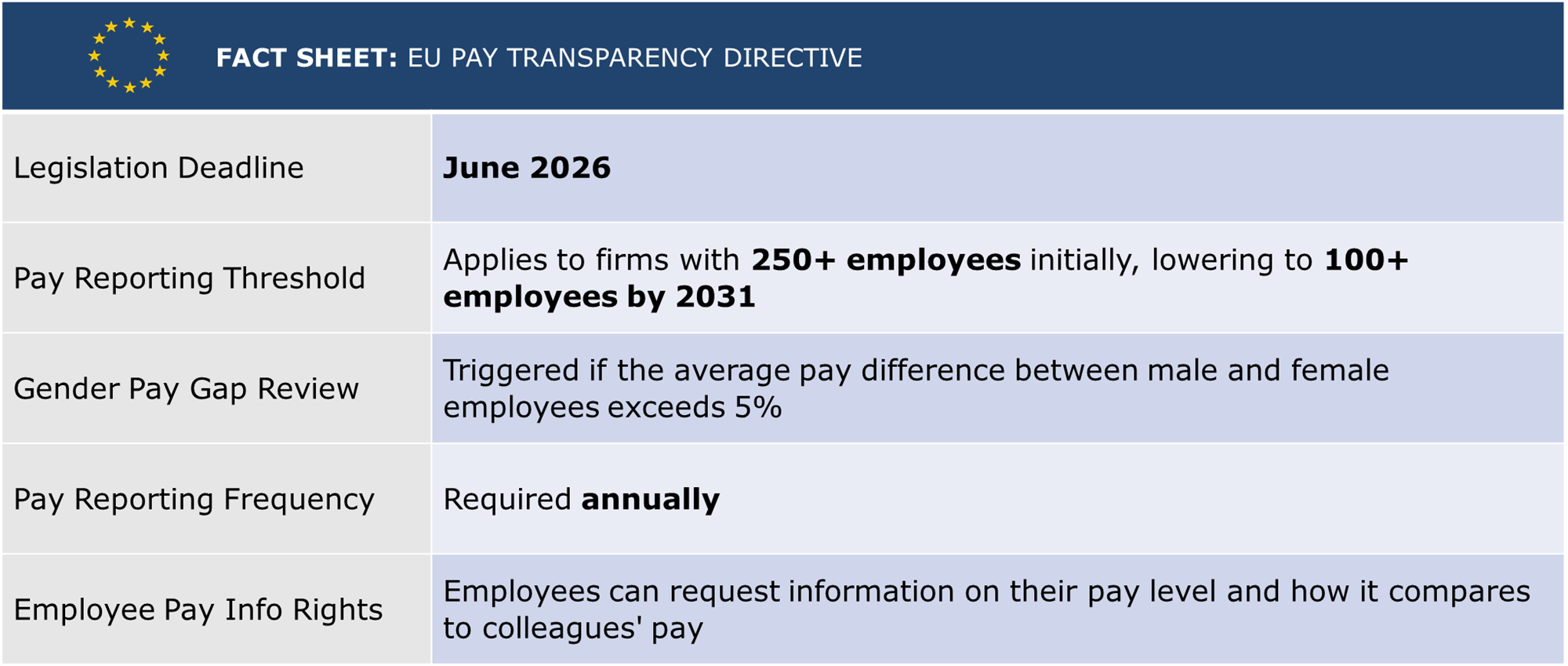
The EU Pay Transparency Directive moves into effect in 2026 and represents one of the most significant regulatory changes affecting compensation management in decades. From mid-2026, Member States are required to have transposed the Directive into national law, after which employers will face new, enforceable obligations around pay transparency, reporting, and employee rights to pay information. Designed to strengthen equal pay for equal work or work of equal value and to close persistent gender pay gaps across Europe, the Directive introduces legally binding measures that go beyond most existing national frameworks, reshaping how organisations define, structure, communicate, and justify pay.
Key Requirements of the Directive
Once transposed into national law, the Directive introduces a set of binding obligations for employers across the EU, including:
- Pay transparency in recruitment: Employers must disclose the starting salary or pay range in job advertisements or prior to the first interview, and may not ask candidates about pay history.
- Employee rights to pay information: Employees can request information on their own pay and on average pay levels for comparable roles, broken down by gender.
- Gender pay gap reporting: Employers with 250+ employees must report annually, with the first reports due in 2027. Employers with 150–249 employees will report every three years from 2027. Employers with 100–149 employees will be brought into scope later under phased national timelines.
- Mandatory corrective action: Where a gender pay gap of 5 percent or more cannot be objectively justified, employers must conduct a joint pay assessment and take remedial action.
- Broader discrimination coverage: The Directive explicitly covers intersectional discrimination, and affected employees are entitled to compensation.
EU Member States must transpose these requirements into national law by 7 June 2026, after which enforcement and reporting obligations will apply according to employer size.
Why the Directive Matters
Despite decades of policies aimed at promoting pay equity, the gender pay gap in the EU remains around 12 percent on average. Structural opacity in pay systems has made it difficult for employees to understand how pay is determined and for authorities to detect discrimination. By mandating transparency, the Directive seeks to transform pay equity from principle into practice.
Improved transparency has the potential to generate meaningful benefits. Research by labour unions suggests that even modest reductions in pay gaps could translate into significant annual earnings increases for many workers. Beyond compliance, transparent pay systems also foster trust with employees, strengthen employer brand, and enhance talent attraction.
Current Organisational Readiness
Recent surveys indicate that many organisations are still in the early stages of preparing for the Directive. A 2025 survey of HR professionals in Germany found that only one in three HR managers were familiar with the Directive’s details. Nearly half of respondents expected implementing the changes to take more than six months, and many cited concerns about additional workload and potential internal conflicts. At least ten EU Member States had taken no steps toward implementation by late 2025, while others were in draft or partial stages of preparation.
Implications for Compensation Teams
The Directive has several practical implications for compensation and HR teams:
- Compensation Structure Review and Redesign: Organisations must ensure that pay structures are defensible under transparency scrutiny. Broad pay grades and informal pay practices must give way to clearly documented, objective, and gender-neutral criteria. Pay decisions must align with job architecture and evaluation systems.
- Pay Gap Reporting and Analytics: Teams must collect, analyse, and report pay data by gender and pay category. This requires accurate, governed data, structured processes for analysis, and mechanisms to address pay gaps exceeding five percent without valid justification.
- Recruitment and Job Advertising: Salary transparency now requires organisations to include pay ranges in job postings or provide this information early in the hiring process. Compensation teams must carefully define salary bands to maintain internal equity once disclosed publicly.
- Talent Attraction and Employer Branding: Transparent pay practices can become a competitive advantage, attracting top talent and building trust with employees and candidates.
Practical Steps to Prepare
To meet the Directive’s requirements, organisations should begin preparations immediately:
- Educate HR, legal, finance, and executive teams about the Directive’s scope, timelines, and obligations.
- Audit pay data, job classifications, and pay bands to identify gaps or inconsistencies.
- Update job evaluation methodologies and pay policies to align with objective, gender-neutral criteria.
- Build repeatable processes for ongoing pay gap reporting and data governance.
- Prepare internal communication strategies to ensure transparency changes are understood and culturally supported.
- Consider technology solutions that automate data collection, reporting, and analytics to improve efficiency and accuracy.
Starting these steps early helps avoid rushed implementation and positions organisations for long-term compliance and pay governance improvements.
Challenges to Anticipate
Even with preparation, compensation teams will face challenges:
- Policy complexity as countries may interpret the Directive differently, creating a patchwork of requirements for multinational organisations.
- Incomplete or inconsistent pay data, which can make reporting difficult without strong governance.
- Sensitive internal discussions around pay transparency, requiring careful communication to maintain trust.
Non-compliance carries legal risk and can damage employer brand and employee trust.
Turning Compliance Into Advantage
While the EU Pay Transparency Directive introduces increased scrutiny and workload, it also offers an opportunity. Organisations that approach transparency strategically can strengthen pay governance, improve employee trust, and enhance employer branding. Clear, fair, and well-structured compensation systems will not only meet legal requirements but also provide a competitive edge in attracting and retaining talent.
For compensation teams, the Directive represents a clear mandate: transparency is coming, and the question is whether it arrives as a disruption or as a capability the organisation is ready to lead.
Supporting Pay Structures Under Increased Scrutiny
Vencon Research advises organisations on how to prepare pay structures for the practical realities of pay transparency. Using market-aligned benchmarking data, we help compensation teams test pay ranges, job matching, and progression frameworks against external practice and identify areas of potential exposure ahead of implementation.
Our advisory work goes beyond supplying data. We work with clients to interpret market evidence, assess pay gap risk, and ensure that pay decisions can be clearly explained to employees, leadership, and regulators once transparency requirements apply.
More information on our advisory services is available here.
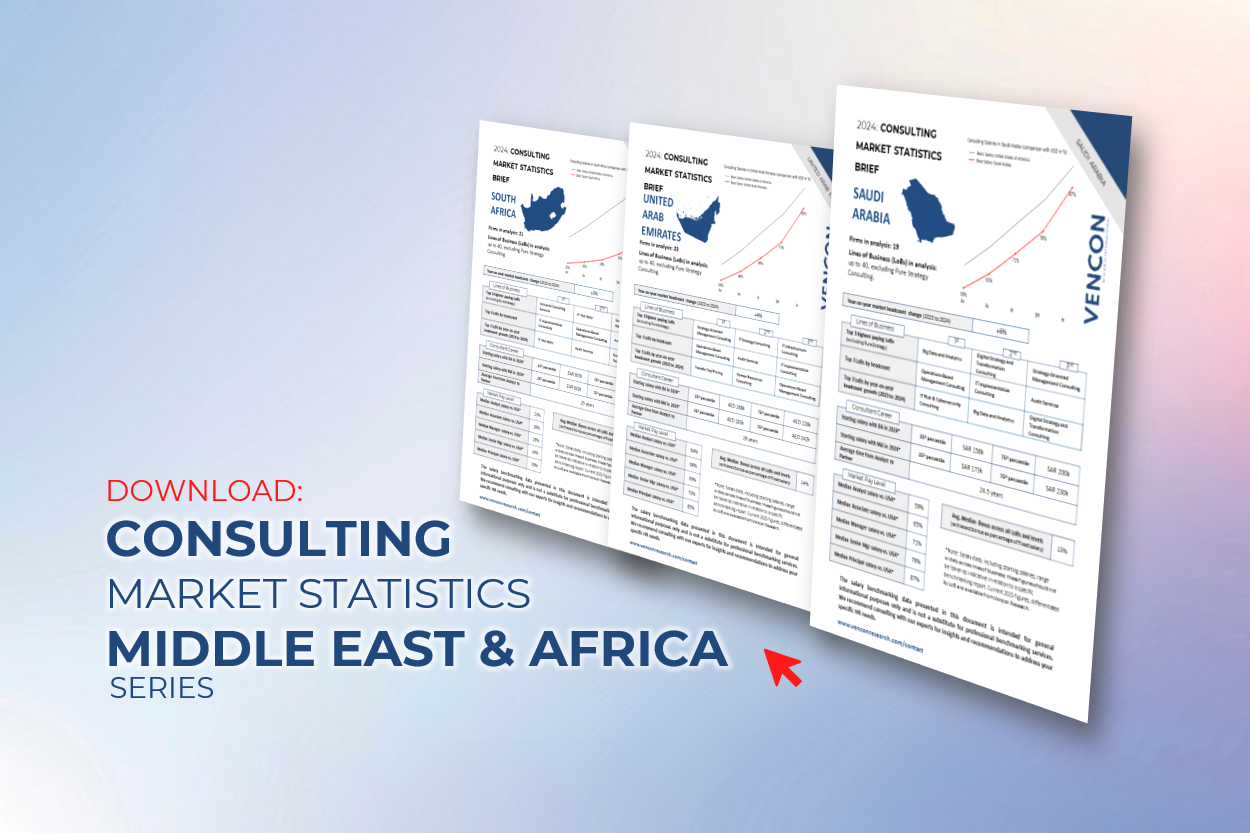
Download: Middle East & Africa Consulting Market HR Insights 2024-2025
This series of briefs consolidates essential HR indicators for the consulting sector across three markets in the Middle East and Africa: the United Arab Emirates, Saudi Arabia, and South Africa. It provides a comparative view of compensation positioning, workforce structure, career progression, and service line dynamics across the region.


Benchmarking Data that Works
In order to make informed decisions about compensation packages in your field, you need the latest data at
your fingertips.