

Latest InSights

Timing is Key: Why Financial Year Alignment Matters in Compensation Benchmarking
By Deepali Bist, MBA & Osas Ohenhen - Business Development
In compensation benchmarking, timing is everything. One often overlooked but critical factor influencing accuracy is a firm’s financial and salary review cycles — of which the financial year (FY) is often a key reference point.
For consulting firms (and indeed for many organizations), understanding the timing nuances is not just an accounting formality; it is a strategic cornerstone for effective remuneration planning and decision-making.
What Is a Financial Year (FY)?
A financial year (FY) is a 12-month period an organization uses for financial reporting and performance measurement. While some firms align their FY with the calendar year (January–December), others adopt alternative cycles such as:
- April–March (e.g., Big4 India, most UK based consulting firms)
- July–June
- October–September (common among several Big4 firms globally)
These choices typically reflect tax regulations, business seasonality, or internal strategic preferences. As a result, peer firms within the same industry may operate under different FY cycles, which can influence when they set budgets, review salaries, and adjust remuneration components.
Understanding these timelines ensures benchmarking efforts reflect the right data points in the right context.
Why FY Alignment Matters in Compensation Benchmarking
Financial year alignment is crucial for ensuring compensation benchmarking delivers accurate, actionable insights. It affects planning, salary review timing, and remuneration components.
1. Planning & Budgeting
Most firms align salary increases and bonuses with their FY. A mismatch in timing can distort benchmarking insights.
Example: Firm ABC Consulting follows an April 2025–March 2026 FY (FY26) but did not finalize its budget until December 2025. As a result, they only received benchmarking data in April 2026, by which time many peer firms had already reviewed and adjusted salaries.
Consequently, ABC’s benchmarking data appeared inflated or outdated — not because the market had changed dramatically, but because the comparison timing was misaligned.
Best Practice: Firms should synchronize benchmarking cycles with their budgeting and salary review windows to ensure market data reflects the most relevant and current pay decisions.
2. Salary Review Cycles
Salary review cycles vary significantly across firms and markets. Understanding when peers conduct reviews helps maintain competitiveness and prevent attrition.
Example: In India and the UK, salary reviews often occur around April, aligning with the April–March FY. So a simple example of how a firm with a financial year spanning April 1, 2025 – March 31, 2026 (FY26) might structure its remuneration planning:
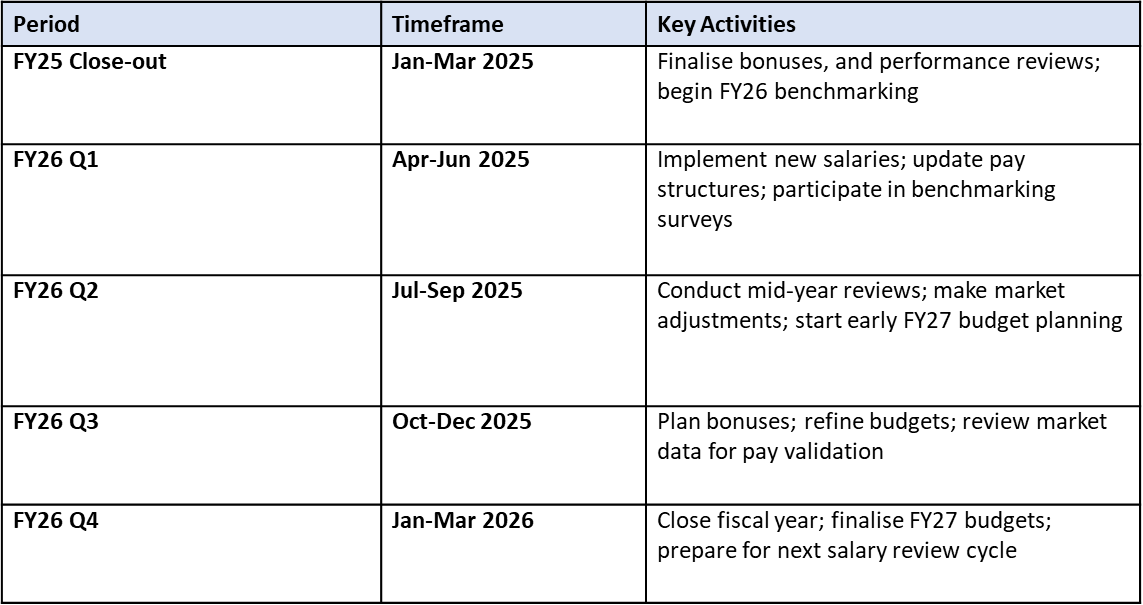
Best Practice: To stay aligned, firms should:
- Identify peer firms’ salary review months within each market.
- Incorporate effective date mapping into their benchmarking framework.
- Use multi-market benchmarking data carefully, ensuring timing equivalence.
3. Remuneration Components
Beyond base salary, FY cycles influence a range of pay elements linked to financial performance, including:
- Bonus pay-outs (individual and company performance)
- Long-term incentives (LTIs)
- Fixed overtime (e.g., Japan)
- Allowances (e.g., India, Mexico, Brazil, Belgium, UAE)
- Gratuity and pension contributions (e.g., India’s PF, Australia’s Superannuation)
- Profit-sharing
These components often follow fiscal performance outcomes, meaning that aligning benchmarking with FY cycles ensures accurate comparisons of total remuneration.
Risks of Overlooking FY in Benchmarking
Overlooking FY differences can lead to:
- Misinterpreted market data
- Mistimed salary reviews
- Inaccurate budgeting
- Loss of top talent
Global HR leaders often face additional complexity due to market-specific pay structures. For instance:
- France: Profit-sharing schemes (Participation and Intéressement)
- Belgium/Luxembourg: Representation allowances
- India: Gratuity and Provident Fund
- Australia: Superannuation
For multinational consulting firms, these considerations are interconnected. Failing to integrate such region-specific components into FY-aligned benchmarking can result in significant data inconsistencies and inaccurate pay comparisons.
Understanding Fiscal Naming vs Salary Validity
There is often confusion between fiscal year naming and salary validity.
For a firm with April 1, 2025 – March 31, 2026 (FY26):
- March 2025: FY25 ends.
- April 1, 2025: New salaries take effect (referred to as 2025 salaries).
- These salaries remain valid until March 31, 2026 (FY26).
In short: Even though the fiscal year is called FY26, the salary adjustments effective April 2025 are 2025 salaries, since they take effect in calendar year 2025.
Understanding this distinction prevents confusion when comparing data across firms using different fiscal and salary naming conventions.
Vencon’s Approach: Turning Timing Complexity into Benchmarking Clarity
At Vencon Research, we recognize that timing alignment is not just administrative — it is strategic. Our experience supporting consulting and professional services firms enables us to help HR leaders:
1. Align Benchmarking Cycles with Firm-Specific FY Structures
- Data Continuity: We collect and refresh data continuously, delivering “point-in-time” reports aligned with clients’ salary review cycles. For example: A survey with data up to June 30, 2025 remains valid through May 2026.
- Data Collection: Our questionnaires capture key timing details — salary effective dates, review periods, and bonus pay-out months — ensuring precise interpretation.
- Market Validity Mapping: We validate each market’s data against local pay cycle trends to prevent temporal distortion.
2. Interpret Market Data in the Correct Timing Context
- Example – Turkey: Due to high inflation and currency volatility, we collect data at a single point (e.g., 31 October 2025) for a realistic snapshot.
- Example – Bulgaria: With euro adoption scheduled for 1 January 2026, our pre-transition survey provides insights into how peers manage conversions, rounding, and timing communication.
3. Build Efficient, Data-Driven Review and Budgeting Processes
We help clients integrate benchmarking outcomes directly into budget planning tools, ensuring that FY-linked pay reviews and financial planning are data-driven, consistent, and actionable.
Strategic Implications
While fiscal calendars and salary reviews may appear technical, their implications for compensation benchmarking are strategic.
For consulting firms seeking to strengthen remuneration planning, improve timing, and retain high-performing talent, aligning compensation benchmarking with your financial year is a crucial practice. Reach out to Vencon Research to ensure your next review cycle is built on accurate, industry-specific data.

Consulting in Latin America: A Market Defined by Operational Depth and Emerging Specialisations
By Gonzalo Lavín Alfaro - Business Development Manager
While consulting has developed along broadly similar lines worldwide, each region exhibits distinct strengths shaped by its economic structure, client base, and regulatory landscape. Western Europe and North America remain established centres for general management and strategy consulting, and regions such as Eastern Europe and India are recognised for their focus on IT and implementation. In contrast, Latin America stands out for a more diverse consulting landscape — one defined by operational depth, regulatory complexity, and accelerating growth in emerging service areas.
In this overview, we take a closer look at the consulting landscape across Latin America — highlighting where firms are most active, how service lines are evolving, and what this means for compensation trends across the region.
Sustainability and ESG Advisory
Sustainability and ESG consulting are emerging as dynamic growth areas, particularly in energy, mining, and agriculture. As local regulations evolve and investor expectations rise, demand for advisory work in sustainability reporting, carbon management, and responsible supply chains is increasing rapidly.
Operations and Efficiency Improvement
Latin America’s consulting sector has traditionally centred on operational excellence. Many local and regional firms built their reputations on helping clients optimise processes, reduce costs, and improve supply chain performance. This remains a key focus area across industries such as manufacturing, logistics, and energy, where operational improvements often deliver faster, more tangible returns than strategic repositioning.
Finance, Risk, and Regulatory Advisory
The complexity of local tax and compliance environments — particularly in countries such as Brazil and Argentina — has driven consistent demand for consultants who can navigate these challenges. Advisory work in corporate governance, internal controls, and financial risk management continues to represent a significant share of consulting activity in the region.
Implementation and Digital Transformation
Implementation-oriented consulting has expanded rapidly, driven by growing investment in technology and automation. Multinational firms increasingly view Latin America not only as a delivery base but also as a developing market for digital services, with strong momentum in ERP implementation, process automation, and data analytics.
Human Capital and Organisational Consulting
Human capital consulting plays an important role, particularly within large domestic conglomerates and subsidiaries of global firms. Engagements often focus on organisational design, compensation, and talent management — reflecting the region’s focus on workforce adaptability and productivity.
Strategy Consulting
Strategy consulting, while smaller in overall scale, is concentrated in the region’s largest and most internationally connected economies: Brazil, Mexico, and Chile. Here, companies are more likely to invest in strategic transformation, international expansion, and market-entry projects.
Expected Salary Increases in Latin America
Despite higher inflation than the OECD average, Latin America’s consulting industry continues to show steady growth. With relatively limited geopolitical disruption compared to other markets, countries such as Colombia, Mexico, and Brazil are leading salary growth projections — expected to exceed 5.3% in many cases. This reflects the region’s rising demand for skilled professionals and sustained investment in expanding service lines such as ESG, digital transformation, and implementation.
Nearshoring and Delivery Centres
The region, particularly Mexico, has become an important hub for nearshoring and delivery centres serving North America and other markets. The transfer of business operations to nearby, lower-cost locations has long been associated with India and Eastern Europe, but Latin America is increasingly capturing this activity. Proximity to clients, time-zone alignment, and cost advantages are driving consulting firms to establish or expand delivery centres in the region, creating new opportunities for talent and service delivery.
Understanding how consulting work is distributed across lines of business is essential when assessing compensation levels. Even within the same country, firms may vary widely in focus and service mix, influencing both pay structures and career paths.
Vencon Research’s benchmarking products capture these distinctions by matching roles precisely by line of business, level, and local market context. This enables consulting firms to make accurate, meaningful comparisons when reviewing compensation within their market.
Explore Vencon Research’s benchmarking services ›
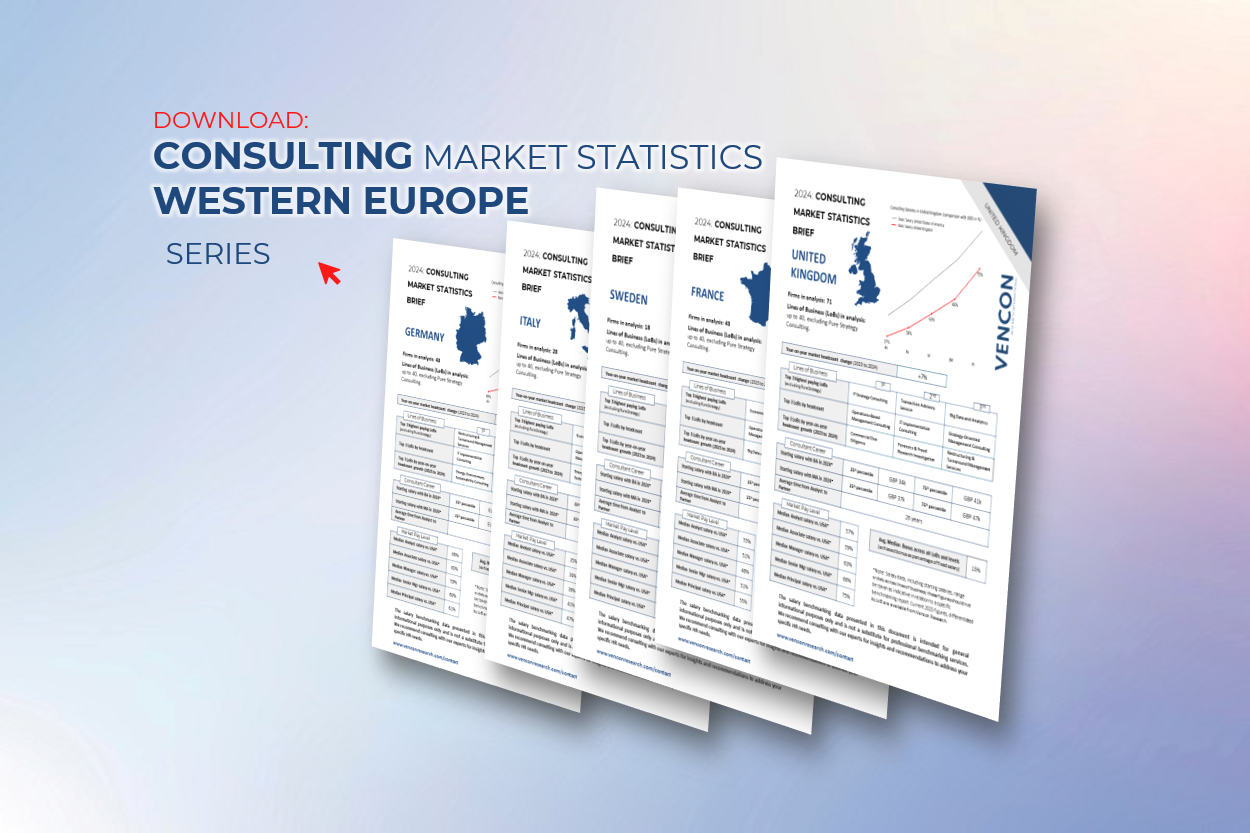
Download: Western Europe Consulting HR Stats 2024 to 2025
Key HR indicators for the consulting industry
This collection of market statistics briefs highlights key consulting market statistics across four countries in the Western Europe region: United Kingdom, France, Germany, Sweden and Italy. It offers insights into various key factors, such as the highest paying lines of businesses, market growth, starting salaries, career progression, and market pay level.
Notable highlights across Eastern Europe
- The year-on-year market headcount increase across these five countries ranged up to +7%, with “Energy, Environment and Sustainability Consulting” and “Big Data and Analytics” lines of businesses witnessing the largest growth.
- The average time required to progress from analyst level to partner level ranged from 24.5 to 26.5 years, with Germany having the fastest track.
- “Economics Consulting” was one of the highest-paid lines of business and "Restructuring & Turnaround Management Services" also ranked among the top three highest paid in three of five countries.
The sheets also present median salaries for all Vencon Research career levels as percentages of basic salaries paid in the United States. Out of the five countries presented here, consultants in Germany were paid the highest at entry level, while the United Kingdom saw the highest salaries as of Manger level.

HR Trends: Job Hugging in the U.S. and Its Implications for Total Rewards
By Yao Tang - Business Development Manager
In recent discussions with consulting firms in the U.S., one recurring theme has been job hugging: employees remaining in their current roles longer than usual, not necessarily due to engagement or satisfaction, but because external opportunities appear limited or uncertain.
From a Total Rewards standpoint, this trend carries several implications:
- Lower turnover may give an incomplete picture of workforce stability.
- Firms with slower salary progression or career advancement may face sharper attrition once mobility returns.
- Reviewing competitiveness now can prevent costly corrections later.
What Is “Job Hugging”?
Job hugging refers to employees choosing to stay put — often despite feeling underutilised or dissatisfied — rather than pursuing external opportunities. It represents a reversal of the “job hopping” behaviour that characterised much of the post-pandemic period.
Why It’s Emerging
Several factors are contributing to this shift:
- Economic uncertainty and layoff activity: Employees are more risk-averse and value job security.
- Perceived scarcity of external opportunities: A cooling labour market has reduced hiring across sectors.
- Relative comfort: If pay and benefits are broadly competitive, employees may see limited incentive to move.
Implications for Consulting Firms
1. Low Turnover Can Mask Underlying Risk
U.S. quit rates have fallen to around 2% per month (compared with roughly 3% during the peak of the “Great Resignation,” according to the Bureau of Labor Statistics). On the surface, this appears positive — but reduced movement may reflect caution rather than commitment.
When hiring activity picks up again, turnover could accelerate sharply, particularly among high performers who have postponed their next move.
Key point: Low attrition during periods of uncertainty should not be interpreted as loyalty. Job hugging is a temporary pause, not a sign of long-term satisfaction.
2. Slower Career and Pay Progression Amplify Future Attrition
Career growth remains a defining factor for consulting talent. If internal progression is noticeably slower than market norms — for example, where promotion steps take several years longer or salary growth at promotion is smaller — frustration can accumulate even during periods of low mobility.
When external opportunities re-emerge, those who feel “stuck” are often the first to leave.
Key point: Firms with below-market progression structures risk concentrated attrition once confidence returns to the labour market.
3. Proactive Benchmarking Reduces Future Costs
The last period of rapid mobility (2021–2022) showed how quickly pay structures can come under pressure. Firms that had not reviewed salary levels in advance often needed substantial market corrections to retain staff.
Regular benchmarking helps identify misalignments early and allows for phased, measured adjustments — avoiding sudden, reactive pay increases later.
Key point: Periodic benchmarking is not simply about keeping pace; it’s about maintaining readiness when market dynamics change.
Staying Prepared
Vencon Research works with consulting firms across markets, using directly collected and regularly updated compensation data from entry level through senior roles. This provides firms with a clear view of how their salary structures compare today — and how they may need to evolve as market conditions shift.
Accurate benchmarking is ultimately about preparedness. Understanding where you stand now ensures you’re ready when job hugging transitions back into job hopping.
Vencon Research is the largest player in the field of consulting compensation metrics. Our client list includes 85 per cent of the world’s major management consulting firms and we have over 20 years of experience and data at our fingertips. To find out more about our benchmarking products and services, visit our website or get in touch with our team.

Consultant Pay vs. Cost of Living in Germany’s Major Cities: 2025 and Beyond
By Irina Kvirikadze & Makar Evdokimov
Consultant pay is often used as a benchmark for career and business decisions, but headline figures alone rarely tell the full story. Pay may look similar across Germany at first glance, yet local costs mean the real value of a consultant’s salary can vary widely.
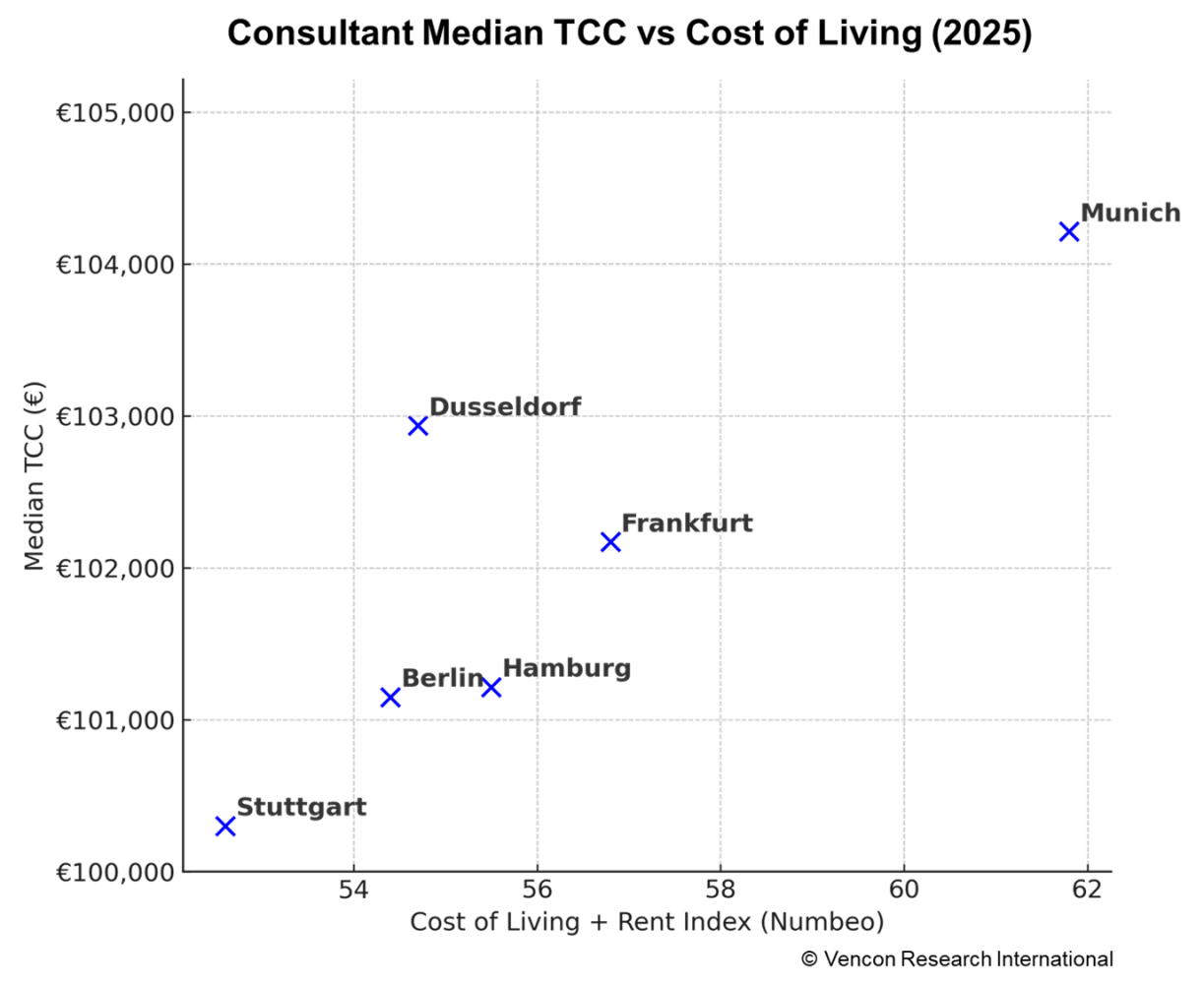
Based on Vencon Research’s compensation data, we benchmarked consultant compensation across six major German cities: Berlin, Düsseldorf, Frankfurt, Hamburg, Munich, and Stuttgart. We used our firm-weighted dataset that captures both base salary and bonus (Total Cash Compensation or TCC). To make comparisons more meaningful, we adjusted salaries against the Cost of Living + Rent Index (Numbeo), which reflects the true purchasing power of a consultant (all levels excluding partners) once local expenses are considered.
The results highlight striking differences in how far consultant pay really goes across Germany.
Key Findings
Munich: high pay, high cost
Consultants in Munich earn the most, with median TCC across all levels excluding Partner at just above €104,000. But with a cost index of 62, the steepest in Germany, much of this headline advantage is consumed by living expenses. Munich remains attractive for its prestige, corporate headquarters, and concentration of top-tier firms, but it is far less compelling when measured by net take-home value.
Düsseldorf: the sweet spot
With median compensation of €103,000 across all levels and a relatively modest cost index (54.5), Düsseldorf offers the most attractive balance between earnings and affordability. It consistently ranks as the strongest city for consultants seeking both competitive earnings and reasonable living costs.
Frankfurt: strong pay, middling value
Frankfurt consultants earn a median TCC of €102,200, but the city’s cost index (56.8) places it squarely in the middle of the pack. As Germany’s financial capital, Frankfurt provides stability and opportunity but doesn’t shine in relative value once affordability is factored in.
Berlin vs. Hamburg: a convergence story
Both Berlin and Hamburg cluster at €101,000 median pay with cost indices between 54–56. This is significant: Berlin was historically far more affordable, but rising rents and living costs have nearly eliminated its affordability edge, bringing it level with Hamburg.
Stuttgart: the hidden value play
Stuttgart ranks lowest in consultant pay (€100,200 median across levels), but also lowest in cost index (52.8). For consultants seeking to maximize savings rather than prestige, Stuttgart offers a compelling case as the most cost-efficient city in this comparison.
Real Purchasing Power Perspective: The Rankings Flip
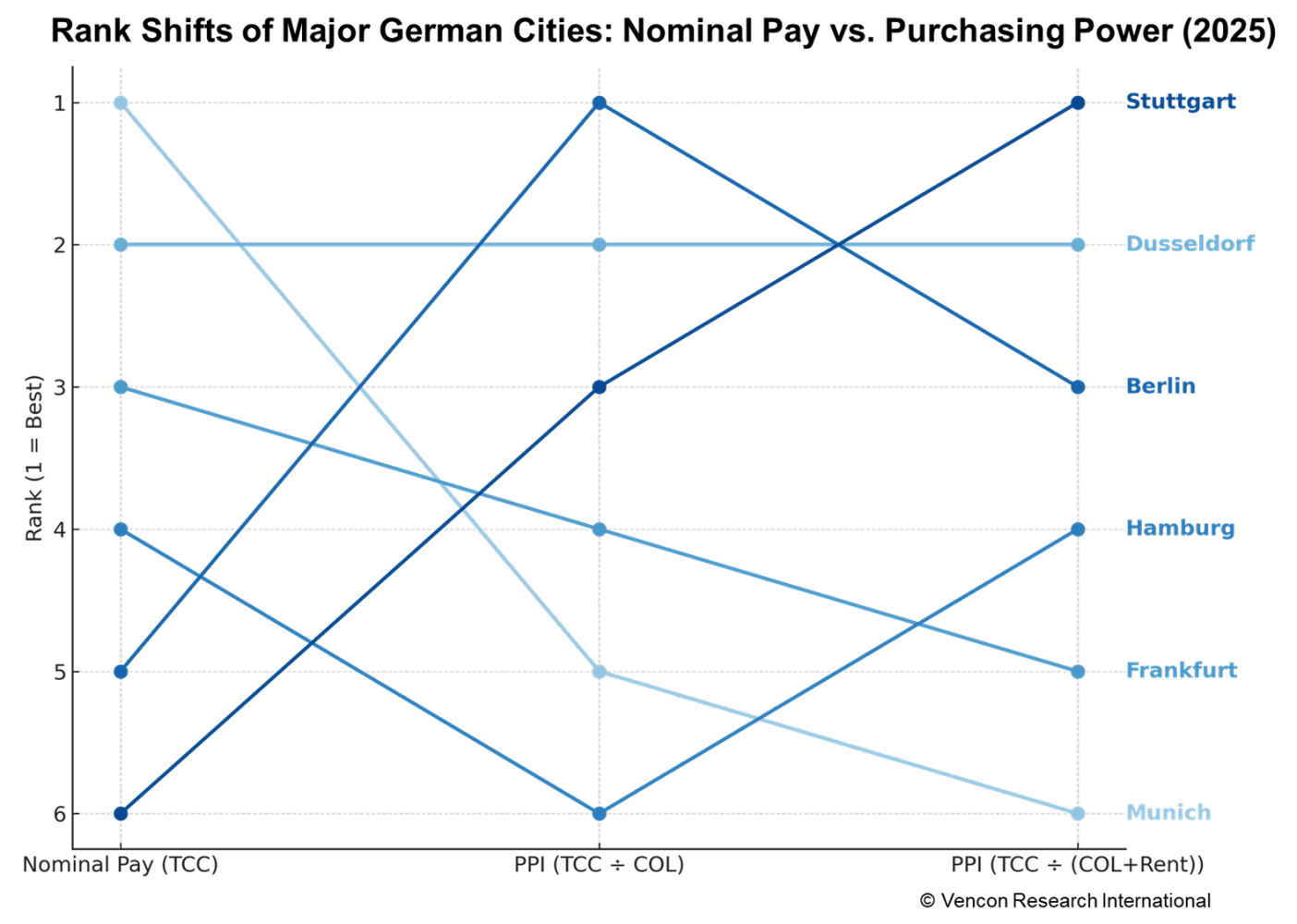
Looking beyond nominal pay to purchasing power (PPI 2025) adjusted for cost of living and rent, the rankings shift dramatically:
- Munich drops from #1 in nominal pay to last place (#6) once high costs are included.
- Frankfurt follows a similar decline, slipping down the ranks when affordability is considered.
- Düsseldorf remains the most balanced, combining high pay with manageable costs.
- Berlin and Hamburg are now nearly indistinguishable in value.
- Stuttgart emerges as the clear winner, ranking #1 when adjusted for both cost of living and rent.
Why These Differences Exist: It’s More Than Just Numbers
Several dynamics explain why salaries and affordability have evolved the way they have:
- Munich continues to attract global headquarters and top-tier consulting firms, especially in strategy and technology. This prestige drives up both salaries and housing costs, creating a high-pay, high-cost profile.
- Berlin, once seen primarily as a creative and start-up hub, has evolved into a magnet for global consulting firms. The city attracts young, international talent with expertise in digital, analytics, and technology—skills that are increasingly critical as client projects shift toward transformation and digitalization. This demand is pushing salaries up, but it's also making the city more expensive for everyone.
- Frankfurt remains Germany’s financial centre. Driven by the banking and financial services sector, demand for finance, risk, and regulatory expertise fuels robust compensation and a steady, high-pay, high-cost environment, however with less explosive growth than tech-centric hubs.
- Stuttgart reflects its regional profile: fewer top-tier consulting firms and more moderate salaries, but far more manageable living costs.
The Future of Consultant Pay (2025-2030)
Looking ahead, several dynamics are likely to reshape consultant pay and affordability across Germany’s major cities:
- Housing market pressures will intensify. Demand for urban housing in cities like Munich, Berlin, and Frankfurt will remain high, keeping the cost of living elevated.
- Remote and hybrid models may redistribute talent. As consulting firms adopt more flexible working models, consultants may increasingly live in lower-cost regions while remaining attached to high-paying city offices. This could weaken the traditional pay–location link over time, especially in costlier locations like Munich.
- Sector shifts will influence city attractiveness:
- Munich and Frankfurt are likely to maintain premium pay due to strategy and finance concentrations.
- Berlin should keep climbing as digital, data, and transformation work become core revenue drivers for firms.
- Stuttgart’s automotive focus could face headwinds if industrial transformation accelerates, potentially limiting salary growth unless diversification occurs.
- Generational and lifestyle choices will shape preferences. Younger consultants continue to value cultural vibrancy and international exposure (Berlin, Hamburg), while mid-career professionals with families may gravitate toward more balanced, affordable environments (Stuttgart, Düsseldorf).
- Purchasing power gaps may narrow further. As costs rise everywhere, the real purchasing power of salaries will become more similar across cities. By 2030, take-home pay could become less of a differentiator between locations
Implication: For consulting firms, this means compensation strategy will need to be more finely tuned to role, level, and specialization, not just location. For professionals, location choice may increasingly be driven by family status, lifestyle and sector focus, as the pure financial trade-offs between cities gradually flatten.
City-Level Dynamics and the Future of Pay
Understanding city-level dynamics is essential for consulting firms when shaping talent strategies, setting competitive pay, and maintaining internal equity. Over the next five years, rising housing costs, remote work, and shifting sector dynamics are expected to narrow city-to-city differences making lifestyle, specialization, and career goals as important as pay when choosing where to work. Firms will therefore need to refine compensation strategies beyond geography.
To stay competitive in this evolving market, deeper insight into level-specific pay, performance-linked rewards, and benefits will be critical. Our detailed country reports provide the intelligence consulting firms and professionals need to make informed, strategic decisions.

Allowances in Compensation: A Worldwide Overview of Pay Beyond Salary
By Yao Tang - Business Development Manager
In a previous article, we discussed the various components of remuneration packages, and today, we will dive deeper into one of the key elements: Allowances.
Allowances are additional fixed payments provided alongside basic salary to address specific expenses, such as housing, transportation, or meals. While allowances are not typically included in bonus calculations, in certain regions they play a significant role in the overall compensation structure.
Regional Differences in Allowances
Allowances and their importance vary significantly across regions. Here's how they differ:
Gulf Countries (UAE, Saudi Arabia, Qatar)
In the Gulf region, allowances play a critical role in consultants’ pay packages. They often account for 30-50% of total compensation, particularly for expatriates. Common allowances in this region include:
- Housing: Often provided due to the high cost of living in major cities.
- Transportation: To cover the cost of commuting or car ownership.
- Education: Expatriate families may receive allowances to cover tuition fees for their children.
- Relocation: Moving expenses are often reimbursed.
- Home leave: Usually flights (roundtrip) once per year for employees and their families are reimbursed.
Allowances are prominent in the UAE because they offer employers greater flexibility and cost control. Since end-of-service gratuity is calculated only on the basic salary, structuring pay with a lower base and higher allowances reduces long-term liabilities. This approach also aligns with local labour laws and common market practices, particularly for expatriate-heavy workforces where housing, transport, and education allowances are expected. Additionally, allowances can be adjusted more easily than fixed salaries, making them a practical tool for managing changing business needs.
India
In India, allowances are highly structured and play a significant role in compensation packages, often due to tax benefits. Common allowances in India include:
- Housing Rent Allowance (HRA): To help cover the cost of housing
- Leave Travel Allowance (LTA): To reimburse travel expenses for employees and their families.
- Fuel/Transport Allowances: To assist with commuting costs.
India also uses a Cost-to-Company (CTC) model, where the total compensation (salary, allowances, and benefits) is disclosed as a single figure. As a result, employees may find that their take-home pay is lower than expected, since some allowances and benefits are included in the CTC but not always in the direct salary portion.
Europe & North America
In most parts of Europe and North America, allowances are less common compared to regions like the Gulf or India. Instead, firms tend to offer higher base salaries. When allowances are provided, they are typically for specific purposes, such as:
- Transportation stipends
- Meal vouchers
- Relocation support
In these regions, performance-based incentives, such as bonuses, stock options, or profit sharing, are more common than fixed allowances.
Asia-Pacific (Singapore, China)
In high-cost cities like Shanghai, Hong Kong, and Singapore, housing allowances are quite common to offset the high costs of living. Expatriates in these markets may also receive additional perks, such as:
- International school tuition for children
- Home leave flights
- Relocation benefits
Local hires in these regions generally receive fewer allowances, with firms often opting for higher base salaries or bonuses instead.
Are Allowances Always Considered Part of Total Cash Compensation (TCC)?
The answer is generally yes—and this is consistent with Vencon Research’s approach. In most markets, allowances such as housing, transportation, and meal stipends are included in Total Cash Compensation (TCC), especially in regions where such allowances make up a substantial portion of overall pay.
One exception is children’s education allowances, which are usually excluded and instead captured in our separate Benefits Survey. This is primarily because such benefits are not universally applicable—for example, not all employees have children.
Accurate Comparison Requires Regional Nuance
At Vencon, we understand that taking into consideration regional differences in each component of Total Cash Compensation (TCC)—such as allowances—is essential for accurate and meaningful compensation comparisons. We've discussed how allowances can significantly impact total compensation packages in different markets, and we ensure that all these variations are considered in our analyses.
In markets where allowances make up a larger portion of compensation, we provide detailed breakdowns to offer a comprehensive understanding of the total compensation package. These insights combined allow Vencon Research to help organizations make well-informed decisions when benchmarking salaries and structuring compensation packages globally.
By leveraging Vencon Research’s structured approach and industry-specific insights, consulting firms can ensure their compensation practices remain competitive, equitable, and aligned with market expectations.


Benchmarking Data that Works
In order to make informed decisions about compensation packages in your field, you need the latest data at
your fingertips.