

Dernières publications

Workforce Adjustments in Strategy Consulting: Insights from 2023–2024
By Mik Bodnar - Business Development Senior Manager
Strategy consulting firms are facing notable shifts in workforce dynamics, shaped by evolving market demands and regional economic conditions. Recent analysis by Vencon Research highlights significant headcount trends across Germany, Japan, the UAE, the UK, and the USA, offering valuable insights for HR leaders faced with these realities.
Workforce Trends in Strategy Consulting
The consulting industry continues to grapple with tightening talent markets and rising compensation pressures. Entry-level positions have been disproportionately affected, reflecting cost containment strategies and evolving hiring priorities. At the same time, senior roles such as Principal-level positions remain in demand, suggesting a focus on leadership and specialized expertise.
Meanwhile, regional disparities have become more pronounced. While mature markets like Germany and the USA reported negligible changes in overall headcount, the UAE experienced exceptional growth, driven by strong demand for consulting services in the region.
These trends align with broader industry shifts. Hybrid work models, purpose-driven consulting, and demand for cross-functional expertise are reshaping workforce strategies in the sector. Effective talent management, including targeted upskilling and leadership development programs, has become critical for retaining top talent in an increasingly competitive market.
Findings from Vencon Research

Vencon Research's year-on-year analysis of strategy consulting firms reveals the following key trends:
- Declines in Entry-Level Roles: Analyst positions experienced the largest reductions, with headcounts decreasing by over 10% in Japan, the UK, and the USA.
- Growth in Senior Roles: Principals were the only group to show consistent headcount increases across all regions studied.
- Regional Variations:
- Minimal Changes in Germany and the USA: Overall headcounts remained relatively stable.
- Decreases in Japan and the UK: These markets saw modest declines in total headcount.
- Exceptional Growth in the UAE: Headcount increased by nearly 20%, with associate roles surging over 40%.
Implications for HR Leaders in Strategy Consulting
Current workforce trends present both challenges and opportunities for HR and business leaders in strategy consulting. As firms reassess their approaches to talent management and compensation, several key questions emerge:
- Are our workforce trends aligned with market benchmarks, or should we adjust to remain competitive?
- How can we capitalize on opportunities to attract top talent amid rising attrition at competing firms?
- What measures can optimize compensation strategies, particularly for critical senior-level roles?
Addressing these issues demands a balanced strategy—maintaining workforce stability while remaining responsive to changing economic and market conditions. For example, reductions in entry-level positions may appear manageable in the short term but could weaken the talent pipeline over time. Conversely, growth at senior levels underscores the importance of retaining and fairly compensating leadership talent while controlling costs.
Making informed decisions starts with access to accurate, market-specific data. Vencon Research provides targeted solutions to help firms act decisively. Our compensation benchmarking services deliver precise, actionable insights tailored to strategy consulting firms, enabling leaders to align pay structures with evolving market realities. By including detailed job matching as a core component, these services ensure roles are benchmarked with precision, providing a solid foundation for competitive and equitable compensation plans.
Beyond benchmarking, Vencon Research offers customized solutions to tackle unique challenges. Whether addressing talent shortages in established markets, identifying growth opportunities in high-demand regions like the UAE, or refining workforce strategies in response to economic shifts, our expertise equips firms with the tools to act with confidence.
To learn how Vencon Research can support your firm in meeting workforce and compensation challenges, visit venconresearch.com. With comprehensive insights and practical solutions, strategy consulting firms can position themselves not only to overcome today’s challenges but to strengthen their teams for long-term success.

What are the Key Statistics that Matter in Compensation Benchmarking?
By Makar Evdokimov - Data Integrity Senior Associate
At Vencon Research, we pride ourselves on being the leading specialist provider of compensation and pay metrics to the global professional services, management, and IT consulting industries.
In this article we take a closer look at the statistical measures used in our compensation reports to represent remuneration levels in the market. Taken together these ensure accuracy and relevance for a variety of benchmarking purposes.
Mean: a common starting point with considerable limitations
Looking at the average (mean) salary might be the most intuitive way to get an idea about the overall situation in the market. Statistically speaking, the arithmetic mean is an unbiased estimator of expected value, so from a theoretical perspective, it is a meaningful way to describe the distribution of values with a single number. However, in practice, the average may be somewhat misleading, especially when dealing with remuneration.

Even if we compare employees that have very similar scope of responsibilities and hold positions in firms which are direct competitors, the financial compensation may vary drastically from one case to another. Quite often, such a population will include a few individuals whose remuneration is substantially higher than that of the rest of the group. Such incumbents would be the outliers that drive the average value for the population upwards. The average considers all remuneration values in the population, but it may still be considerably higher than the financial compensation of most of the employees. This undermines the ability of the mean to represent the level of remuneration in the market. Therefore, it is common practice to use other, more robust indicators to aggregate remuneration data in a meaningful way.
Median and percentiles: analysing data distribution
The median is the most common measure used when evaluating remuneration levels in a market. While the mean requires an arithmetic operation involving all values in the sample, the median is rather defined by how the values in the sample are distributed across its range. The median value of remuneration in a population is basically such a value that half of the population is paid lower than the median and the other half is paid higher.

The median provides meaningful insight into the distribution of the values and it is more robust to outliers than the mean. This makes it one of the most important measures utilized in our surveys. Nonetheless, a single value can only say so much about a large dataset, so to provide an extensive overview of the market distribution of various remuneration components, the entire percentile range alongside the median (50th percentile) is presented in our surveys. This is especially helpful if your firm is interested in paying employees above or below the market, which means that the target market percentile (TMP) is not the median but a different point within the range. Vencon Research surveys provide all the data and tools necessary for benchmarking against any target - allowing you to select market target percentiles ranging from the lowest 5th to the highest 95th.
Our surveys also display distribution in the form of boxplot visualizations, charts that focus on five data points in the population: minimum, 25th percentile, median, 75th percentile, maximum.

Such visual aid gives a quick understanding of how the distribution is shaped which can become a valuable insight about the market.
Midpoint: a range-focused indicator
The midpoint (also known as the mid-range) is an arithmetic mean of the maximum and the minimum values in the population.

Even though it seems to be a poor measure of the remuneration level in the market, since it is very much not robust to outliers, the midpoint value is a range-focused indicator that can tell you how much the values of remuneration are dispersed in the market.
Compa-ratio: a key benchmark for salary comparison

One of the most useful metrics utilized in compensation benchmarking is the compa-ratio. The compa-ratio is calculated as your firm’s pay level divided by the market pay level. The selected measure of pay level can vary: mean, midpoint, median, or any other percentile can be used. Nonetheless, it is most common to calculate compa-ratio based on medians. In this case, a compa-ratio value of 0.85 or 85% indicates that the level of remuneration at your firm is 15% below the market level, while a compa-ratio of 1.1 would mean that your employees are paid 10% more than in the market. The comparative ratio assesses how competitive the remuneration at your firm is and gives a specific quantitative estimate of how far your current pay level is from your target in relative terms.

Our reports include the compa-ratio in interactive tool format, allowing you to select the target market percentile with which to compare your firm’s compensation. This allows you to quickly interpret the difference between your firm and the market pay rate at any level or sub-level, across while targeting any point on the entire percentile range.
Actionable statistics for accurate and goal-oriented benchmarking
In our comprehensive compensation benchmarking surveys, Vencon Research utilizes these statistical measures to deliver precise and insightful analyses. By comparing your firm’s pay levels with market data, you can determine how competitive your compensation packages are. At Vencon Research, we are dedicated to providing our clients with the tools and insights needed to make informed decisions about employee compensation. Our meticulous approach ensures that you have the most accurate and actionable data at your fingertips, helping you maintain a competitive edge in the market.
To find out more about our surveys and our benchmarking methodology do not hesitate to get in touch. Our team is always ready to provide personalized assistance to meet your specific needs.

Unlocking Strategic Insights: Vencon Research Introduces Pay Recommendations
By: Andy Klose and Jalol Khodjaev
In the competitive landscape of consulting firms, attracting and retaining top talent is crucial. Vencon Research has recognized the need for strategic guidance in compensation management and has introduced Pay Recommendations, an innovative enhancement to our compensation benchmark reports for the consulting industry. This solution is designed for both consultants and partners and has the potential to revolutionise how consulting companies approach their compensation strategies.

Tailored Solutions for Consulting Firms
At the heart of our Pay Recommendations lies a deep understanding of the unique needs of consulting firms, particularly for client-facing career levels below Partners and above. These recommendations are not one-size-fits-all; rather, they are bespoke reports crafted based on the Consultant Salary Reports or Partner Compensation Reports delivered to clients. Taking into account the specific local and service line dynamics of each client’s company, our reports provide a comprehensive evaluation of various compensation elements, including Total Cash Compensation, Basic Salary, Target Bonus, and Allowances.

Strategic Insights for Optimal Compensation Strategies
Vencon Research provides strategic insights into career progression and budget implications, in addition to numerical analysis. We align compensation elements with the client's desired market positioning to ensure adherence to the firm's pay philosophy while maintaining market competitiveness. Our aim is to facilitate gradual increases aligned with market percentiles, fostering employee rewards and career development in tandem.

Actionable Recommendations for Sustainable Growth
The true value of our Pay Recommendations lies in their actionable nature. With detailed suggestions for appropriate changes in each relevant compensation element, tailored to the client's positioning target, pay philosophy, and other metrics, our reports empower consulting firms to make informed decisions. By providing insights into the expected budget impact and assessing staff distribution across career levels, we enable strategic workforce planning and optimization of resources.

Illustrative Graphics and Comparative Analysis
Illustrative graphics within our reports vividly demonstrate the gap between current pay structures and market percentiles, highlighting areas for improvement. Through comparative analysis, we offer a holistic view of the client’s situation, enabling them to benchmark their compensation practices against industry standards. Moreover, our unique feature comparing career progression provides a time-based perspective on firm attractiveness for career development opportunities.

Guidance and Insights
Our Pay Recommendations provide clear and concise guidance on compensation elements, ensuring ease of implementation. We offer simulations of expected budget impacts and comparisons of staff distribution across levels, providing valuable insights into competitive positioning. Vencon Research provides data-driven recommendations and strategic guidance to empower consulting companies to optimize their compensation strategies for sustainable growth.

Empowering Consulting Firms for Success
In conclusion, Vencon Research's Pay Recommendations signify a significant change in how consulting firms approach compensation management. Our Pay Recommendations provide actionable insights, specific pay suggestions, and strategic guidance, empowering our clients to attract and retain top talent while maintaining competitiveness in the market. As the consulting landscape continues to evolve, our commitment to unlocking strategic insights remains unwavering. With Vencon Research as your partner, you can embark on a journey towards success, driven by informed decision-making and strategic vision.
A video overview of the Pay Recommendations report is available here.
We are at your disposal for further questions and suggestions regarding how you optimally design pay ranges and/or remuneration systems for your company.
Book your introduction meeting online here.
Andy Klose is an Associate Partner at Vencon Research International and heads the firm’s consulting unit.
Jalol Khodjaev is a Senior Consultant at Vencon Research International’s consulting unit.
Vencon Research International is a leading provider of compensation benchmarking and research as well as of compensation and performance-related consulting services for professional service firms, especially for audit and tax, management consulting, and IT services firms. Vencon Research International provides services to a full range of clients in more than 75 countries worldwide and is proud to name more than 85% of the world’s major consulting and/or professional services firm its clients.

The EU Pay Transparency Directive Is Not a Reporting Exercise
The countdown to the transposition of the EU Pay Transparency Directive in June 2026 has already started. For many organisations, the most visible requirement is the obligation to report gender pay gap data and provide employees with access to certain pay information.
This has led to a common initial reaction: build the reporting. But reporting is not the system. It is the output of the system.
The directive was designed precisely to make pay discrimination easier to identify and enforce by linking transparency across several different mechanisms. Reporting sits at the end of that chain. Compliance depends on whether the underlying pay structure, decision logic, and governance framework can withstand scrutiny.
In practice, that means organisations must be able to explain why pay differences exist, how roles are compared, and which criteria determine pay progression. Without those foundations, reporting can quickly surface gaps that cannot be objectively justified neither towards officials nor to employees.
Vencon Research supports organisations’ readiness efforts for the directive across the full lifecycle: from initial diagnostics through structural design, operational implementation, internal communication and reporting.
Why the Directive Goes Beyond Pay Gap Numbers
The directive introduces a broader architecture of transparency obligations that work together.
These include:
- defining categories of workers performing the same work or work of equal value
- establishing objective criteria for pay-setting and pay progression
- providing employees with the right to request pay information
- ensuring salary transparency in recruitment
- producing gender pay gap reporting
- conducting joint pay assessments when unexplained gaps persist
Each of these elements relies on the others. For example, gender pay gap reporting requires organisations to calculate average pay differences between men and women within categories of workers performing equal work or work of equal value.
If those categories are poorly defined—or if job architecture is inconsistent—the resulting comparisons can be misleading or difficult to defend.
Similarly, when employees request pay information about their category, organisations must be able to clearly demonstrate how pay levels and progression decisions are determined.
In other words, transparency forces organisations to make their pay systems explicit, consistent, and auditable.
Many organisations are therefore starting with a structured readiness assessment to understand where their current pay systems may face challenges under the directive.
The Hidden Risk: Escalation Mechanisms
One of the most important aspects of the directive is what happens after pay gaps are identified.
If a gender pay gap of 5% or more appears within a worker category and cannot be objectively justified, employers may be required to carry out a joint pay assessment with employee representatives.
This introduces a form of escalation pressure. Organisations must be able to demonstrate:
- how pay decisions were made
- whether objective criteria were applied consistently
- what corrective actions are required if structural issues are identified
Preparing for these scenarios cannot happen once reporting is already underway. The underlying governance and documentation processes must already be in place.
Preparing early for these escalation scenarios, both analytically and operationally, is becoming a core focus for organisations working toward directive compliance.
Why a Modular Approach Is Often Necessary
Because the directive touches multiple aspects of the pay system, organisations rarely face a single isolated problem.
Instead, they typically need to address several interconnected questions:
- Is the underlying HR and payroll data structured in a way that supports reliable analysis?
- Are job roles and levels defined clearly enough to enable meaningful equal-value comparisons?
- Are pay-setting and progression rules documented and consistently applied?
- Are HR teams and managers prepared to communicate pay ranges and criteria transparently?
- Is there a clear governance process for responding to information requests or investigating potential gaps?
- Which guidelines, policies and communication materials will have to be created, reviewed or changed?
Attempting to solve only the reporting requirement often leaves these questions unanswered.
For that reason, many organisations are beginning to approach the directive as a series of structured building blocks rather than a single compliance project.
Vencon Research works with organisations to design pragmatic implementation roadmaps that address these elements step by step while aligning with the directive’s timelines.
Building the Foundation: Data and Diagnostics
The first step is usually establishing a reliable fact base.
Pay transparency requirements rely on the ability to combine data from several systems, including HRIS, payroll, organisational structure data, and job information. In many organisations these datasets exist, but definitions and calculation rules differ across functions.
Creating a consolidated and auditable dataset allows organisations to:
- define pay components consistently
- standardise FTE and working-time adjustments
- segment employees into meaningful analytical groups
- reproduce calculations reliably for future reporting
Once this foundation exists, organisations can begin to assess the current state of pay equity. This typically involves analysing gender pay gaps across multiple segments—such as job families, levels, locations, or contract types—and distinguishing between structural drivers and potentially unexplained differences.
The purpose of this diagnostic is not only to measure current gaps but also to identify areas where the organisation may face higher scrutiny under the directive.
Vencon Research supports organisations in building auditable pay datasets and conducting detailed pay equity diagnostics aligned with directive requirements.
Defining “Work of Equal Value”
One of the most technically complex aspects of the directive is the concept of equal value comparisons.
Organisations must be able to compare roles across functions using gender-neutral criteria such as:
- skills
- effort
- responsibility
- working conditions
- contributions
In practice, this requires a coherent job architecture and job evaluation logic that allows roles from different functions to be assessed within the same framework.
For example, a marketing role and a finance role may be very different operationally, but the directive requires employers to demonstrate whether they represent comparable value in terms of responsibility, complexity, and required capabilities.
Without a structured job architecture, these comparisons become extremely difficult to defend.
Designing robust job architectures and evaluation frameworks is therefore a key step in preparing organisations for equal-value comparisons under the directive.
Embedding Transparency Into HR Processes
Even with a clear structure in place, transparency only works if the organisation’s day-to-day processes align with it.
This often requires reviewing how pay decisions are made across several areas:
- hiring and salary offers
- promotions and role changes
- annual pay reviews
- variable pay and allowances
Managers need clear guidelines on how pay ranges are applied and how exceptions are documented. Organisations also need to define how pay-setting and progression criteria are communicated to employees in a consistent and understandable way.
This is where communication and enablement become critical. Transparency requirements affect not only HR teams but also recruiters, line managers, and senior leadership.
Vencon Research supports organisations in embedding transparent pay governance into HR processes, policies, and manager decision frameworks.
Preparing for Reporting and Employee Requests
Once the underlying structure and processes are in place, organisations can build the reporting outputs required under the directive.
These typically include:
- gender pay gap calculations across defined worker categories
- documentation explaining the methodology used
- governance processes for reviewing and approving results
- templates for responding to employee pay information requests
Equally important is preparing for scenarios where gaps require further investigation or remediation.
Having predefined approaches for documentation, corrective action, and stakeholder involvement allows organisations to respond quickly if reporting results trigger additional obligations.
Vencon Research helps organisations establish repeatable reporting frameworks and prepare operational responses for employee information requests and potential joint pay assessments.
A Structural Shift in Pay Governance
The EU Pay Transparency Directive represents a shift in how pay systems are expected to operate.
Historically, many organisations relied on implicit practices and informal decision-making frameworks that worked reasonably well internally but were rarely documented in detail.
Transparency changes that expectation.
Pay systems must now be designed so that they can be explained, justified, and audited. This requires stronger data foundations, clearer role structures, and more explicit governance around pay decisions.
For organisations that address these elements systematically, the directive becomes manageable. Those that focus only on the final reporting step may find themselves dealing with much more complex questions once transparency exposes how their pay system actually works.
Organisations beginning their preparation now have the advantage of building these foundations in a structured way before reporting obligations come into force.
Preparing for the EU Pay Transparency Directive? Vencon Research supports organisations across the full preparation journey—from pay equity diagnostics and job architecture to governance frameworks and reporting readiness. Get in touch to discuss how we can support your organisation.

Shifting Patterns in Global Consulting Demand: A Benchmarking Analysis
By Gunjan Kalwani and Noel Tetteh - Data Integrity
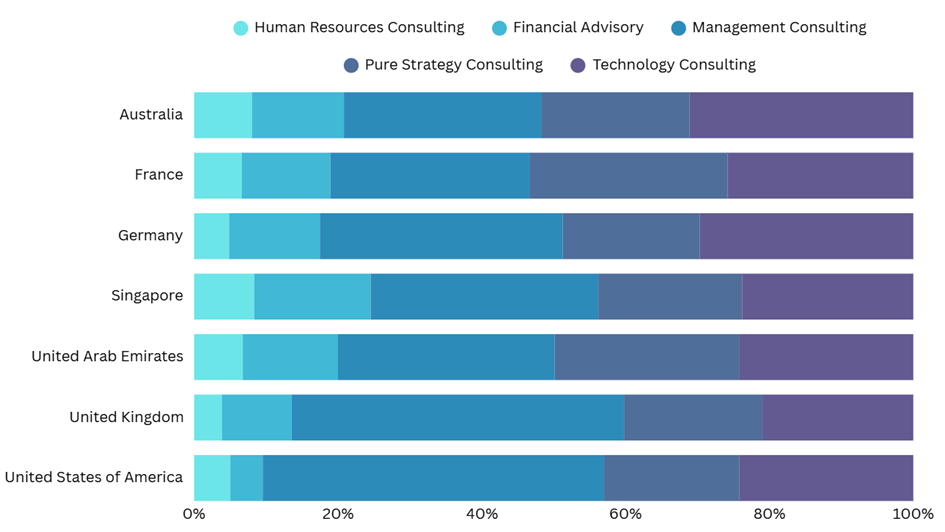
Vencon Research’s proprietary compensation benchmarking data reveals a decisive shift in the consulting landscape. While five core Lines of Business (LoBs); Strategic Consulting (SCF), Management Consulting & Advisory (CON), Human Resources Consulting (HRC), Corporate Finance & Transactional Services (CFT), and IT Consulting (ITC) continue to define value creation globally, the highest growth is now concentrated outside traditional hubs.
This report identifies the emerging markets where national ambition is generating multi-year, project-driven demand, presenting a strategic expansion opportunity for firms with global ambitions.
Established Markets: Consistent Demand Profiles
Out of the 40+ LoBs Vencon Research tracks across 70+ countries, distinct regional specialties emerge.
These mature markets show stable demand, with each maintaining a consistent profile:
United States of America & United Kingdom: Dominance in high-level Strategic consulting and Management advisory.
Germany: Strong Management consulting, complemented by robust Technology and industrial advisory.
Singapore: A focus on Management and Operational consulting (OPO), aligned with its role as a financial hub.
United Arab Emirates: Prioritizes Strategic and Management consulting (CON) in line with its ‘We the UAE 2031’ vision.
Australia: Driven by digital transformation, demanding both Technology and Strategic consulting.
France: Uniquely balanced demand across all service areas.
Growth Markets: Expanding Demand Across Core Services
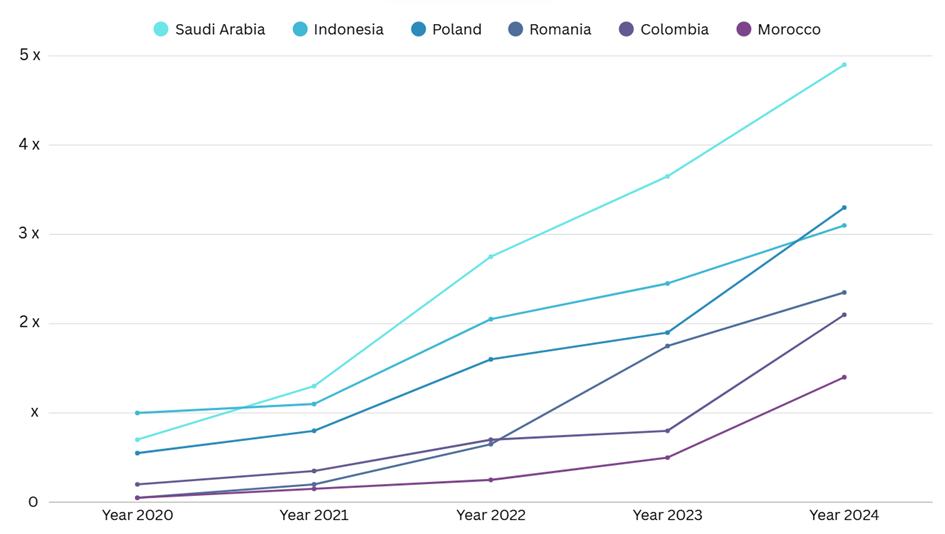
Our Market Engagement Index (MEI) below shows a fundamental reallocation of consulting resources. Strategic focus on key emerging markets has more than doubled since 2020. These are not fleeting opportunities but stable, long-term gateways to their regions, characterized by sustained, double-digit growth across core LoBs.
Country-Level Analysis: Markets with Rising Demand
Saudi Arabia
Key Driver: Saudi Arabia’s ‘Vision 2030’ transition from strategy to execution.
LoB Impact: Demand has shifted from SCF for giga-projects planning to a rise in OPO for implementation and ITC for digital infrastructure. HRC growth remains steady, driven by talent competition and regulation.
Poland & Romania
Key Drivers: Poland’s €60 billion EU recovery fund; Romania’s $1.3 billion tech sector.
LoB Impact: BDA and Digital Strategy projects have more than doubled. ITC growth has exceeded 150%, fuelled by smart city and cybersecurity mandates. SCF and CFT have grown significantly as local companies have matured and deal activity has nearly tripled.
Morocco
Key Driver: The "Digital Morocco 2030" strategy and 2030 World Cup preparations.
LoB Impact: The entire CON segment is growing, split between OPS for strategic advisory on cloud and AI, and OPO for the physical execution of 5G rollout and digital infrastructure.
Colombia
Key Drivers: A thriving fintech sector, exemplified by the successful launch of the Bre-B payment system, and a focus on green energy.
LoB Impact: Sustained growth in ITC from digitalization, complemented by rising CON demand for ESG transitions. A 55% surge in international hiring (Deel) is creating new needs in HRC for global workforce integration.
Indonesia
Key Drivers: The $32.7B Nusantara capital city, a $146B digital economy, and a $172B initiative to restructure and modernize state-owned enterprises.
LoB Impact: Our MEI shows rising demand across the board:
- SCF, DIG, BDA: For new city planning and digital economy strategy.
- ITC: For cloud and cybersecurity infrastructure.
- HRC, DIG, ITC: Driven by the formalization of 62 million SMEs.
- SCF, CON, BDA: For green finance and ESG linked to the 2060 net-zero goal.
Implications for Consulting Firms
The data mandates a strategic response. To remain competitive, consulting firms must:
- Recognize the Shift: The growth of these emerging hubs marks a fundamental reorientation of the global consulting market.
- Pivot Resources Strategically: To compete, firms must deliberately reallocate focus and investment to these regions.
- Establish a Local Presence: Build a strong physical presence in these markets.
- Invest in Local Talent: Prioritize the recruitment and development of in-region expertise to ensure relevance and execution.
- Specialize in High-Demand Services: Build deep, specialized capacity in the core service lines driving growth: DIG, BDA, ITC, OPO.
Growth Markets
The market is sending a clear signal. We are seeing a fundamental shift in where the real growth is happening for consulting firms. The most consistent and sustained demand is no longer confined to the traditional hubs, but is anchored in markets where national development agendas and national ambitions are generating multi-year project pipelines. For consulting firms looking to build a lasting advantage, these regions represent an opportunity not to be missed.
Benchmarking demand is key to growth. Vencon Research identifies the markets and service lines driving sustained consulting opportunities, giving your firm the insights needed to focus resources and capture high-growth regions.

Support Staff Compensation Benchmarking in Consulting Firms
By Yogendra Balayar - Senior Associate Data Integrity
Compensation strategies in consulting often focus on client-facing positions, but administration and support teams play a critical role in keeping firms running efficiently. These roles—ranging from reception and office management to recruiting, design, and internal research—are diverse, and compensation practices can vary widely. Without reliable data, it’s difficult to know whether pay levels are competitive or appropriate.
Vencon Research’s Administration & Support Staff Survey provides firms with detailed, market-based insights to support compensation planning and evaluation for these roles. The survey covers a broad range of support functions and job levels, helping firms make well-informed decisions across their internal operations.
Why Benchmark Support Staff Compensation?
1. Attracting Talent
Support roles need to be filled by capable, reliable professionals—and competitive compensation is key to attracting them. Benchmarking shows what similar roles are paid elsewhere, making it easier to set realistic salary ranges.
2. Retaining Skilled Staff
Good employees are hard to replace. Monitoring compensation trends helps firms stay aligned with the market and reduce the risk of losing valuable team members to better-paying offers.
3. Planning and Managing Budgets
Understanding what comparable roles cost across the industry supports more accurate and sustainable budgeting. Benchmarking also helps firms plan for changes, such as adjustments during reviews or promotions.
4. Demonstrating Fairness
When employees see that their compensation is based on objective market data, it fosters transparency and trust. Firms that benchmark regularly are better equipped to explain and justify their pay structures.
How Vencon Research Supports Better Compensation Decisions
To help consulting firms make informed, market-aligned decisions around support staff pay, Vencon Research offers a dedicated Administration & Support Staff Survey. The survey is designed to reflect the realities of internal roles within consulting—providing comprehensive, reliable data that goes beyond job titles to capture the actual scope and structure of support positions
Detailed Compensation Data
The survey provides a comprehensive view of compensation components: base salaries, bonuses, total cash, and applicable market-specific allowances. Results are broken down by role, level, and geography.

Accurate Role Matching
Job titles alone often don’t reflect the real responsibilities behind a role. The survey includes a structured job matching process that looks at actual tasks and reporting lines to ensure valid comparisons across firms.

Support for Multi-Function Roles
Support staff frequently handle responsibilities across more than one function. The survey allows for incumbents to be matched to multiple sub-functions when necessary, reflecting the way these roles actually operate.

Career Level Consistency
Instead of assuming equivalence based on titles, roles are matched based on skill level, responsibility, and decision-making scope. This results in more accurate level-to-level comparisons across firms.
Additional Insights
The report also covers non-compensation elements such as overtime pay, vacation days, and year-on-year salary movement. These data points help provide a broader understanding of employment practices in support functions.

International Coverage
Data is collected from consulting firms across a range of markets, including the US, UK, Middle East, and selected emerging markets. This global perspective is especially useful for firms with cross-border operations.
Confidential and Reliable
All data is gathered directly from HR professionals or firm leadership and treated with full confidentiality. No firm- or individual-level data is disclosed in the reporting.
A Structured Approach to Support Staff Pay
For consulting firms, the Administration & Support Staff Survey offers a clear and reliable basis for setting and reviewing compensation across non-consulting functions. With accurate job matching, robust data coverage, and detailed reporting, firms gain the insight needed to make better decisions—whether the goal is attracting new hires, retaining experienced staff, or aligning internal structures with the wider market.
Vencon Research helps consulting firms make informed, data-backed decisions on compensation—across both client-facing and internal roles. From accurate job matching to reliable benchmarking, our surveys provide the depth and clarity firms need to navigate compensation planning with confidence. To find out how our data can support your firm, contact us or visit our website.


Données utiles et fiables
Pour prendre des décisions éclairées sur les packages de rémunération dans votre secteur, vous avez besoin des données les plus récentes à portée de main.