

Dernières publications
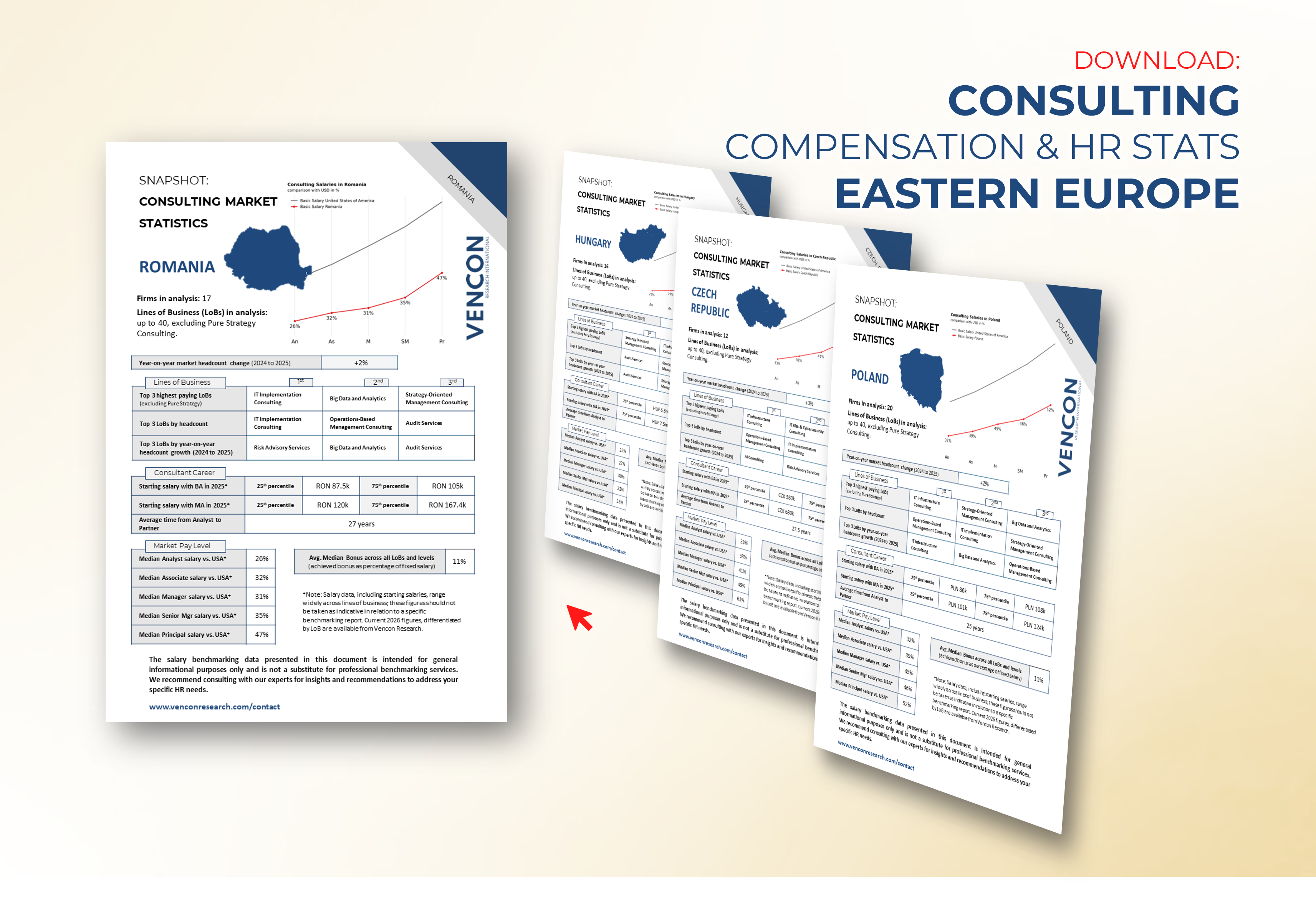
Download: 2026 Eastern Europe Consulting Market HR Statistics
Key HR indicators for the consulting industry
This collection of market statistics briefs highlights key consulting market statistics across four countries in the Eastern Europe region: Czech Republic, Hungary, Romania, and Poland. It offers insights into various key factors, such as the highest paying lines of businesses, market growth, starting salaries, career progression, and market pay level.
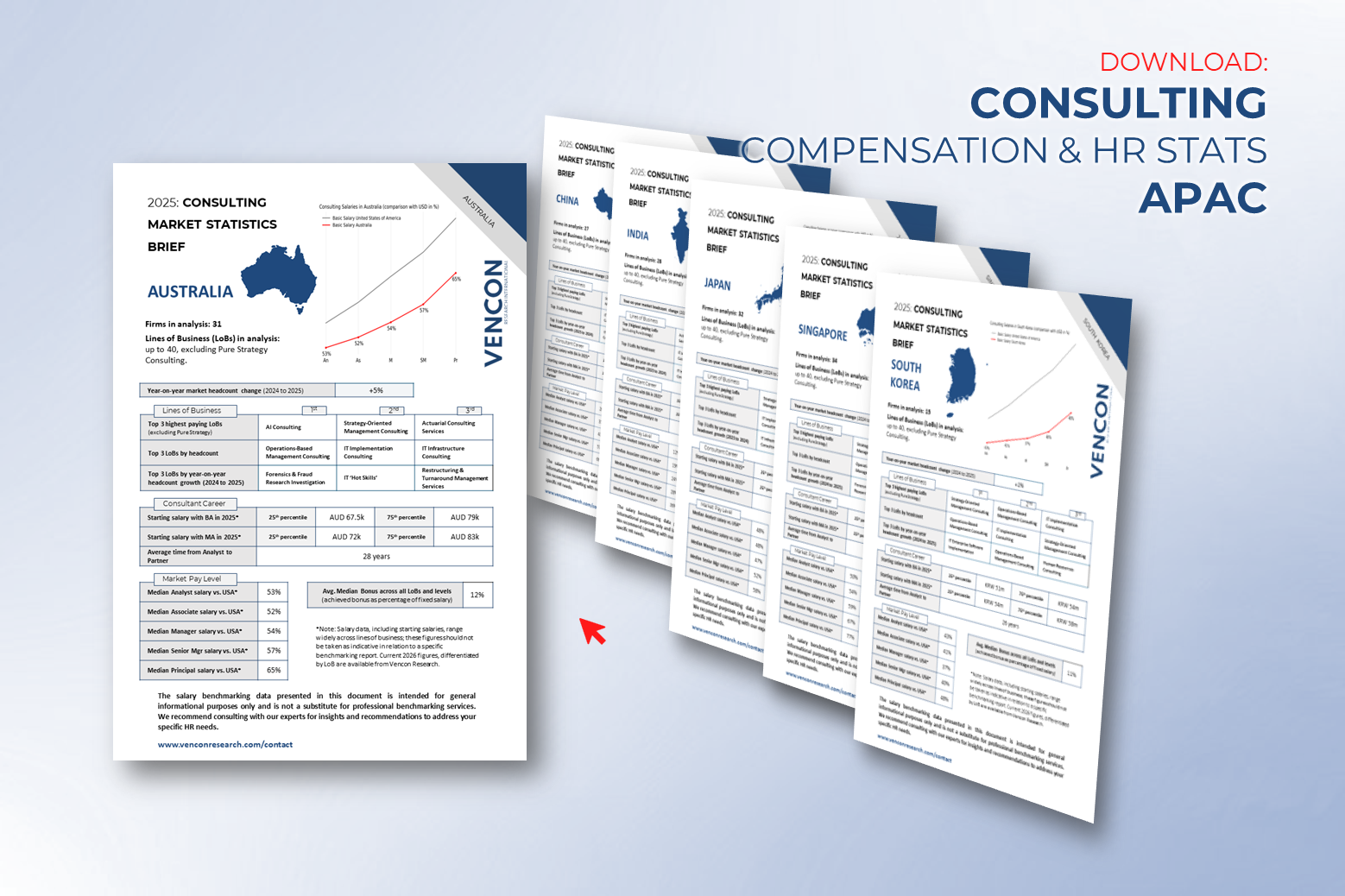
Download: 2026 APAC Consulting Market HR Statistics
Key HR indicators for the consulting industry
This collection of market statistics briefs highlights key consulting market statistics across six countries in the Asia-Pacific (APAC) region: Australia, China, India, Japan, Singapore, and South Korea. It offers insights into various key factors, such as the highest paying lines of businesses, market growth, starting salaries, career progression, and market pay level.

AI Talent Compensation in Consulting: Beyond the Salary Headlines
By Shukhrat Iskandarov - Client Solutions Manager
If you follow discussions about AI hiring, it's easy to conclude that the market has become a pure salary race.
Stories about multi-million-dollar compensation packages for elite AI researchers receive a great deal of attention. They are real, but they describe a very small part of the global talent market.
For consulting firms, the more relevant question is different: what AI capabilities create value for clients, and how should firms reward those capabilities in a sustainable way?
That distinction matters. Most consulting firms are not competing for a handful of frontier AI researchers. They are competing for professionals who can help clients apply AI effectively in real business settings.
Demand for AI Skills Has Changed Hiring Priorities
AI has moved from experimentation to implementation. Consulting clients increasingly expect support with areas such as generative AI adoption, process automation, analytics modernization, responsible AI governance, and AI-enabled operating models.
This has increased demand for consultants who combine technical understanding with industry knowledge and client-facing skills.
Recent labor market research shows that demand for developers with AI-related skills has grown far faster than demand for traditional software development skills, and AI capabilities now appear in a significant share of technical job postings. The direction of travel is clear: AI skills have become a mainstream hiring consideration rather than a niche specialty.
For consulting firms, however, demand alone does not determine compensation.
AI Is Not a Single Skill
One of the most common mistakes in AI hiring is treating all AI experience as equivalent.
A consultant who has helped clients deploy AI solutions into production, manage model performance, redesign business processes, and establish governance frameworks brings a very different level of value from someone who has only experimented with AI tools.
In consulting, the strongest performers are usually those who can answer three questions clearly:
- What problem is being solved?
- How will the AI solution improve the client's business?
- What risks, costs, and implementation challenges need to be managed?
Technical knowledge matters, but client impact matters more.
Compensation Is About More Than Base Salary
Base salary remains important, but consulting firms increasingly compete on the overall employment proposition.
Experienced AI consultants often look for:
- access to meaningful client work,
- opportunities to build new capabilities,
- exposure to senior decision-makers,
- clear career progression,
- flexibility in where and how they work, and
- participation in high-impact transformation programs.
As a result, total compensation may include performance bonuses, profit sharing, equity participation in some firms, learning support, and accelerated promotion opportunities.
The mix varies significantly by firm type. A technology-focused consulting boutique may emphasize growth opportunities and variable pay, while a large global consulting firm may compete more on brand, career development, international mobility, and the scale of client engagements.
The Market Premium Reflects Scarcity
The largest compensation premiums are generally associated with skills that remain relatively scarce.
In consulting, these often include:
- leading enterprise AI transformations,
- integrating AI into core business processes,
- designing responsible AI frameworks,
- managing AI-related regulatory and risk issues,
- building AI operating models, and
- translating technical capabilities into measurable business outcomes.
The premium is not for having "AI" on a résumé. It is for having a track record of helping clients achieve results.
Geography Still Matters
AI compensation is not a single global market.
A senior AI consultant in New York, London, or San Francisco may command a very different package from a consultant with a similar title in another country. Differences in client demand, talent supply, billing rates, and cost structures continue to influence compensation levels.
This is why consulting firms need market-specific benchmarking rather than headline figures drawn from a few high-profile technology companies.
At Vencon Research, our consulting compensation benchmarking work covers more than 75 countries, 500+ consulting firms, and over 650,000 consulting professionals worldwide. The data consistently shows that AI-related premiums vary materially by geography, consulting segment, and level of seniority.
A More Balanced Market Is Emerging
As AI capabilities become more widespread, compensation is likely to become more differentiated.
A small number of exceptional researchers and technical specialists will continue to attract extraordinary packages. For most consulting professionals, however, long-term market value will depend on a broader combination of capabilities:
- technical literacy,
- commercial judgment,
- industry expertise,
- communication skills,
- change management, and
- delivery experience.
Consulting clients ultimately pay for outcomes, not for familiarity with a particular model or tool.
The Practical Question for Consulting Leaders
For consulting firms, the central challenge is not whether AI talent is expensive. It is whether compensation structures accurately reflect the value that different AI capabilities create for clients and for the firm.
Firms that reward proven client impact, delivery capability, and leadership are more likely to build sustainable AI practices than firms that simply react to headline salary stories.
In that sense, AI compensation in consulting is becoming less about chasing the highest number and more about identifying the capabilities that genuinely strengthen client service and long-term firm performance.
Benchmarking AI-Related Consulting Skills
As AI continues to reshape consulting roles and skill requirements, reliable compensation benchmarks can help firms understand where the market is moving and how their pay compares.
Vencon Research provides compensation benchmarking for consulting firms across 75+ country markets, covering AI-related and other specialist consulting skills. Contact us to learn more about our compensation surveys and benchmarking data.

Why Sales Commissions Fail in Consulting
By Andy Klose - Associate Partner and Head of Advisory
In many consulting firms, the incentives debate starts with an apparently obvious thought: if senior leaders are expected to win work, why not pay them like salespeople and introduce sales commissions? The logic feels clean—more deals, more pay, more growth. Yet in consulting, this “clean” logic often produces messy outcomes: weaker risk discipline, more internal friction, and—most damaging—reduced client trust. The reason is structural, not ideological. Classic, deal-based sales commissions are designed for transactional selling; consulting is a relational, team-based, judgment-heavy business where value is co-created and realized over time.
The intuitive idea – and where it goes wrong
Product-style sales commissions assume a world of discrete transactions: a salesperson closes a deal, hands it over, and gets paid. The model works because the boundaries are clear—between selling and delivery, between one deal and the next, and between individual contribution and enterprise value.
Consulting rarely fits that template. “Selling” is usually inseparable from diagnosing the problem, shaping the approach, assembling the right team, and standing behind the outcome. When incentives treat consulting like a sequence of independent deals, they encourage behaviors that optimize short-term bookings at the expense of long-term client impact and firm health.
What makes consulting structurally different from transactional sales
Sales commissions become increasingly fragile as offerings become more bespoke and knowledge-intensive. In classic consulting—strategy, operations, HR, organization, transformation—the economics differ in three ways.
First, sales and delivery are integrated. Senior consultants and partners do not merely close; they commit the firm, lead the work, and remain accountable for what was promised.
Second, solutions are heterogeneous by design. Even when proposals reuse methods and modules, each engagement is shaped by client context, politics, risk, data availability, team mix, and outcome uncertainty. This makes “fair” and behaviorally sound deal-level metrics hard to define.
Third, the asset is the relationship, not the transaction. Consulting revenue typically unfolds in waves—diagnosis, design, implementation, follow-on scaling—within a relationship where trust accumulates slowly and can be lost quickly.
A practical rule holds: the more relational and bespoke the work, the less compatible deal-level sales commissions become.
How sales commissions backfire in consulting
Once you view consulting as an interdependent, multi-year value chain, several failure mechanisms become predictable. They reinforce each other, which is why “small” commission schemes often expand into large cultural and economic problems over time.
1. Sales commissions shift the partner mindset from “best answer” to “best-sellable answer”
Consulting buyers pay for judgment and independence. Deal-based sales commissions introduce a strong bias toward whatever is easiest to monetize now. Common patterns include scope inflation, premature solutioning, and a preference for short, high-fee projects over work that builds sustainable client capability. Even if outcomes remain acceptable, clients quickly sense when advice is optimized for revenue rather than relevance. Trust erodes—and trust is the foundation of repeat business.
2. Sales commissions weaken risk discipline and deal quality
Healthy consulting firms say “no” more often than outsiders assume: no to unrealistic timelines, no to misaligned stakeholders, no to underpriced work, no to engagements where success probability is low. Sales commissions can invert that discipline. A large, high-fee, high-risk project becomes personally attractive even if the firm later absorbs the delivery pain, write-offs, or reputational impact. Over time, governance mechanisms—review boards, pricing discipline, delivery readiness checks—get pressured by individuals who are rewarded for closing, not for outcomes.
3. Sales commissions undermine collaboration in a team-based business
Modern consulting delivery is cross-practice and cross-geography. The best client solution often requires multiple senior leaders and specialists to contribute. Sales commissions turn that collaborative system into a contest for “origination credit.” The predictable consequences are territorial behavior (“my client”), reluctance to bring in colleagues if it dilutes payout, and internal negotiation about credit allocation that consumes energy better spent on the client. In a partnership model, internal trust is a strategic asset; sales commissions tax that asset.
4. Sales commissions distort time allocation in multi-task leadership roles
Senior consulting roles are inherently multi-dimensional. Partners and senior leaders must balance business development with delivery leadership, talent development, intellectual capital, and firm stewardship. High-powered incentives tied heavily to sales drive effort toward what is measured and paid, crowding out activities that build long-term advantage—coaching, proposition building, quality assurance, recruiting, and leadership roles. The firm may temporarily see a spike in bookings while quietly accumulating delivery and people risks that surface later.
5. Sales commissions mis-attribute value creation and fuel perceived unfairness
Few consulting wins are attributable to one person. A sale often reflects prior delivery excellence, a long-nurtured relationship, specialist insight, a high-performing team, and the firm’s reputation. Deal-based sales commissions force an artificial choice: either reward the visible “closer” disproportionately, or build complex split models that feel arbitrary and create constant debate. Both outcomes erode perceived fairness—one of the most sensitive levers in professional services cultures.
When commission-like incentives can work (and the boundary conditions)
This is not an argument against variable pay or against rewarding business development. The question is fit: under which conditions do sales commissions align with the operating model?
Commission-like approaches are more viable when most of the following are true:
- Standardized, repeatable offerings (e.g., fixed-scope diagnostics, packaged implementations, training products);
- Clear separation of roles between sales and delivery (dedicated sales teams with limited delivery accountability);
- Lower delivery uncertainty and more predictable scope, timelines, and outcomes;
- Limited cross-team dependency or clearly defined handovers and responsibilities.
Even then, two guardrails are critical: (1) strong controls to prevent overselling or misrepresentation, and (2) commission weightings that signal importance without overwhelming other leadership responsibilities.
In other words, commissions fit best where consulting behaves more like a product business. In bespoke advisory partnerships, those conditions are the exception—not the norm.
What to do instead: incentive principles aligned with consulting economics
If deal-level sales commissions are structurally misaligned, what should consulting firms use to reward and steer senior performance? There is no universal formula, but a consistent set of principles tends to work across partnership and professional services models.
Reward the portfolio, not the deal
Shift the unit of performance from individual transactions to the health of a client portfolio over time. This supports better behavior: disciplined pricing, thoughtful sequencing of engagements, and an emphasis on relationship durability rather than quarterly wins.
Use a balanced set of metrics, not a single “sales number”
Senior performance should reflect the true job, not a simplified proxy. Many firms use a balanced scorecard that includes financial outcomes (revenue and profitability), client outcomes (satisfaction, retention, expansion), people outcomes (team feedback, development, hiring contribution), and firm-building outcomes (thought leadership, proposition development, leadership roles). Business development remains highly valued—but not isolated from delivery quality and stewardship.
Keep “sales credit” as an input to judgment, not an automatic cash engine
Tracking origination and contribution is useful—especially for promotions, recognition, and performance discussions. The risk arises when that tracking becomes a rigid, formulaic payout mechanism. Consulting requires judgment in assessing contribution, risk-taking quality, collaboration, and long-term impact. Incentive systems should preserve room for that judgment.
Protect the partnership logic
Partnerships thrive on shared ownership, mutual accountability, and investment in the next generation. Incentives should reinforce those norms: encouraging leaders to bring the best team to the client, share relationships, develop talent, and protect the firm’s reputation—even when doing so reduces short-term personal upside.
Implications for HR and firm leadership
Incentive design in consulting is not a technical exercise; it is a strategic choice about culture and operating model. HR and leadership teams should treat sales commissions as a “model decision,” not a compensation tweak. Introducing deal-based commissions often forces a firm—implicitly—toward a more individualistic, franchise-like structure with higher internal competition and weaker collective governance.
A more sustainable path typically involves three moves:
- Align incentives with how value is created (team-based, relational, outcome-oriented).
- Design for the long term (multi-year performance, portfolio health, reputation protection).
- Make trade-offs explicit (accepting slightly lower short-term sales intensity in exchange for better collaboration, lower delivery risk, and stronger client relationships).
Conclusion: Don’t install a transactional engine in a relational business
Sales commissions are not inherently “bad.” They are simply optimized for a different context: standardized offerings, separable sales and delivery roles, and value captured in discrete transactions. Consulting—at its core—is the opposite: bespoke problem solving, integrated delivery accountability, and trust built over time.
For consulting firms, the most important question is therefore not, “How do we bolt sales commissions onto our partnership?” It is: Which behaviors and cultural norms does our business model require—and what incentive architecture reinforces those behaviors rather than fighting them? In most advisory partnerships, honest answers to that question lead away from deal-level commissions and toward more balanced, portfolio-based, and collective mechanisms that reward sustainable client impact.
We would be pleased to assist you with any additional inquiries you may have and offer recommendations on how to enhance your organisation’s compensation and incentive models.
Andy Klose is an Associate Partner at Vencon Research International and heads the firm’s advisory unit.
Vencon Research International is a leading provider of compensation benchmarking and research as well as of compensation and performance-related consulting services for professional service firms, especially for audit and tax, management consulting, and IT services firms. Vencon Research International provides services to a full range of clients in more than 75 countries worldwide and is proud to name more than 85% of the world’s major consulting and/or professional services firm its clients.

Timing is Key: Why Financial Year Alignment Matters in Compensation Benchmarking
By Deepali Bist, MBA & Osas Ohenhen - Business Development
In compensation benchmarking, timing is everything. One often overlooked but critical factor influencing accuracy is a firm’s financial and salary review cycles — of which the financial year (FY) is often a key reference point.
For consulting firms (and indeed for many organizations), understanding the timing nuances is not just an accounting formality; it is a strategic cornerstone for effective remuneration planning and decision-making.
What Is a Financial Year (FY)?
A financial year (FY) is a 12-month period an organization uses for financial reporting and performance measurement. While some firms align their FY with the calendar year (January–December), others adopt alternative cycles such as:
- April–March (e.g., Big4 India, most UK based consulting firms)
- July–June
- October–September (common among several Big4 firms globally)
These choices typically reflect tax regulations, business seasonality, or internal strategic preferences. As a result, peer firms within the same industry may operate under different FY cycles, which can influence when they set budgets, review salaries, and adjust remuneration components.
Understanding these timelines ensures benchmarking efforts reflect the right data points in the right context.
Why FY Alignment Matters in Compensation Benchmarking
Financial year alignment is crucial for ensuring compensation benchmarking delivers accurate, actionable insights. It affects planning, salary review timing, and remuneration components.
1. Planning & Budgeting
Most firms align salary increases and bonuses with their FY. A mismatch in timing can distort benchmarking insights.
Example: Firm ABC Consulting follows an April 2025–March 2026 FY (FY26) but did not finalize its budget until December 2025. As a result, they only received benchmarking data in April 2026, by which time many peer firms had already reviewed and adjusted salaries.
Consequently, ABC’s benchmarking data appeared inflated or outdated — not because the market had changed dramatically, but because the comparison timing was misaligned.
Best Practice: Firms should synchronize benchmarking cycles with their budgeting and salary review windows to ensure market data reflects the most relevant and current pay decisions.
2. Salary Review Cycles
Salary review cycles vary significantly across firms and markets. Understanding when peers conduct reviews helps maintain competitiveness and prevent attrition.
Example: In India and the UK, salary reviews often occur around April, aligning with the April–March FY. So a simple example of how a firm with a financial year spanning April 1, 2025 – March 31, 2026 (FY26) might structure its remuneration planning:
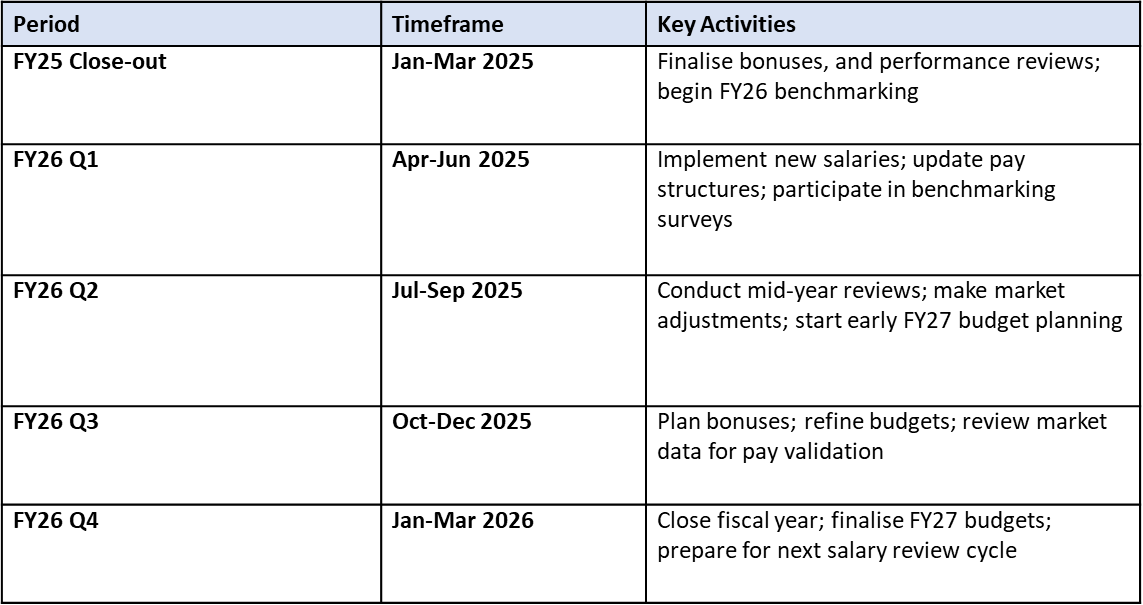
Best Practice: To stay aligned, firms should:
- Identify peer firms’ salary review months within each market.
- Incorporate effective date mapping into their benchmarking framework.
- Use multi-market benchmarking data carefully, ensuring timing equivalence.
3. Remuneration Components
Beyond base salary, FY cycles influence a range of pay elements linked to financial performance, including:
- Bonus pay-outs (individual and company performance)
- Long-term incentives (LTIs)
- Fixed overtime (e.g., Japan)
- Allowances (e.g., India, Mexico, Brazil, Belgium, UAE)
- Gratuity and pension contributions (e.g., India’s PF, Australia’s Superannuation)
- Profit-sharing
These components often follow fiscal performance outcomes, meaning that aligning benchmarking with FY cycles ensures accurate comparisons of total remuneration.
Risks of Overlooking FY in Benchmarking
Overlooking FY differences can lead to:
- Misinterpreted market data
- Mistimed salary reviews
- Inaccurate budgeting
- Loss of top talent
Global HR leaders often face additional complexity due to market-specific pay structures. For instance:
- France: Profit-sharing schemes (Participation and Intéressement)
- Belgium/Luxembourg: Representation allowances
- India: Gratuity and Provident Fund
- Australia: Superannuation
For multinational consulting firms, these considerations are interconnected. Failing to integrate such region-specific components into FY-aligned benchmarking can result in significant data inconsistencies and inaccurate pay comparisons.
Understanding Fiscal Naming vs Salary Validity
There is often confusion between fiscal year naming and salary validity.
For a firm with April 1, 2025 – March 31, 2026 (FY26):
- March 2025: FY25 ends.
- April 1, 2025: New salaries take effect (referred to as 2025 salaries).
- These salaries remain valid until March 31, 2026 (FY26).
In short: Even though the fiscal year is called FY26, the salary adjustments effective April 2025 are 2025 salaries, since they take effect in calendar year 2025.
Understanding this distinction prevents confusion when comparing data across firms using different fiscal and salary naming conventions.
Vencon’s Approach: Turning Timing Complexity into Benchmarking Clarity
At Vencon Research, we recognize that timing alignment is not just administrative — it is strategic. Our experience supporting consulting and professional services firms enables us to help HR leaders:
1. Align Benchmarking Cycles with Firm-Specific FY Structures
- Data Continuity: We collect and refresh data continuously, delivering “point-in-time” reports aligned with clients’ salary review cycles. For example: A survey with data up to June 30, 2025 remains valid through May 2026.
- Data Collection: Our questionnaires capture key timing details — salary effective dates, review periods, and bonus pay-out months — ensuring precise interpretation.
- Market Validity Mapping: We validate each market’s data against local pay cycle trends to prevent temporal distortion.
2. Interpret Market Data in the Correct Timing Context
- Example – Turkey: Due to high inflation and currency volatility, we collect data at a single point (e.g., 31 October 2025) for a realistic snapshot.
- Example – Bulgaria: With euro adoption scheduled for 1 January 2026, our pre-transition survey provides insights into how peers manage conversions, rounding, and timing communication.
3. Build Efficient, Data-Driven Review and Budgeting Processes
We help clients integrate benchmarking outcomes directly into budget planning tools, ensuring that FY-linked pay reviews and financial planning are data-driven, consistent, and actionable.
Strategic Implications
While fiscal calendars and salary reviews may appear technical, their implications for compensation benchmarking are strategic.
For consulting firms seeking to strengthen remuneration planning, improve timing, and retain high-performing talent, aligning compensation benchmarking with your financial year is a crucial practice. Reach out to Vencon Research to ensure your next review cycle is built on accurate, industry-specific data.

Understanding the EU's New Pay Transparency Directive
The European Union has introduced an important update to its regulations on pay transparency, aimed at addressing gender pay disparities and fostering greater fairness in salary practices across its member states.
This new legislation mandates that companies disclose salary information in job postings, provide employees with clear insights into pay structures, and allow individuals to understand how their compensation compares to others in similar roles. While this shift represents a major leap toward a more transparent and equitable workplace, it also creates new challenges and opportunities for businesses to adapt their compensation practices in line with evolving regulations.
What the EU Pay Transparency Directive Means for Employers
The EU’s Pay Transparency Directive, which will fully take effect by 2027, imposes several key obligations on employers. One of the most significant changes is that companies with 250 or more employees (and eventually 100 employees by 2031) will be required to disclose detailed pay data. This includes breaking down salaries by gender and role, a practice that will no longer be hidden behind confidentiality clauses or other restrictive policies. Companies will also be required to report this data on an annual basis, increasing visibility of any pay disparities and putting pressure on businesses to act.

Under the new rules, if a gender pay gap of over 5% is discovered, employers must conduct a joint pay assessment with employee representatives to investigate the cause of the gap and take corrective measures. This provision forces businesses to confront any existing disparities and make necessary adjustments to their compensation structures. Furthermore, employees will have the right to request pay information at any time, enabling them to negotiate more effectively and ensure fair treatment in salary discussions.
Ensuring Competitive and Fair Compensation
The introduction of these new transparency measures highlights the need for companies to stay competitive by offering fair compensation packages that align with market standards. With the increased visibility into pay structures, firms will need to be proactive in reviewing their compensation practices to ensure they meet legal requirements and reflect industry trends.
By using detailed, market-based data, organizations can make informed decisions about their pay structures, ensuring they attract top talent while maintaining equity within their teams. This becomes especially important as businesses seek to comply with the new EU regulations and avoid potential backlash for not addressing pay disparities.
Adapting to the New Regulatory Landscape
The EU’s pay transparency initiative is more than just a regulatory obligation; it is an opportunity for businesses to demonstrate their commitment to fair pay practices. Firms must act swiftly to ensure their compensation structures are not only compliant but also aligned with broader market expectations. This will involve examining not just salary figures, but the full spectrum of compensation, including benefits, bonuses, and other forms of remuneration.
For consulting firms, particularly those in industries with highly competitive labour markets, staying ahead of the curve in terms of pay equity and transparency will be essential. As firms adjust their compensation models to comply with new laws, they will also need to ensure they remain attractive to potential hires, particularly in an era where talent is at a premium.
Embracing Transparency, Strengthening Competitiveness
The EU's new Pay Transparency Directive marks a significant step toward reducing gender pay gaps and promoting fairness in compensation practices across industries. While these changes may pose challenges, they also provide an important opportunity for businesses to assess and refine their pay practices to ensure they are both competitive and compliant.
With full implementation set for 2027, companies will need to act quickly to ensure compliance and begin integrating the necessary changes. At Vencon Research, we are committed to helping consulting firms navigate these regulatory changes and build stronger, more equitable compensation structures. With a focus on providing detailed and relevant benchmarking data, we support our clients in maintaining compliance while ensuring they remain attractive employers in an increasingly transparent labour market. Through comprehensive, data-driven insights, businesses can confidently adapt to the new EU regulations and continue to foster an environment of fairness and competitive compensation.
At Vencon Research, we specialize in helping consulting firms adapt to regulatory shifts like the EU Pay Transparency Directive. Our detailed benchmarking data and HR expertise enable firms to build equitable and competitive compensation structures. Contact us today to stay ahead of the curve and demonstrate your commitment to fair pay practices.


Données utiles et fiables
Pour prendre des décisions éclairées sur les packages de rémunération dans votre secteur, vous avez besoin des données les plus récentes à portée de main.