

By Makar Evdokimov - Rewards Insights & Intelligence
Where does a consultant earn more: Germany, France or the United Kingdom? The answer depends on two choices made before any number is read: how pay is measured, and what is being compared with what.
Ask where a consultant earns more – in Germany, France or the United Kingdom – and you will usually get a confident answer. Yet the answer is less straightforward than it looks.
Consider a consulting manager in the UK. They earn about the same dollar amount as a counterpart in Germany. Adjust for local prices, and they fall 12% behind. Take contracted working hours into account, and the gap narrows to about 4%. Compare entire markets rather than offices of the same firms, and the UK manager comes out almost 9% ahead in US dollar terms. Four reasonable answers to what appears to be a single question.
There are two separate dimensions to getting these comparisons right:
- How compensation is measured: as an annual amount, adjusted for local purchasing power, or relative to contracted working hours.
- What is being compared: compensation levels across entire national markets, or differences between offices of the same international firm.
Both choices can materially change the result.
Why it matters for international firms
International compensation comparisons inform real business decisions:
- How much should a firm offer a consultant relocating abroad?
- How should location factors be set in a global grading structure?
- Is it more cost-effective to staff a project from one country’s office rather than another?
Each question calls for a different comparison. A relocation offer should reflect what the compensation buys at the destination. A location factor should reflect local market pay. A staffing decision needs to consider the cost of each contracted working hour. Choosing the wrong approach can shift the result by more than 10 percentage points.
To examine how much these choices matter, we analysed remuneration for comparable roles at 14 international consulting firms operating across Europe’s three largest consulting markets: Germany, France and the UK.
The first choice: how do you measure compensation?
Most international comparisons start with annual salary converted into a common currency. This is a reasonable starting point, but it shows how much money changes hands, not what that money buys or how much contracted time is required to earn it.
We therefore examine remuneration from three perspectives:
- Annual compensation (nominal): Gross annual total cash compensation converted into US dollars. This is the closest measure of the amount paid by the firm.
- Compensation adjusted for purchasing power: The same compensation adjusted for differences in national price levels, giving a better indication of what employees can afford with their earnings where they live. See Purchasing Power Parity (PPP) and Cost of Living Adjustment (COLA) in our knowledge base.
- Compensation per contracted hour: Purchasing-power-adjusted compensation divided by annual contracted working hours, accounting for differences in the time employees are expected to spend at work.
To keep the comparison consistent, each figure in this section compares employees at the same career stage – non-managerial (junior) and managerial (senior) – within the same firm. In other words, each firm’s offices in France and the UK are compared with its own offices in Germany. This isolates differences in how individual firms compensate comparable employees across countries, rather than differences between the firms themselves.
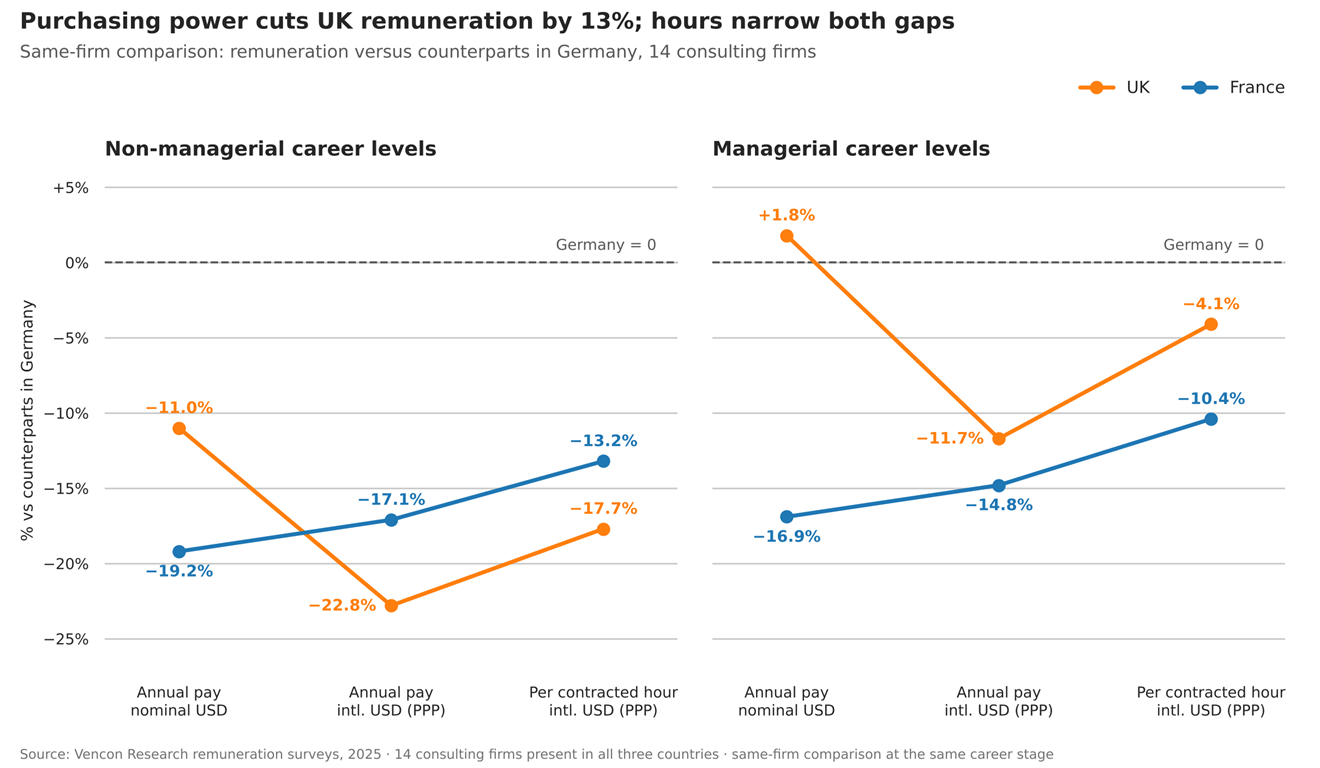
Looking only at nominal annual compensation, one might conclude that offices in Germany pay more almost across the board. Consultants in France earn 17–19% less than their counterparts in Germany, while UK remuneration sits about 4% below overall. That UK average, however, conceals two quite different career stages, as the chart shows.
Adjusting for purchasing power changes the picture considerably. The UK falls about 14 percentage points (pp) further behind Germany, reflecting its higher price levels relative to Germany at market exchange rates. France, where living costs are slightly lower, gains about 2pp.
Accounting for contracted working hours then moves both countries back towards Germany, by roughly 5 to 8 percentage points. An often-overlooked factor in international compensation comparisons is the contracted working time reported by the firms in the sample. In this analysis, German firms reported the longest contracted working year, which reduces Germany’s relative advantage when remuneration is expressed per contracted hour. This is a finding specific to our sample, not a general characteristic of the three consulting markets. A different set of participating firms could produce a different result.
For UK managers, the two adjustments partly offset each other. Their nominal annual compensation is broadly in line with that of their German counterparts, but they fall considerably behind once differences in purchasing power are taken into account. Their relative position improves again when the contracted working hours reported by the firms are factored in.
Change in each group’s compensation gap relative to same-firm counterparts in Germany, in log points (approximately percentage points at this magnitude), moving from nominal annual compensation to purchasing-power-adjusted compensation per contracted hour.
A caveat for France: how long is a working day?
The working-hours perspective requires an additional qualification for France. Many French managers are employed under contracts that specify working days rather than hours, so their compensation per hour depends on how long those days are assumed to be. Based on eight-hour days, they would earn slightly more per contracted hour than their German counterparts; based on ten-hour days, they would fall almost 19% behind. The contracted hours reported by the firms in our sample generally correspond to a nine-hour working day (see the sensitivity analysis under “Data and Methodology”).
This illustrates an important limitation of hourly comparisons. Contracted hours provide a useful basis for comparing remuneration, but they do not necessarily reflect the time employees actually spend working.
The second choice: what exactly are you comparing?
So far, we have compared offices within individual firms. This is one way to assess compensation differences across countries, but it is not necessarily the most appropriate approach for every business question. In practice, international salary benchmarking can answer two distinct questions.
1. The local market: what does the market pay for this role in France? A firm establishing or reviewing its compensation structure in France, or setting a location factor for the country, needs to understand local market conditions. Market medians provide precisely this information. See Survey Statistics for how medians and percentiles are used in benchmarking.
2. Differences within an international organisation: how does compensation change when the same job, within the same firm, moves from Germany to France? This is relevant to international transfers and relocations. Answering it requires comparing each firm’s own offices rather than country-level market figures. See also Expatriate Compensation and Secondment.
The distinction matters because the two approaches account for differences between firms in different ways. In a within-firm comparison, a company that pays relatively well across all its offices does not automatically raise the result for either country; what matters is the difference between its own offices. A market comparison, by contrast, places the middle of each country’s remuneration distribution side by side. Differences in firms’ international pay practices and the size of their workforces can therefore produce different results under the two approaches. The same logic underlies the difference between firm-weighted and incumbent-weighted market data.
We applied both methods to the same 14 firms and examined all three ways of measuring remuneration.
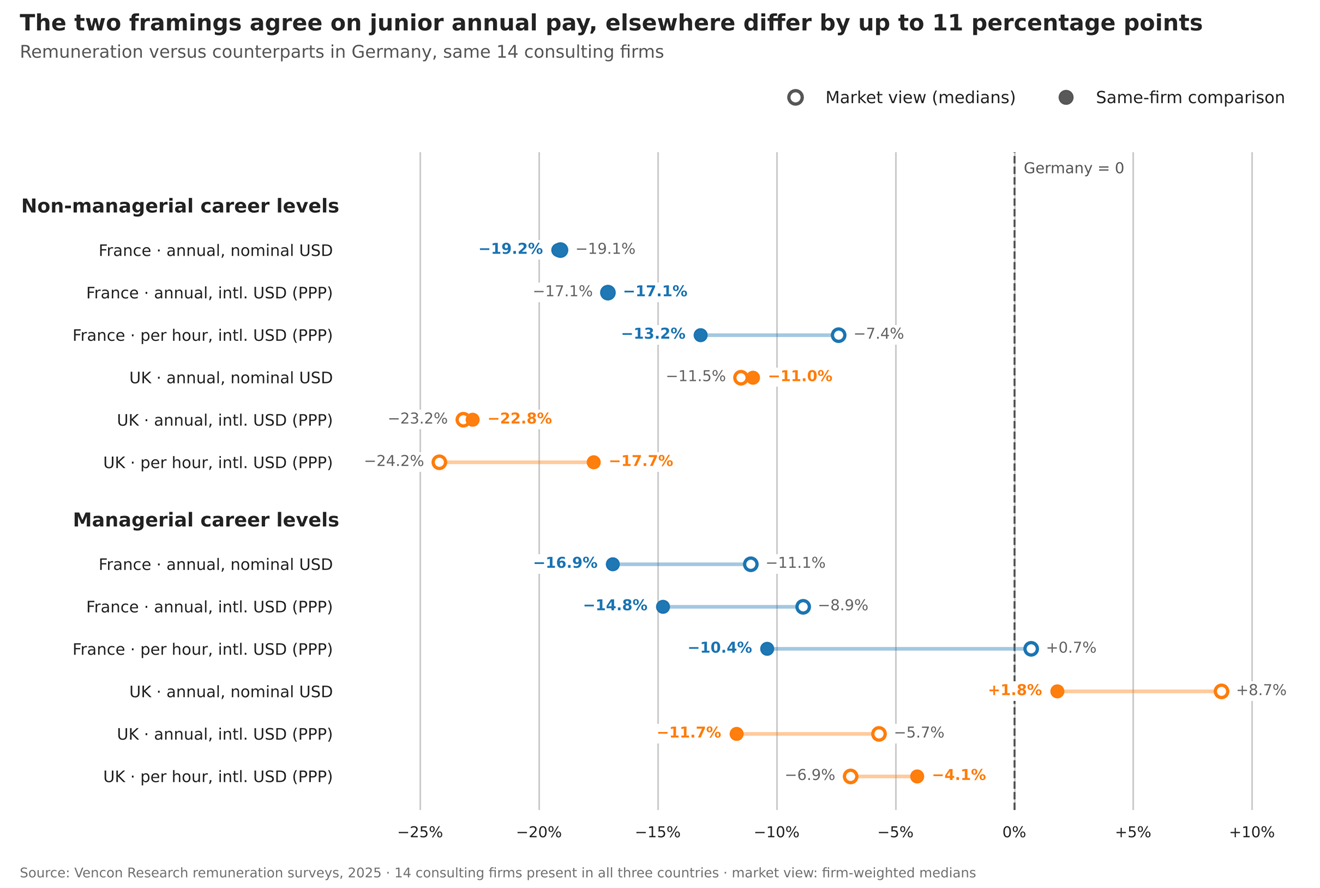
For junior employees on nominal annual compensation, the two approaches produce almost identical results. For managers, and particularly when comparing compensation per contracted hour, they diverge by as much as 11 percentage points. On a per-hour basis, managers in France earn slightly more than their German counterparts in the market comparison, but approximately 10% less in the within-firm comparison.
Neither result is wrong. Each answers a different question. The differences are most pronounced at senior levels and when working hours are taken into account, which is where differences in firms’ remuneration practices and working-time arrangements have the strongest influence.
What the comparisons have in common
Despite the differences introduced by the measurement and comparison methods, several findings remain consistent.
First, junior consultants in France and the UK earn less than their German counterparts across all three remuneration measures and in both comparison approaches.
Second, the UK’s pay progression between junior and managerial levels is consistently steeper than Germany’s. Junior employees in the UK sit well below their German counterparts, while UK managers reach comparable or higher compensation levels in US dollar terms.
This difference in career progression has important implications for international compensation structures. A single location factor applied across all career levels would fail to reflect the different pay relationships between junior and managerial positions. A factor calibrated to junior salaries could leave managers underpaid, while one based on managerial compensation could result in junior employees being overpaid. See Career Models for more on how progression is designed.
Findings that hold across different measurement and comparison approaches are particularly valuable. They indicate underlying differences that are not simply the result of methodological choices, and they provide a more reliable basis for compensation decisions.
Choosing the right comparison for the decision
International compensation comparisons rarely go wrong because of a lack of data. More often, the challenge is interpreting the numbers without first defining the question they are supposed to answer.
Is the objective to understand what a local market pays, or how compensation changes when an employee moves between countries within the same firm? Does the comparison need to reflect nominal salary, purchasing power or the cost of a contracted working hour? These choices determine which insights the analysis can provide and, ultimately, which business decisions it can support.
Our analysis shows that the choice of remuneration measure can change a compensation gap by up to 13 percentage points, while the choice between a market and a within-firm comparison can shift the result by up to 11 points. These differences are systematic, not statistical anomalies. Each approach answers a different question, which makes a clear definition of the business objective the starting point for meaningful international compensation benchmarking.
As consulting firms build teams across more markets, these comparisons become increasingly important. Vencon Research helps consulting firms understand local market compensation levels through its international benchmarking data, while our Advisory team supports more tailored analyses of cross-border remuneration structures and company-specific compensation questions.
Whether the objective is to assess market positioning, evaluate international pay differences or develop global remuneration structures, choosing the appropriate analytical approach is essential. Get in touch with Vencon to discuss how targeted compensation benchmarking can support your organisation.
Data and Methodology
Data
- Sample: 14 international consulting firms that participated in Vencon Research’s 2025 Consultant Salary Survey in all three countries. The surveys use the same remuneration definitions and job matching, making the figures comparable across countries.
- Career stages: Roles were grouped into two career stages, non-managerial and managerial, using Vencon’s responsibility-based job matching, applied consistently in every country. Each stage covers several job levels.
- Remuneration: Gross annual total cash compensation (base salary plus bonus); benefits and allowances are excluded.
- Currency conversion: Exchange rates as of 30 September 2025 for nominal figures; OECD purchasing power parities for actual individual consumption, 2025 (provisional), for purchasing-power adjustments.
- Working hours: Annual contracted hours as reported by each firm, rather than hours actually worked.
- Market comparison: Firm-weighted medians for each country and career stage, based on the same 14 firms. Hourly figures are medians of individual incumbents’ compensation per contracted hour.
The comparison methodology
Each within-firm result comes from a regression on individual incumbents in which every firm has its own baseline pay level:
log(pay_i) = α + β_c(i) + γ_ℓ(i) + λ_c(i)ℓ(i) + δ_f(i) + ε_i
- c = country (Germany is the reference)
- ℓ = career stage (non-managerial is the reference)
- f = firm
- The firm terms δ account for differences in overall pay levels between firms. Country differences therefore come from comparing each firm’s offices with one another.
- The interaction term λ allows the country gap to differ between managerial and non-managerial employees. The gap for a given career stage is calculated as exp(β + λ) − 1.
- Standard errors are clustered by firm.
In practical terms, the model calculates each firm’s pay difference between two countries at a given career stage and averages those differences across firms, with firms that have more incumbents carrying more weight.
The market comparison uses firm-weighted medians instead, so firms contribute according to their representation in the sample rather than the number of individual incumbents. This difference in weighting is one reason the two approaches can produce different results.
Three remuneration measures, two comparison approaches
Purchasing-power adjustments do not require a separate statistical model. Each conversion factor is a single figure for each country, so moving from nominal to purchasing-power-adjusted compensation shifts the country gap by a known amount without changing the underlying model or its uncertainty.
Compensation per contracted hour does require a separate model, because contracted hours differ between firms within the same country. The difference between the annual and hourly models is the contracted-hours adjustment shown in the table above.
Robustness check
Adding three further firms that reported in only two of the three countries changes the within-firm estimates by less than 1.5 percentage points.
Wild cluster bootstrap tests, designed for situations with a small number of clusters, confirm the France gap. With only 14 firms, we treat p-values as indicative and place greater weight on the stability checks.
Sensitivity analysis: working days in France
Many managers in France are employed under contracts that specify working days (typically 218 per year) rather than hours. Their compensation per hour therefore depends on the assumed length of each working day.
Limitations
- Sample representativeness: The results describe the 14 participating firms, not the entire consulting market in each country.
- Contracted vs actual working hours: Contracted hours do not necessarily reflect hours actually worked, and firms define standard working time differently. The per-hour figures are therefore the least certain of the three remuneration measures. Contracted hours are also specific to the participating firms and should not be interpreted as representative of national working-time practices.
- Gross vs net compensation: All remuneration figures are gross. Differences in taxes and social contributions between the three countries are not included. See Employer Contributions for the employer-side cost dimension.
- Purchasing power: Purchasing power parities are national measures and may understate living costs in expensive cities such as London and Paris.
Further reading
- Consultant Pay vs. Cost of Living in Germany’s Major Cities: 2025 and Beyond
- Expected Salary Increases 2026: Global Consulting Outlook
- Dedicated Data Mapping Is What Makes Benchmarking Work
- Allowances in Compensation: A Worldwide Overview of Pay Beyond Salary
- Download: Western Europe Consulting HR Stats 2024 to 2025
Related terms in the knowledge base: Purchasing Power Parity, Cost of Living Adjustment, Expatriate Compensation, Firm-weighted vs Incumbent-weighted, Competitor Set, Survey Statistics, Employer Contributions, Market Positioning