

By Yogendra Balayar - Rewards Intelligence & Insights
In brief: Administrative staffing needs shift in three main ways: through growth and expansion, through restructuring and transformation, and through changes in the talent market. In every case, reliable benchmarking data helps firms balance capability, competitiveness and cost.
Changes in business strategy, market conditions and organisational structures do not only affect a consulting firm’s consultants and client-facing teams. They can also have significant implications for the administrative and support functions that underpin its operations.
Whether a firm is expanding into new markets, developing new service lines, restructuring its organisation or responding to changing client demand, its requirements for administrative personnel are likely to evolve. The challenge is not necessarily to increase or reduce headcount, but to ensure that the composition, capabilities and cost of the support workforce remain appropriate for the firm’s needs.
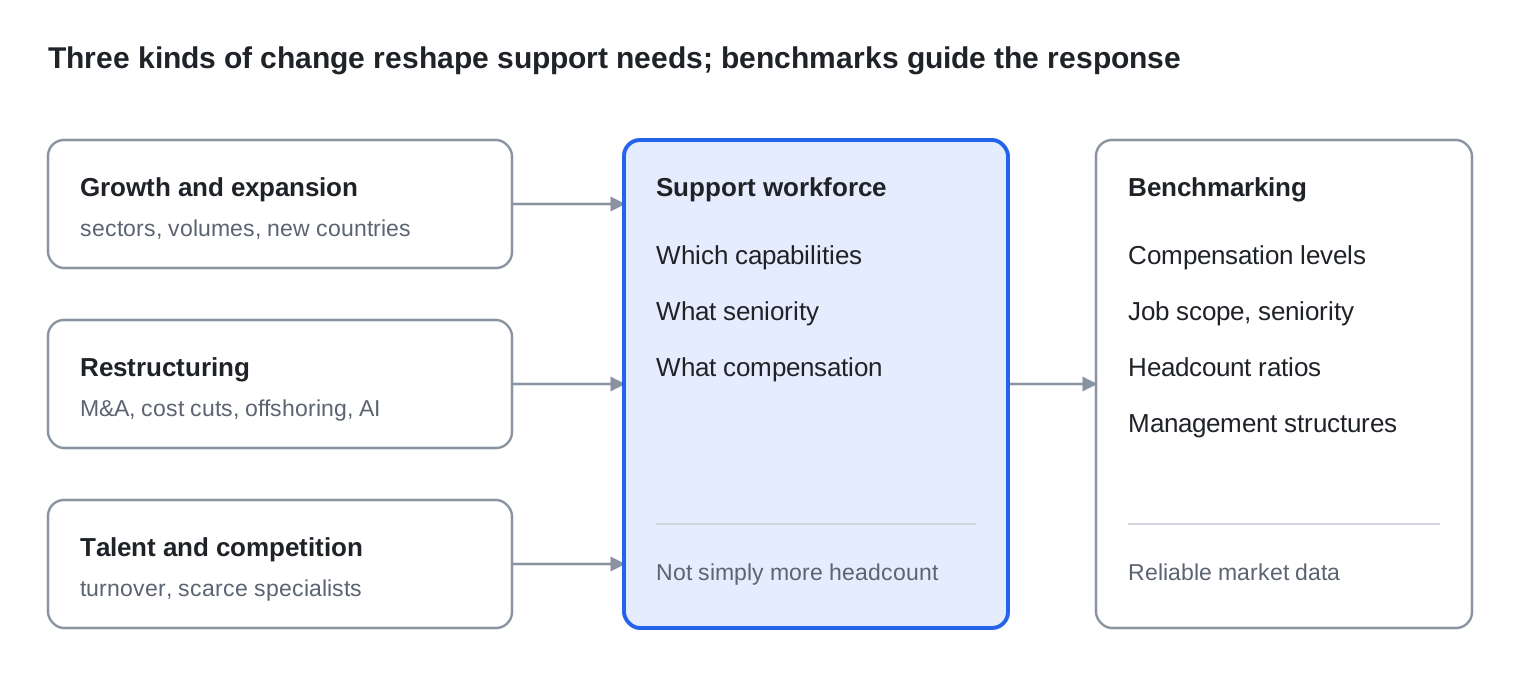
Growth, restructuring and talent pressures each change what the support workforce needs; benchmarking data shows how to respond.
At a glance: business developments and their staffing impact
Growth and expansion
Targeted growth in particular sectors or service lines can create demand for additional business development, marketing, proposal management, research and specialist support personnel. Similarly, increasing client demand and project volumes may require more project coordinators, resource planners, billing administrators and engagement support staff.
Rapid overall growth can have wider implications, requiring firms to expand their HR, recruitment, finance, IT and general administration functions. As organisations become larger, they may also need additional functional managers and more specialised positions.
Geographic expansion presents a different set of requirements. Entering a new country or establishing a regional office can create demand for local HR, finance, payroll, compliance, recruitment and office management capabilities. As international operations develop, firms may also need regional management positions and more sophisticated coordination between local offices and central functions.
In each case, the objective is not simply to recruit additional employees. Firms must establish:
- which capabilities are required,
- what level of experience is appropriate, and
- how compensation compares with the relevant local or international talent markets.
Organisational restructuring and operational transformation
Changes to organisational structures can have equally significant consequences for administrative staffing.
- Mergers and acquisitions may initially increase demand for HR, finance and systems integration support, while subsequently creating opportunities to consolidate overlapping functions.
- Restructuring and cost reduction programmes can lead to the redistribution of responsibilities, consolidation of positions and removal of management layers.
- Centralisation, outsourcing and offshoring can change the balance between local administrative teams and centralised service functions.
- Digital transformation and the adoption of AI introduce another dimension. While automation may reduce the need for certain routine administrative activities, it can increase demand for IT specialists, data management, automation expertise and employees responsible for overseeing new systems and processes.
These developments often change the nature of existing positions rather than simply eliminating or creating jobs. Employees may take on broader responsibilities, more specialised tasks or greater managerial oversight. This can have implications for appropriate job grading, seniority and compensation.
Changing talent and competitive requirements
Not all staffing changes are driven by organisational growth or structural transformation. Firms may also need to reconsider their administrative workforce in response to recruitment difficulties, employee turnover or increasing competition for specialist talent.
For example, difficulties attracting experienced HR professionals, financial controllers, IT specialists or compliance personnel may require firms to review their compensation packages and employment propositions. Increased investment in recruitment, talent management, learning and development or employee experience may also become necessary to improve retention.
At the same time, changes in partnership structures, regulatory requirements and operational complexity can create demand for more senior or specialised support positions. Areas where the need for experienced personnel may become more pronounced include:
- partnership administration
- governance
- financial reporting
- risk management
- information security
In these situations, competitive compensation is important not only for filling vacancies but also for retaining institutional knowledge and ensuring that critical support functions operate effectively.
Balancing capability, competitiveness and cost
Across these different circumstances, consulting firms face a common challenge: ensuring that their administrative workforce is appropriately structured, sufficiently capable and economically sustainable.
Increasing headcount is not necessarily the right response to greater business activity. Firms may instead need to improve productivity, redistribute responsibilities, invest in more experienced employees or introduce more efficient processes.
Equally, reducing administrative costs should not come at the expense of essential capabilities. Underpaying specialist employees, for example, can make recruitment more difficult, increase turnover and ultimately undermine operational efficiency.
Finding the appropriate balance requires an understanding of both internal requirements and external market conditions. Firms need to know:
- whether their compensation levels are competitive,
- whether their positions reflect the responsibilities involved, and
- whether their staffing structures are broadly in line with relevant market practice.
The role of compensation and organisational benchmarking
Reliable market data can support these decisions in several ways.
- Compensation benchmarking helps firms assess salary levels, bonuses and benefits against relevant competitors, supporting both recruitment and retention while providing a basis for managing personnel costs.
- Job benchmarking is equally important when new positions are introduced or existing responsibilities change. Comparing roles based on their actual scope, complexity and seniority helps ensure that compensation remains appropriate as organisational structures evolve.
- Workforce comparisons provide useful context. Administrative headcount ratios, functional staffing distributions and management structures can help firms assess how their support functions compare with those of other consulting organisations.
The relevance of these comparisons will depend on the circumstances. A firm entering a new country may prioritise local salary levels and the availability of specialist talent, whereas an organisation undergoing restructuring may be more interested in functional structures, job responsibilities and compensation costs.
A Foundation for Sustainable Performance
Administrative and support functions should not be viewed simply as an overhead to be increased or reduced in response to changing business conditions. They are an important part of a consulting firm’s operating capability. Ensuring that these functions have the right people, skills and organisational structures, while maintaining competitive and sustainable compensation levels, is essential to supporting the firm’s wider business objectives.
Further reading
- HR & Compensation Knowledge Base: definitions of key compensation and HR terms
- Administration & Support Staff Survey: benchmarks for support roles
- From Support to Core: The Rise of Delivery Centers in Consulting
- Consulting Faces Intensified Talent Competition from Tech and Finance
- Shifting Patterns in Global Consulting Demand: A Benchmarking Analysis
- HR Trends in Consulting for 2026
Related terms in the knowledge base: Benchmarking, Job Matching, Job Architecture, Headcount Planning, Delivery Centre, Talent Acquisition, Talent Retention, Employer Value Proposition