

By Shukhrat Iskandar - Client Solutions
The EU Pay Transparency Directive moves into effect in 2026 and represents one of the most significant regulatory changes affecting compensation management in decades. From mid-2026, Member States are required to have transposed the Directive into national law, after which employers will face new, enforceable obligations around pay transparency, reporting, and employee rights to pay information. Designed to strengthen equal pay for equal work or work of equal value and to close persistent gender pay gaps across Europe, the Directive introduces legally binding measures that go beyond most existing national frameworks, reshaping how organisations define, structure, communicate, and justify pay.
Key Requirements of the Directive
Once transposed into national law, the Directive introduces a set of binding obligations for employers across the EU, including:
- Pay transparency in recruitment: Employers must disclose the starting salary or pay range in job advertisements or prior to the first interview, and may not ask candidates about pay history.
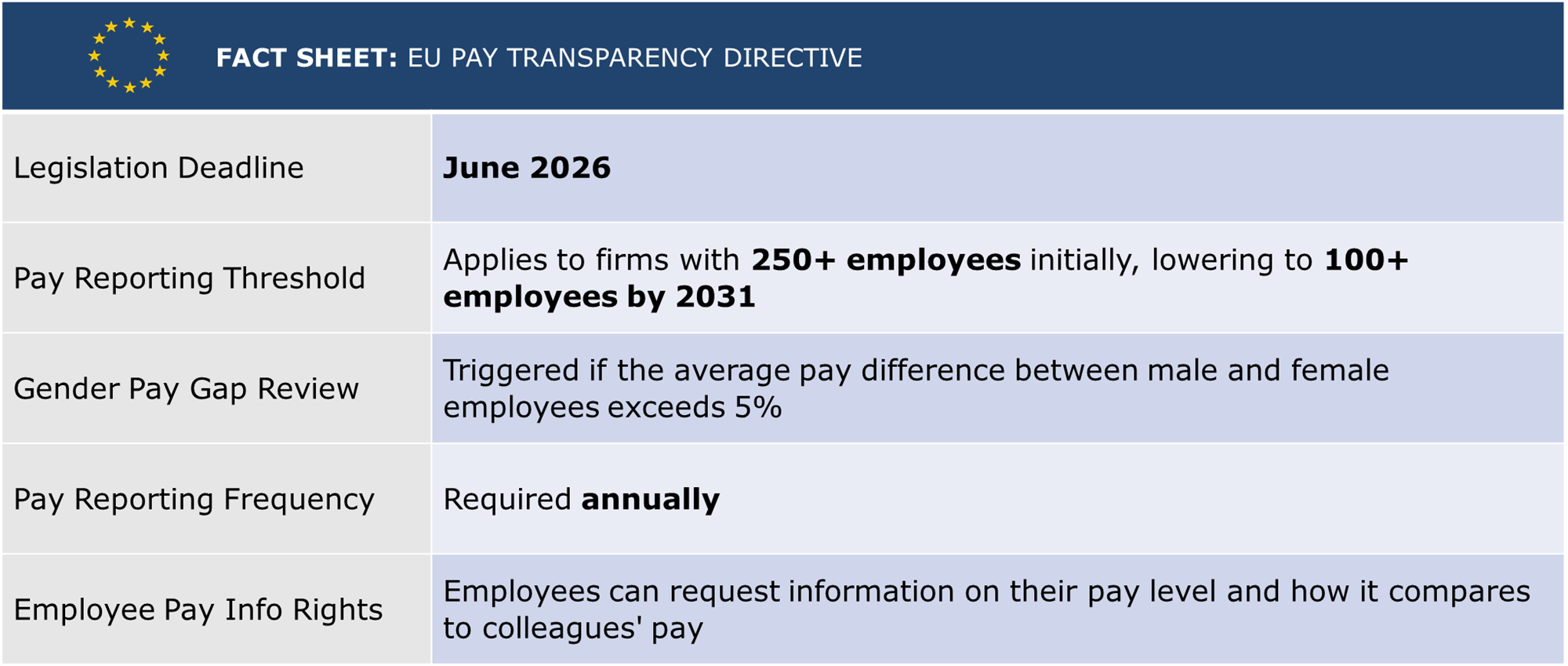
- Employee rights to pay information: Employees can request information on their own pay and on average pay levels for comparable roles, broken down by gender.
- Gender pay gap reporting: Employers with 250+ employees must report annually, with the first reports due in 2027. Employers with 150–249 employees will report every three years from 2027. Employers with 100–149 employees will be brought into scope later under phased national timelines.
- Mandatory corrective action: Where a gender pay gap of 5 percent or more cannot be objectively justified, employers must conduct a joint pay assessment and take remedial action.
- Broader discrimination coverage: The Directive explicitly covers intersectional discrimination, and affected employees are entitled to compensation.
EU Member States must transpose these requirements into national law by 7 June 2026, after which enforcement and reporting obligations will apply according to employer size.
Why the Directive Matters
Despite decades of policies aimed at promoting pay equity, the gender pay gap in the EU remains around 12 percent on average. Structural opacity in pay systems has made it difficult for employees to understand how pay is determined and for authorities to detect discrimination. By mandating transparency, the Directive seeks to transform pay equity from principle into practice.
Improved transparency has the potential to generate meaningful benefits. Research by labour unions suggests that even modest reductions in pay gaps could translate into significant annual earnings increases for many workers. Beyond compliance, transparent pay systems also foster trust with employees, strengthen employer brand, and enhance talent attraction.
Current Organisational Readiness
Recent surveys indicate that many organisations are still in the early stages of preparing for the Directive. A 2025 survey of HR professionals in Germany found that only one in three HR managers were familiar with the Directive’s details. Nearly half of respondents expected implementing the changes to take more than six months, and many cited concerns about additional workload and potential internal conflicts. At least ten EU Member States had taken no steps toward implementation by late 2025, while others were in draft or partial stages of preparation.
Implications for Compensation Teams
The Directive has several practical implications for compensation and HR teams:
- Compensation Structure Review and Redesign: Organisations must ensure that pay structures are defensible under transparency scrutiny. Broad pay grades and informal pay practices must give way to clearly documented, objective, and gender-neutral criteria. Pay decisions must align with job architecture and evaluation systems.
- Pay Gap Reporting and Analytics: Teams must collect, analyse, and report pay data by gender and pay category. This requires accurate, governed data, structured processes for analysis, and mechanisms to address pay gaps exceeding five percent without valid justification.
- Recruitment and Job Advertising: Salary transparency now requires organisations to include pay ranges in job postings or provide this information early in the hiring process. Compensation teams must carefully define salary bands to maintain internal equity once disclosed publicly.
- Talent Attraction and Employer Branding: Transparent pay practices can become a competitive advantage, attracting top talent and building trust with employees and candidates.
Practical Steps to Prepare
To meet the Directive’s requirements, organisations should begin preparations immediately:
- Educate HR, legal, finance, and executive teams about the Directive’s scope, timelines, and obligations.
- Audit pay data, job classifications, and pay bands to identify gaps or inconsistencies.
- Update job evaluation methodologies and pay policies to align with objective, gender-neutral criteria.
- Build repeatable processes for ongoing pay gap reporting and data governance.
- Prepare internal communication strategies to ensure transparency changes are understood and culturally supported.
- Consider technology solutions that automate data collection, reporting, and analytics to improve efficiency and accuracy.
Starting these steps early helps avoid rushed implementation and positions organisations for long-term compliance and pay governance improvements.
Challenges to Anticipate
Even with preparation, compensation teams will face challenges:
- Policy complexity as countries may interpret the Directive differently, creating a patchwork of requirements for multinational organisations.
- Incomplete or inconsistent pay data, which can make reporting difficult without strong governance.
- Sensitive internal discussions around pay transparency, requiring careful communication to maintain trust.
Non-compliance carries legal risk and can damage employer brand and employee trust.
Turning Compliance Into Advantage
While the EU Pay Transparency Directive introduces increased scrutiny and workload, it also offers an opportunity. Organisations that approach transparency strategically can strengthen pay governance, improve employee trust, and enhance employer branding. Clear, fair, and well-structured compensation systems will not only meet legal requirements but also provide a competitive edge in attracting and retaining talent.
For compensation teams, the Directive represents a clear mandate: transparency is coming, and the question is whether it arrives as a disruption or as a capability the organisation is ready to lead.
Supporting Pay Structures Under Increased Scrutiny
Vencon Research advises organisations on how to prepare pay structures for the practical realities of pay transparency. Using market-aligned benchmarking data, we help compensation teams test pay ranges, job matching, and progression frameworks against external practice and identify areas of potential exposure ahead of implementation.
Our advisory work goes beyond supplying data. We work with clients to interpret market evidence, assess pay gap risk, and ensure that pay decisions can be clearly explained to employees, leadership, and regulators once transparency requirements apply.
More information on our advisory services is available here.