

Dernières publications

Essential Indicators for Effective Compensation Benchmarking Strategies
By Veronika von Strachwitz-Camara - Business Development
In compensation management, a thorough understanding of market trends is essential for businesses aiming to attract and retain talent. This understanding is often gained from salary survey reports, which provide the crucial data points for crafting competitive compensation strategies.
Here, we explore the key indicators highlighted in Vencon Research salary surveys and how they inform decision-making across talent management scenarios.
Client Priorities: Focusing on Essentials
Clients consistently emphasize the usefulness of several key indicators from our salary survey report that help them get the insights they need to focus their compensation strategies.
Total Cash Compensation (TCC) Medians per Career Level:

This metric offers a comprehensive view of compensation, including base salaries and bonuses, serving as a fundamental benchmark.
Alongside Basic Salary and Bonus, Total Cash Compensation is presented in a separate tab, both for the current and previous year as well as in firm and incumbent weighted (link) forms. It is also viewable in the accompanying PDF presentation, as well as via the dashboard.
TCC offers the quickest overview of compensation in the market, while our percentile breakdown indicates the prevalence and level of variance from the median.
Basic Salary Medians per Career Level:

This view provides insights into salary structures across different career levels. Basic salary as a metric is essential for understanding baseline compensation.
Our reports present all data broken down into 5 career levels with 3 sub-levels each. These levels are carefully matched against participants own career structures to ensure like-for-like comparison.
Bonus Medians per Career Level:

Bonuses are integral to compensation packages, and understanding bonus medians helps assess reward structures and performance-based incentives. Bonuses are presented both in monetary value as well as in percentage of basic salary form.
Once again, we present not just the median but the full percentile scale, and allow for comparison with your own firm’s basic salary.

While the median serves as a reliable reference point for many firms, ambitious enterprises may explore higher percentiles for competitive insights.
Firm-weighted Salaries:
For smaller firms, firm-weighted salaries ensure balanced analyses reflective of diverse organizational landscapes.
The choice between firm-weighted and incumbent-weighted data depends on organizational size and preference. We recommend watching our three-minute video on the topic for a concise introduction to the difference in each approach.
Utilization of Data: Practical Applications
Beyond mere observation, clients utilize the data in our reports in various ways:
- Market Positioning Assessment: Well organised compensation data allows organizations to understand their competitive stance within the industry, including employee reactions to compensation changes, turnover trends, and job satisfaction levels.
- Global Teams Harmonizing Salary Ranges: Multinational corporations leverage survey data to align compensation frameworks across regions, empowering local HR teams to refine offerings.
- Strategic Recruitment: Key indicators inform the crafting of compelling compensation packages to attract both junior and senior talent, ensuring competitiveness in the talent market.
- Retention Strategies: By benchmarking against industry standards, organizations identify retention risks and implement targeted interventions to foster loyalty.
- Bonus Allocation: Insights from bonus medians and payout ratios guide organizations in strategically distributing bonuses based on performance and market benchmarks.
Tailoring Indicators to Needs
Different talent management scenarios require emphasis on specific indicators:
Recruiting Junior Levels:
Basic salary medians and bonus structures provide insights into entry-level compensation and growth potential.
Recruiting Senior Levels:
TCC medians and bonus potential are crucial for senior candidates assessing overall value propositions.
Retention Strategies:
Comparative analyses of salary increases aid in identifying retention risks and devising targeted retention strategies for each career level.
Bonus Allocation:
Analysis of bonus medians and payout ratios ensures fair and strategic bonus allocation aligned with performance metrics.
An Invaluable Tool for Compensation Management
Salary survey reports are invaluable tools for compensation management. By understanding key indicators and leveraging data-driven insights, businesses can develop competitive compensation strategies that attract, retain, and motivate top talent effectively.
Find out more about Vencon Research's Consultant Salary Survey here.
As a trusted HR partner for the consulting industry, Vencon Research is here to help you unlock the full potential of your team. Contact us to learn more about how we can support your HR needs and drive success for your business.
.jpg)
Embracing Evolution: Why Generalist Consulting Firms Must Harness Specialist Talent or Risk Falling Behind
By Philip Thomas – Senior Consultant, Advisory
Increasing demand for specialist knowledge across a range of industries means that generalist consulting firms are having to adapt in order to compete. The solution of choice is an increase in the hiring of specialist talent. This calls for evolution not revolution. Firms that evolve successfully and first will be well placed to be at the front of the race for such talent.
An increasing demand for specialisation
Across all major industries, businesses are hurting from a severe lack of internal specialist expertise. The open labour market is unable to satisfy their need for talent. As a result, they turn to consulting firms and demand ever-increasing levels of specialisation to ensure the quality of the tailor-made solutions required. For consulting firms, client impact increasingly requires deep knowledge in niche areas such as digital, blockchain, cybersecurity, climate and sustainability, data science, etc.
Specialist consulting firms, by their nature, may be well placed already. Generalist consulting firms, however, need to react if they have not already done so.
Tapping into the specialist talent pool
Not all personalities suit the traditional generalist consultant role. Requirements to resolve poorly defined problems, to be flexible enough to fill any resource gaps and to work towards leadership positions where people management and dealing with the unknown is a common theme is not only not suitable but also simply not desirable for some individuals. Many such individuals are actively searching for a different career path and they may well be looking to specialise.
Specialists (also sometimes referred to as experts or subject matter experts), with their deep subject knowledge, have strong problem-solving abilities with respect to their speciality. By nature of experience and proven, known solutions, their approach to work is streamlined and efficient. Given their subject matter passion, they actively seek specialist roles that suit their skills, interests and career goals best rather than force fitting themselves into alternative career scenarios they may consider less satisfying.
When given the opportunity to do so, specialists find places to excel. They find a home where their talents thrive and their subject matter passion can be nurtured and maximally leveraged.
Leading generalist firms are already evolving
A number of generalist consulting firms, ahead in the rapidly advancing game, have already partially evolved. They have recognised that no single career path suits all possible talent. Such firms are becoming more flexible and creative with respect to offering differing, alternative types of careers.
Specialist career tracks are now being offered by increasing numbers of generalist consulting firms, as well as many of the top-tier strategy-oriented firms, including Bain, BCG and McKinsey. These specialist tracks typically differ from generalist tracks in a number of ways, including:
Less client-facing time: Specialists are typically less client facing than generalists, often working across multiple project teams while focussing on the same topic.
Career path: The path to partnership is not yet common. In many cases Specialists will not have a path to partnership. In these cases, career levels before partnership are viewed as landing positions and this was historically accepted by the incumbents. However, with the large increase in the number of specialists working for consulting firms, more and more firms are developing specific tracks, which do provide specialists with a path to partnership.
Progression timeline: The timelines for progression on specialist tracks are less rigid. There is often no up-or-out policy. Actual timelines can vary considerably from very quick to relatively slow.
Performance evaluation: While performance expectations are broadly similar to generalists (i.e. utilisation), a specialist’s knowledge and expertise form a much more significant portion of their evaluation and therefore more heavily influence their ultimate success.
Pay: Many firms offer comparable pay. However, specialists carry high credibility due to their deep level of knowledge and experience. This may allow consulting firms to charge higher fee rates for specialist services, so in some cases specialists are able to demand higher salaries. Interestingly, at the most ‘senior’ career levels, specialists may currently lag behind their generalist peers.
Aside from dedicated specialist tracks, many firms are also hiring more specialist consultants but on generalist tracks while allowing for increased specialisation.
Challenges on the road to specialisation
Generalist consulting firms wanting to catch up with the trail blazers are faced with two key and immediate challenges. Those being the limited supply of specialist talent and the need to evolve in order to attract and retain such talent.
Key Challenge #1: The race for specialist talent is already well under way with some firms setting an early pace while others are yet to leave the starting blocks. The mad dash to the always moving finish line is yet to begin. When it does, the intensity of the race will rapidly increase as more and more firms attempt to attract talent from a decreasing supply of specialists.
The longer firms wait, the harder it will become for them to secure the talent they need to compete. To compound the problem, once the supply of specialists starts to run dry, it may take significant time before it is replenished considering the time and effort it takes to reach a certain level of specialisation.
Key Challenge #2: Generalist consulting firms need to become more attractive to specialists. Firms will need to evolve in order to attract the increasingly confident and vocal specialist labour force. Robust and competitive specialist career tracks, sufficiently attractive to specialists but not to the detriment of generalists, must be created and installed. Informed action by firms should be decisive and taken before too long or they may get left behind.
Some firms have a healthy head start with their evolution in this respect. However, with such a dynamic situation, even those that have paved the way so far would do well not to rest on their laurels. We also believe signals coming from the labour market show that candidates are demanding more bespoke career tracks beyond the existing generalist track.
In short, consulting firms should not be asking what specialists can do for them, but what they can do to become attractive to the specialists.
Evolution not revolution
The foundations built on generalist consultants are solid and the demand for the broad expertise of generalists will not disappear. Client demand for specialisation, however, does necessitate the evolution of generalist consulting firms. They will need to evolve by harnessing the power and deeper expertise of specialist consultants. Those firms that fully embrace the importance of specialists and those firms that make themselves more attractive to specialists by offering desirable and specific career tracks will have a major advantage in an increasingly competitive race.
Note: We use the term specialists in this article for simplicity and to avoid inferring that generalists are not experts in their own way.
For more information on this topic or on how you may successfully respond to the issues raised in this article, please contact Vencon Research – as always, we are happy to assist you.

Gender-based Pay in Western Europe's Consulting Industry
By: Irina Kvirikadze – Senior Manager Data Integrity
The gender pay gap, i.e. the disparity in pay between people of different genders, rightly counts among the leading topics in today’s business world, even more so in Western European countries. In this context, the consulting industry is usually expected to be at the forefront of efforts to ensure greater equality. But what does the data actually say?
In this article we take a closer look at the consulting industry in Western Europe, and explore the issues with and implications of gender-based pay in more detail.
What the data says
According to Eurostat[1], gender pay equity in European countries varies significantly. When examining some of the major Western European countries, the unadjusted pay gap level in France is over 15%, in Germany almost 18%, and in Italy only 5%. According to the government’s 2022 Equality Act publication[2], in the United Kingdom the median pay gap is close to 10%. According to the same report, the gap is much higher in the private sector (which would include the consulting industry).
Overall, the consulting industry is notable for its high salaries and competitive work environment. Moreover, consulting firms working in North American and in Western European countries are often regarded as leading advocates for gender equality and greater diversity. Most of these firms have already implemented numerous initiatives in favour of equal pay across the industry[3].
Nevertheless, according to Vencon Research survey data, which includes both the largest full-service firms across Europe, as well as Europe’s significant boutique firms, women with the same level of education, experience or responsibilities, continue to face salary pay gaps when compared to their male counterparts. Furthermore, there are notable differences between countries in terms of the prevalence of a gender-based pay gap. For instance (as shown in table 1 below) France shows a pay-gap of 18%, the UK of 23% and Germany of 27%. Italy shows the smallest gap of the four countries but remains significant at 9%.

Furthermore, pay gap inequalities appear to be even more significant when comparing the managerial levels and less prominent at non-managerial positions, meaning, as one moves up the consulting career path, the pay gap begins to widen.
In France, for example (as shown in table 2 below), the pay gap at non-managerial levels is 5%, whereas at higher rank positions it is 30%. A similar situation can be found in other countries too, with the UK showing a pay-gap of 12% at non-managerial levels and 33% at higher rank positions, and Germany having the highest pay gap discrepancy at non-managerial as well as at senior consulting levels, 14% and 39% respectively.

Italy again has the lowest pay gap out of the four countries, in managerial positions men earn more than women by 23%. In non-managerial positions however, it seems women earn more than their male counterparts. This ‘negative’ pay gap may be driven by the fact that we have found that women in consulting in Italy tend to have a longer tenure in non-senior roles than their male counterparts.
What are some of the drivers of this issue?
There have been a number of studies that examine underlying factors that contribute to the gender pay gap. As previously mentioned, one reason may be that despite the introduction of antidiscrimination policies, gender biases may still be ‘unconsciously’ applied, meaning women may be overlooked for leadership roles, remaining relegated to lower ranking positions and thus do not have the same access to the more lucrative senior roles with better advancement opportunities.
Male versus female representation at senior career levels
Vencon Research’s survey data seems to support the notion that women may be staying longer in certain positions. In fact, male consultants typically reach partner level faster than their female counterparts, who tend to take more time off due to family related reasons and may return to work as part-time employees[4]. This, on the other hand, decelerates their promotion to management levels and may also negatively impact their earning capability.
As shown in table 3 below, the number of female professionals in all four countries in this comparison starts to decrease as one moves to the more senior or managerial levels. This on the other hand, highlights the fact that a significant gender imbalance at the higher-ranking positions remains and that female consultants at senior levels are still underrepresented.
Addressing this issue is also essential as studies show that diverse teams achieve greater success[5]. Moreover, in comparison to their male colleagues at the same level, female leaders seem to achieve a greater level of “employee well-being”, which in turn increases retention rates and employee satisfaction[6].

What can consulting firms do to address the gender pay gap?
There are several steps consulting firms can implement in order to narrow or ideally close the gender pay gap in particular at managerial levels.
The first step is to regularly audit and identify within the firm any pay disparities between male and female colleagues. This will help to ensure fair pay as well as increase transparency around salaries.
In order to support women to balance work and family responsibilities, companies can implement more flexible work arrangements such as flexible schedules, instead of a clock-in-clock-out system and offer remote work options[7]. This can help retain talented female employees and on the other hand, ensure that they are not penalised for taking time off for family related reasons.
Furthermore, it is clear that this complex issue requires a multifaceted approach not only from businesses, but society as a whole. However, firms can and should do more to address gender-based unconscious biases in the workplace, through training and educational programmes, raise awareness and promote a more inclusive work culture. Being pro-active in this matter will help managers recognise and correct their own biases and allow them to make promotion or hiring decisions that do not overlook women for leadership positions. It will also help to increase the number of female consultants at managerial positions and thus reduce the gender-based representation disbalance.
Concluding thoughts
Management consulting firms in Western European countries are at the forefront of efforts to promote gender equality measures, however, they still face significant problems in closing the gender pay gap. There are notable differences among countries, but the general trend is the same, at the non-managerial positions pay disparity between men and women is narrower (or even negative) and female consultants are more represented, while at managerial positions the salary gap is significantly wider and women remain underrepresented.
In conclusion, much work remains to be done to ensure that women are paid fairly and equitably and that they are not only relegated to lower ranking positions. By continuing to implement equal-pay initiatives, such as pay audits, flexible or remote work arrangements and unconscious bias training, consulting companies can help close gender pay disparities, balance gender representation at managerial levels and create a more inclusive work place for all employees.
Sources:
[1]https://ec.europa.eu/eurostat/statistics-explained/index.php?title=Gender_pay_gap_statistics#Gender_pay_gap_levels_vary_significantly_across_EU
[2]https://www.gov.uk/government/publications/dit-gender-pay-gap-report-and-data-2021-to-2022
[3]https://www.ft.com/content/c8118e14-143e-11e9-a168-d45595ad076d
[4]https://managementconsulted.com/gender-pay-gap-consulting/
[5]https://www.cipd.co.uk/knowledge/fundamentals/relations/diversity/managing-multicultural-teams
[6]https://www.mckinsey.com/featured-insights/diversity-and-inclusion/women-in-the-workplace
[7]https://consultport.com/for-consultants/how-do-we-get-more-women-into-consulting/

From Support to Core: The Rise of Delivery Centers in Consulting
By Gunjan Kalwani - Rewards Intelligence & Insights
The consulting industry is constantly evolving in response to changing client needs. Traditionally focused on strategic advice delivered by small, specialized teams, consulting firms are now increasingly responsible for implementing large-scale transformations, building technology platforms, and operating data-driven systems.
At the core of this shift is the expanding role of delivery centers. These are centralized hubs supporting projects through analytics, tech development, research and knowledge management. Once seen primarily as a support function, they are now integral to a consulting firms’ global operating models.
As their role shift, firms are placing greater emphasis on compensation for the delivery center workforce to maintain productivity, competitiveness and scalability.
Redefining the Delivery Center
Delivery centers have evolved from limited support functionality into integrated capability hubs that combine analytics, engineering, research, and knowledge management within a single operating layer. Their remit now extends far beyond slide production or background research.
They play a direct role in hypothesis testing, model development, platform buildout, and increasingly, in client implementation. In parallel, they underpin internal capability building—maintaining knowledge assets, supporting proposal development, and enabling cross-office collaboration at scale.
Firms such as Accenture and the Big Four have long operated global delivery networks and are constantly expanding. Strategy firms such as Boston Consulting Group and Bain & Company have also expanded their capability networks to support more technical and research driven engagements.
Geographically, these networks continue to concentrate in markets such as India, Poland, the Philippines, and Mexico. However, location strategy is becoming more nuanced—balancing cost with specialization, attrition risk, and proximity to key client markets.
From Support Function to Operating Model
The novelty of the delivery center model lies in how it reshapes the economics of consulting.
Historically, leverage was driven by pyramidal team structures within a single geography. Today, leverage is increasingly driven by the interaction between client-facing consultants and distributed capability pools. This creates a dual workforce model: one optimized for client engagement, the other for scalable execution.
This shift introduces new complexities:
- Role fragmentation: Traditional consulting roles are being decomposed into more specialized skill sets (e.g., data engineering, machine learning, UX design).
- Blended team structures: Project teams now span multiple geographies and cost bases, requiring tighter coordination and clearer role definition.
- Different productivity curves: Output is no longer measured purely in billable hours, but in throughput, reusability of assets, and speed of delivery.
In effect, delivery centers are not just supporting consulting work—they are redefining how it is produced.
Compensation Design in a Distributed Workforce
As delivery centers mature into a core part of the consulting operating model, compensation can no longer be managed as a simple extension of traditional consulting pay structures. The underlying workforce is fundamentally different—more specialized, more location-sensitive, and more exposed to external talent markets beyond consulting.
This requires a shift from benchmarking as a periodic exercise to compensation design as an ongoing, structured process.
Two challenges stand out:
- Role definition and comparability Delivery center roles often sit at the intersection of consulting, technology, and operations. Standard job titles rarely map cleanly to external benchmarks. Without precise job matching, compensation decisions risk being anchored to the wrong talent markets, leading to either overpayment or retention challenges.
- Location-sensitive pay structures Geographic arbitrage remains a factor, but it is no longer the sole driver. Talent scarcity, skill depth, and attrition risk vary significantly within and across locations. Effective compensation design needs to reflect these nuances, rather than applying broad location-based discounts.
In this context, benchmarking becomes an input into a broader set of decisions: how roles are structured, how pay bands are defined, and how progression is managed across both consulting and delivery center career paths.
Firms are increasingly using this data to answer more strategic questions—where to build capabilities, which roles to prioritize, and how to maintain a coherent employee value proposition across a globally distributed workforce.
The result is a more deliberate approach to compensation: one that reflects the complexity of the delivery center model rather than forcing it into legacy structures.
Implications for Consulting Firms
The rise of delivery centers introduces a more industrialized layer to consulting—one that requires the same level of rigor in workforce planning as seen in technology or operations-heavy industries.
Firms that treat delivery centers as a homogeneous, cost-driven function risk underinvesting in critical capabilities or mispricing their services. Conversely, those that actively manage these workforces—through precise role definition, targeted benchmarking, and continuous capability assessment—are better positioned to scale without eroding margins.
This is particularly relevant as demand for advanced analytics and AI-related work continues to accelerate. The competition is no longer just between consulting firms, but with technology companies drawing from the same talent pools.
Closing Thought
Delivery centers have moved beyond their original mandate. They are now a defining feature of how consulting firms operate, compete, and grow.
The challenge is no longer whether to build these capabilities, but how to manage them effectively within a global, multi-layered workforce. That requires a more sophisticated approach to benchmarking—one that reflects the reality of hybrid roles, distributed teams, and rapidly evolving skill demands.
Firms that get this right are not just optimizing costs; they are reshaping their delivery model to align with where the industry is heading.
As delivery center models continue to evolve, firms need a clearer understanding of how roles, capabilities, and pay structures compare across markets. Vencon Research supports consulting firms with targeted benchmarking and advisory, helping ensure compensation frameworks reflect the realities of a distributed workforce. Get in touch to discuss how this applies to your organization.
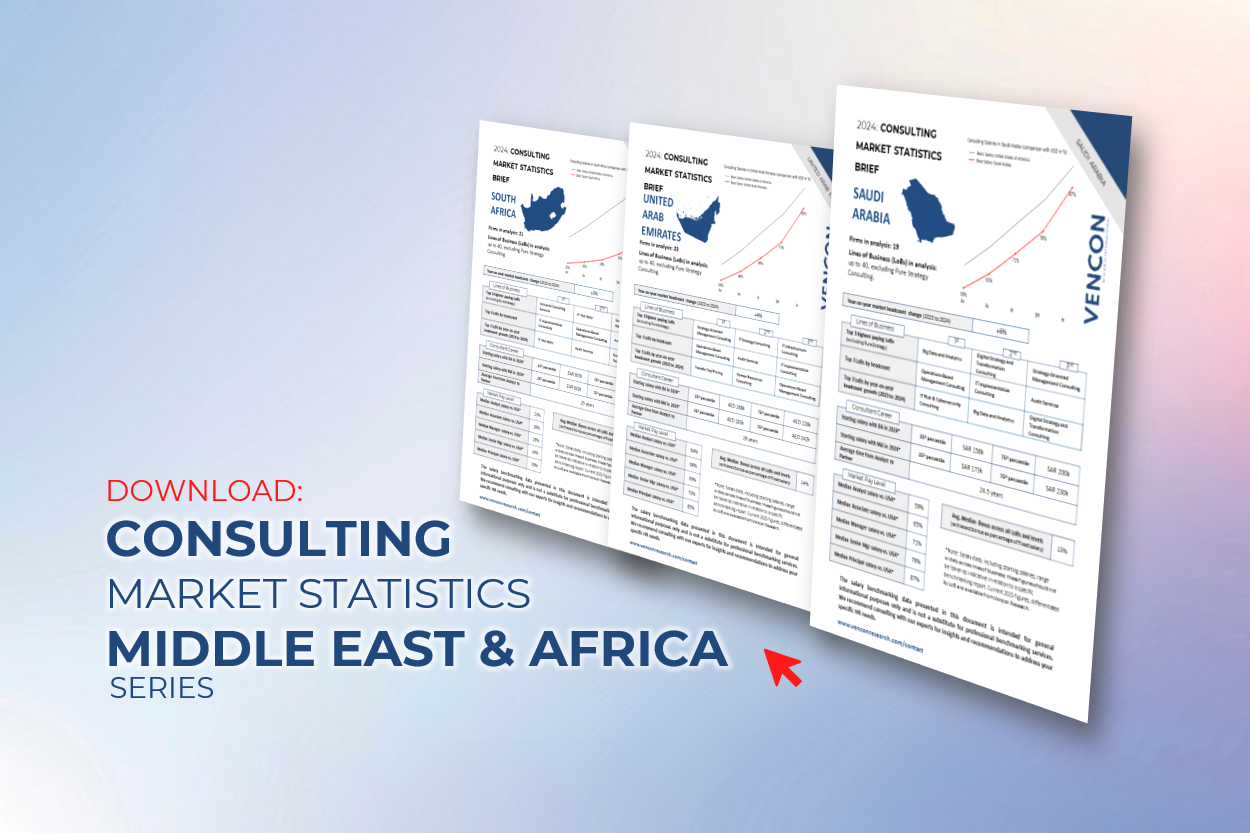
Download: Middle East & Africa Consulting Market HR Insights 2024-2025
This series of briefs consolidates essential HR indicators for the consulting sector across three markets in the Middle East and Africa: the United Arab Emirates, Saudi Arabia, and South Africa. It provides a comparative view of compensation positioning, workforce structure, career progression, and service line dynamics across the region.
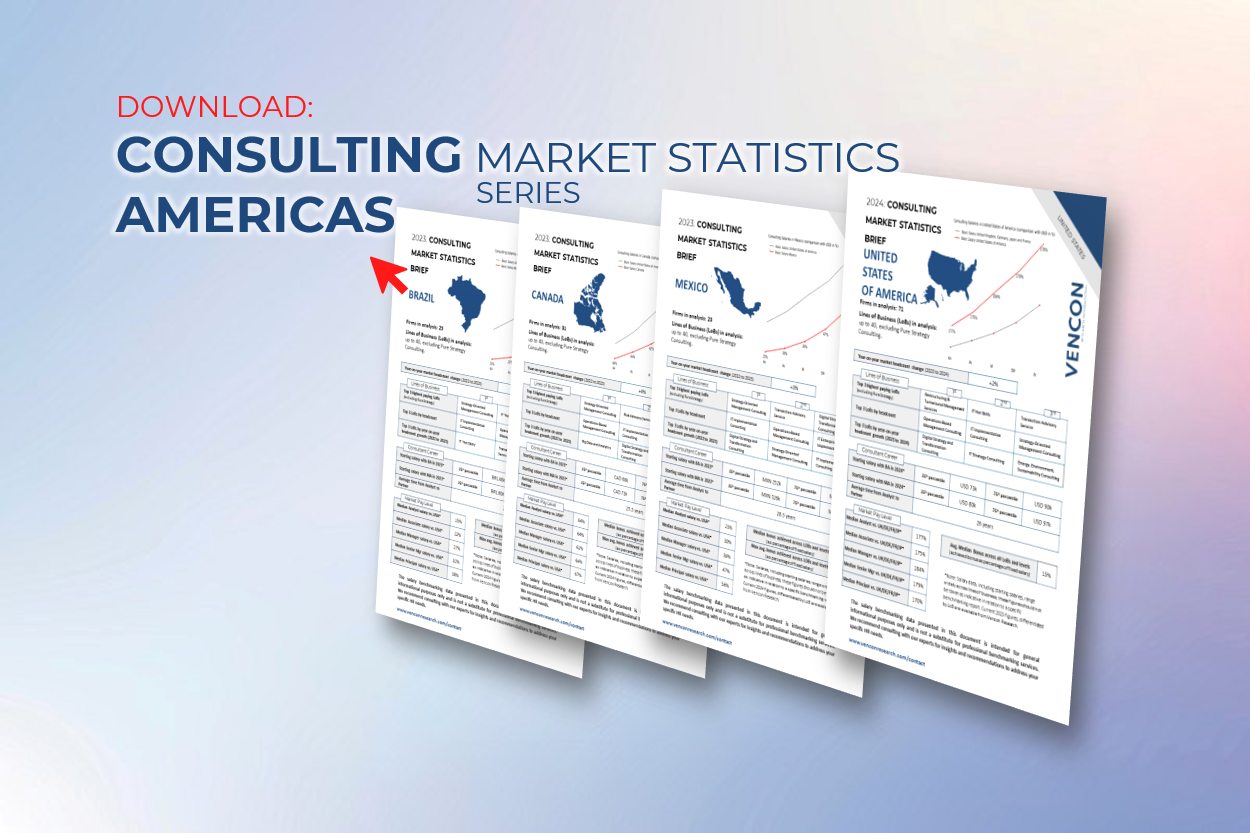


Données utiles et fiables
Pour prendre des décisions éclairées sur les packages de rémunération dans votre secteur, vous avez besoin des données les plus récentes à portée de main.