

Dernières publications

Global Outlook: Expected Salary Increases for 2025
Analysis by Irina Kvirikadze - Senior Manager, Data Integrity Lead
Competitive compensation remains essential for attracting, retaining, and motivating top talent—crucial for delivering client value and sustaining long-term growth into 2025.

Research from Vencon Research and other sources shows that while consulting salaries continue to rise in 2025, the pace of increases has slowed compared to previous years. Firms are regularly adjusting their compensation structures in response to economic conditions, technological advancements, shifting client expectations, and overall business strategy.

Our data indicates that average global salary increases in 2025 stand at 4.5%, with inflation at 2.6%—both lower than the 2024 projections of 5.4% salary growth and 3.1% inflation.
Across regions, the range is narrow, from 4.1% in Europe to 5.6% in the Middle Eastern and African countries analysed. The range of inflation rates is even tighter, from 2.4% to 2.8%.

Expected Regional Salary Growth Projections: Europe
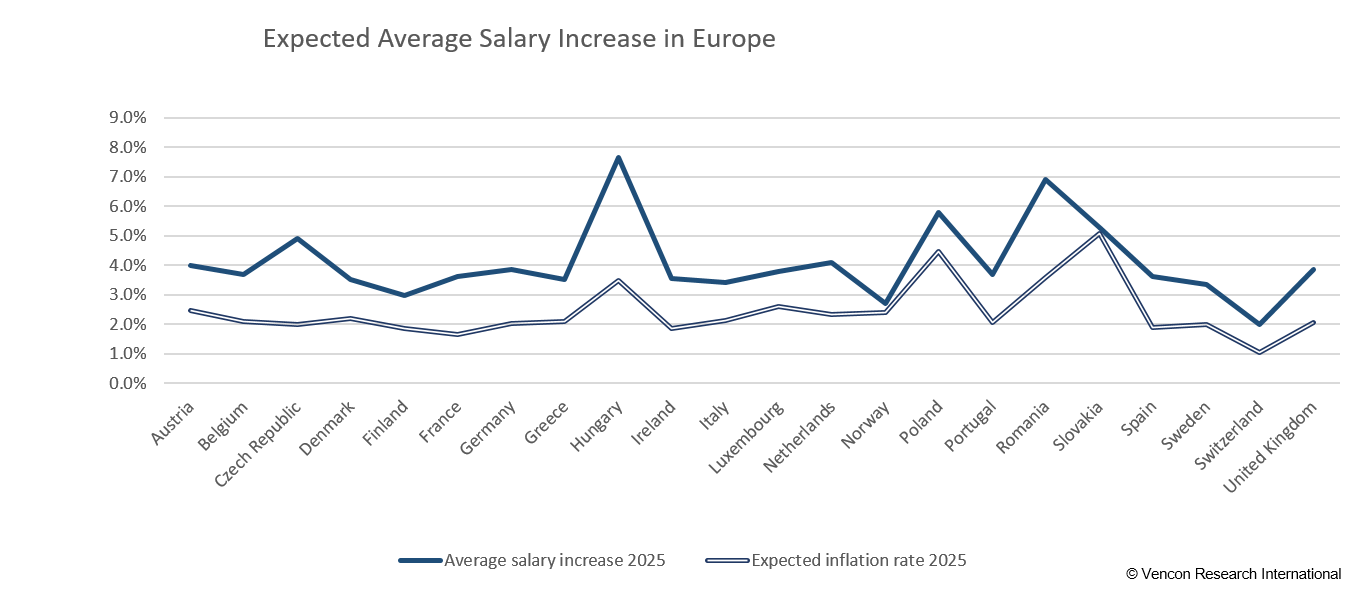
In 2025, salary increases across Europe are expected to range from 2% to 7.6%, while inflation rates are projected between 1% and 5.1%. Overall regional salary growth is forecast between 4.1% and 5.1%, with inflation ranging from 2.4% to 2.8%.
Our country-specific projections indicate 3.6% salary increases in the United Kingdom, 3.9% in Germany, 3.6% in France 3.6%, and 3.6% in Spain.
Expected Regional Salary Growth Projections: Americas
In 2025, salary increases across the Americas are projected to average 4.4%. Excluding Argentina, where hyperinflation distorts salary trends, Latin America is expected to see the highest wage growth in Colombia (6.1%), Mexico (5.4%), and Brazil (5.3%).
In North America, projected salary increases are more moderate, with Canada expected to see a 3.6% increase, while the United States is forecast at 3.7%.

Expected Regional Salary Growth Projections: APAC and MENA
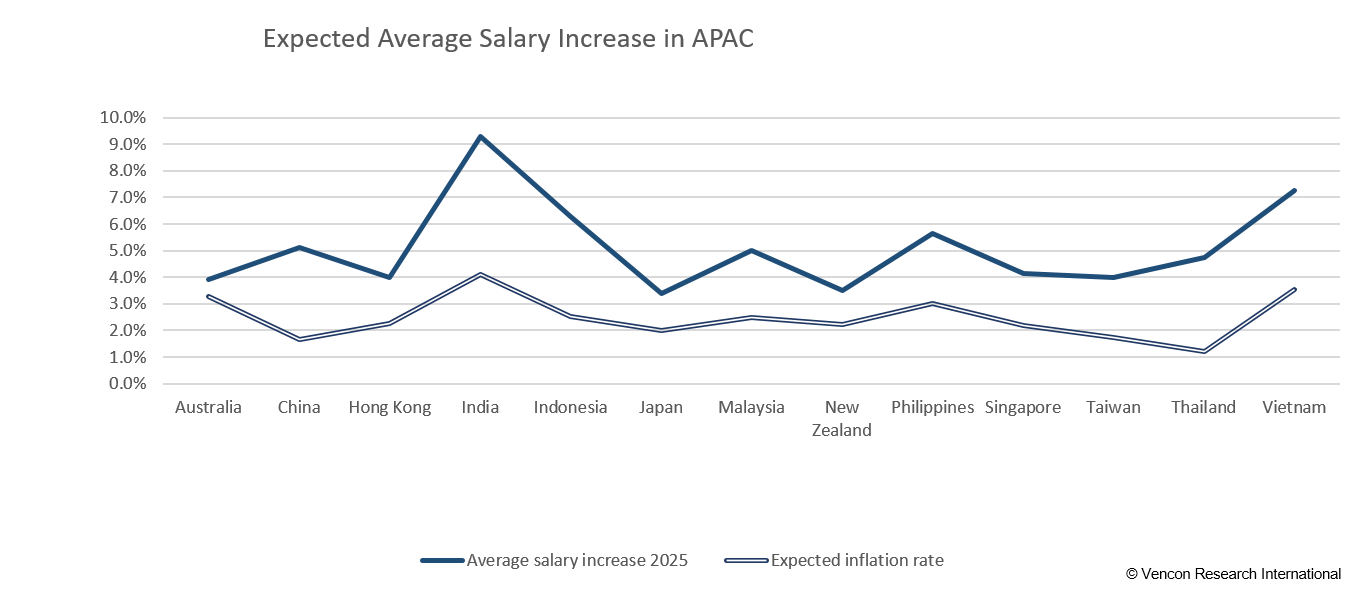
According to our research, most locations in the APAC region are expected to maintain real salary growth rates similar to those seen in the previous year. Additionally, the region is projected to experience some of the lowest inflation rates globally. However, India stands out as a leader in salary growth, with an anticipated 9.3% increase.
In the Middle East and South Africa, average salary increases are expected to be lower than last year but will still remain strong throughout 2025. Projected increases include 4.2% in Saudi Arabia, 5.9% in South Africa, and 3.8% in the United Arab Emirates.

Trends Influencing Salary Changes in 2025
Economic Slowdown and Company Performance
Despite overall salary growth, some consulting firms are moderating salary increases in response to economic slowdowns and declining deal activity, which traditionally drive industry revenues. As a result, firms are increasingly adopting a balanced approach—while base salaries continue to rise, performance-based bonuses may be adjusted downward, particularly in firms that rely heavily on transaction-driven consulting services. This shift reflects a broader focus on cost management and financial sustainability amid uncertain market conditions.
Demand for Digital and AI Expertise
Market dynamics, driven by digital transformation, are pushing up salaries for consultants with expertise in AI, big data, and cloud/cyber technologies. Major firms, including top-tier strategy consulting firms and the Big Four, are making significant investments in AI and data driven consulting solutions. As a result, professionals with strong tech and analytics capabilities are commanding premium salaries.
Demand on Expertise in Sustainability
As businesses increasingly prioritize sustainability and environmental, social, and governance (ESG) strategies, consultants specializing in these areas are seeing salary premiums. Firms are expanding their ESG consulting departments, creating new opportunities for professionals with expertise in sustainability initiatives and triggering subsequent effects on staffing and compensation packages.
Emerging Industry Trends and Competitive Landscape
While established consulting firms maintain their dominance through structured practices and global scale, emerging players and boutique consultancies are gaining traction by focusing on niche sectors and delivering agile, customized solutions. This shifting competitive landscape is fuelling salary growth, as firms compete for top talent with competitive compensation and enhanced benefits. As demand for specialized expertise rises, consultants with sought-after skills and deep industry knowledge are increasingly able to negotiate higher salaries and more lucrative opportunities.
Vencon Research provides consulting firms with precise, industry-specific compensation benchmarking, ensuring they stay competitive in a rapidly evolving market. Our research includes further detailed insights into salary increases for 2025 by country, line of business, and career level, helping firms understand pay trends and make informed compensation decisions.
Learn more about how Vencon Research can support your firm’s pay strategy.

Here to Stay: Continued Growth for Environmental and Sustainability Consulting
By Veronika von Strachwitz-Camara - Business Development Senior Manager
Many larger consulting firms have not only started integrating sustainability and environmental topics into their services but have also established separate entities focusing solely on these issues.
Growth Trajectory
As the world grapples with escalating environmental challenges, companies and organizations have increasingly recognized the imperative to integrate sustainable practices into their operations.
Consulting firms with backgrounds in mining, energy, or engineering provide expertise to help companies navigate the intricate landscape of environmental regulations and develop sustainable strategies.
These were the pioneers. However, nearly all management consultancies have since incorporated environmental and sustainability into their services, recognizing their growing importance in both business and daily life. Such is the popular recognition of environment and sustainability that the enhancement to brand reputation gained from openly addressing it is significant.
Evolution and Current Trends
While the goals of environmental and sustainability consulting have remained largely similar over the years, there are observable shifts in focus from year to year based on changing requirements and technological possibilities.
Public opinion and corporate attitudes towards environmental issues have undergone significant changes over the past decade. Climate change, resource depletion, pollution, and social responsibility have become key concerns globally. Consumers demand environmentally friendly products and services, while investors and sustainable shareholders prioritize them. In response, companies are recognizing the need to incorporate environmental sustainability into their long-term strategies.
Environmental and sustainability consultancies offer expert advice on various issues, including energy efficiency, waste management, emissions reduction, and sustainable supply chain management. They assist in identifying and managing potential environmental risks, helping companies adopt sustainable practices that meet regulatory requirements and international standards.
Factors Driving Continued Growth
Several factors continue to contribute to the steady growth of the environmental and sustainability consulting industry:
- Evolving regulatory landscape: Governments worldwide are introducing stricter environmental regulations, compelling companies to adapt to new compliance requirements. Environmental consulting firms help companies navigate these regulations and develop effective strategies.
- Corporate Social Responsibility (CSR): Companies are under increasing pressure to demonstrate commitment to the environment and social responsibility. Environmental consultants help integrate sustainability into CSR initiatives, showcasing environmental responsibility to stakeholders.
- Cost savings and efficiency: Sustainable practices often lead to cost savings and improved operational efficiency. Environmental consultants identify opportunities for resource optimization, waste reduction, and energy efficiency.
- Improving reputation and brand: Implementing sustainability can enhance a company's reputation and brand value. Environmental consultants help organizations implement sustainable initiatives, improving brand perception and customer loyalty.
- Investor demand: Institutional investors and asset managers increasingly incorporate environmental, social, and governance (ESG) criteria into investment decisions. Environmental consultants help companies identify ESG-related risks and opportunities, meeting investor expectations and accessing capital.
Current Trends in Environmental Consulting
Major current trends in environmental and sustainability consulting include:
- Data-Driven Approach: Accurate and reliable ESG data is essential for providing optimal advice and decision-making. Technological developments allow precise data collection and analysis for ESG decisions.
- Global ESG Frameworks: ESG consultants are promoting international transparency, addressing issues beyond climate change, such as socioeconomic inequality and human rights breaches, reflecting a push for more accountability and transparency.
- Impact Investment: Investments are increasingly made with the aim of creating positive social and environmental effects.
- Decarbonization and "Net-Zero" Aims: Holistic approaches involve switching to renewable energy, decarbonizing supply chains, implementing pricing mechanisms, and promoting circular economy principles.
- Advancing Sustainability Through 5G: The 5G technology impacts sustainability in various fields, including reducing commuting, promoting 'smart' cities, minimizing resource usage, and precision farming.
Expansion and Opportunity
Environmental and sustainability consulting clearly plays a pivotal role in addressing the escalating global challenges we face today. ESG regulations are expanding as are the opportunities in using data to help find the best decisions for companies to tackle environmental, social, and governance challenges. Consultants need to be on top of national and international ESG regulations as well as know how to leverage the “big-data” being generated in this field and optimally advise on operational and investment decisions that companies need to take.
Amidst these trends, it becomes imperative for consulting firms to stay abreast of compensation levels and comparisons within the environmental consulting services sector. This insight is essential for providing optimal advice and decision-making in an ever-evolving landscape.
If you are keen to delve deeper into pay scales and gain valuable insights into environmental and sustainability consulting services, we invite you to connect with Vencon Research International. Our team will provide you with valuable information to navigate the complexities of compensation in this vital industry.

HR in the Consulting Industry: Lessons from Australia’s "Great Burnout"
By Yao Tang - Business Development
In the wake of the widely discussed "great resignation" phenomenon in the United States, a similar trend, albeit less dramatic, has been observed among our clients in Australia. In the course of discussions with HR professionals we’ve heard one theme repeat itself:
Despite not experiencing an extraordinary surge in resignations, there's a palpable sense of burnout, characterized by extreme fatigue and mental exhaustion, among workers, which has resulted in decreased productivity, increased absenteeism, and resistance towards returning to the office post-COVID-19.
To delve deeper into this concerning trend, researchers from The University of Melbourne conducted a comprehensive study in 2022. Surveying 1,400 employed Australians, the study aimed to assess their well-being and work experiences two years after the onset of the pandemic. Regrettably, the findings paint a less-than-ideal picture, emphasizing the widespread symptoms of burnout among workers.
The Burnout Landscape in Australia and Beyond
Burnout is not exclusive to Australia; it's a global concern with serious implications for individuals' health, well-being, and productivity. The consulting industry, a historically demanding sector worldwide, is not immune to this challenge. Several factors contribute to burnout in this industry:
- High Workload: Consultants often grapple with demanding client projects, tight deadlines, and extended working hours, creating an intense pressure to deliver results.
- Travel Requirements: Frequent travel, a common aspect of some consulting roles, leads to physical and emotional exhaustion, posing challenges for those spending extended periods away from home and family.
- Client Expectations: The industry places high expectations on consultants to meet client demands and deliver valuable insights. Balancing these expectations with personal well-being is an ongoing challenge.
- Variability in Workload: Consulting work is inherently cyclical, with periods of intense activity followed by relative calm. This variability can result in irregular working hours and heightened stress.
- Project-Based Nature: Constant adaptation to new teams and clients, a characteristic of project-based work, can be mentally taxing for consultants.
- Remote Work Challenges: The shift towards more remote work and virtual engagements due to the COVID-19 pandemic introduces new challenges related to work-life balance and feelings of isolation.
Addressing Burnout: Solutions for Individuals and Organizations
In the Australian context the issue has been recognised by government, which has implemented various mental health initiatives and programs to address burnout and improve access to mental health care. However, consulting firms, being on the frontline of this issue, shouldn’t wait for government solutions.
Tackling burnout requires a collective effort from both individuals and organizations. Individuals are encouraged to prioritize self-care, set boundaries, manage stress, and seek support when needed. Organizations, on the other hand, play a pivotal role in promoting a healthy work environment. This includes encouraging breaks, offering flexible work arrangements, and providing mental health resources and support.
Concrete steps include:
- Workload Management: Firms can assess and manage consultants' workloads to prevent overburdening. This might involve adjusting project assignments and schedules.
- Mentorship and Support: Provide mentorship and support systems for junior consultants, helping them navigate the challenges of the industry and manage stress.
- Flexible Work Arrangements: Offer flexible work arrangements, including remote work options, to help consultants achieve a better work-life balance.
- Training and Resources: Provide training on stress management, resilience, and mental health awareness. Offer access to mental health resources and counselling services.
- Regular Feedback: Encourage regular feedback between consultants and their managers to address concerns and identify early signs of burnout.
- Promote a Healthy Culture: Foster a culture that values work-life balance, self-care, and well-being. Lead by example from the top down.
- Diverse Project Assignments: Rotate consultants through different types of projects to keep work engaging and prevent monotony.
- Mental health awareness: This should be a priority for employers and society at large, with ongoing efforts to reduce stigma and encourage open conversations about burnout. Employee Assistance Programs (EAPs) can offer confidential counselling and support services to those experiencing stress and burnout.
It's worth noting that addressing burnout is not only the responsibility of consulting firms but also requires individual consultants to take proactive steps to manage their well-being and communicate their needs effectively.
Burnout in the consulting industry can be a complex issue, but with awareness and proactive measures, it is possible to mitigate its impact and promote a healthier work environment. Nevertheless, as we saw with our Australian contacts in the HR departments of consulting firms, it was their awareness, identification and concern to address the issue that lead to launching effective mitigation programmes and improvements for all concerned.
Tailored Collaboration for Success
Vencon Research is your collaborative partner in navigating the complexities of HR management in the consulting industry. Our bespoke recommendations are crafted with your unique needs in mind, ensuring local relevance and global consistency. Contact Vencon Research today to discover HR solutions for your company's success in the global consulting arena.
References
Leah, R., Brendan, C., &David, B. (2023, March 19). The 'great resignation' didn't happen in Australia, but the 'great burnout' did. Find an Expert.unimelb.edu.au. https://findanexpert.unimelb.edu.au/news/63392-the-'great-resignation'-didn't-happen-in-australia--but-the-'great-burnout'-did
Sarah, S. (2023, April 14). The Great Burnout: Exhausted Aussie workers forced into ‘quiet quitting’ and resignations. News.com.au. https://www.news.com.au/finance/work/at-work/the-great-burnout-exhausted-aussie-workers-forced-into-quiet-quitting-and-resignations/news-story/21a83bd5cd14458306469423f10d4585
Steve, H, Tim, C., &Mackenzi, G. (2023, May 4). Seven strategies to avoid employee burnout Prioritizing employee well-being in the workplace. Deloitte. Com https://www2.deloitte.com/us/en/blog/human-capital-blog/2023/how-to-avoid-employee-burnout.html

Hot Skills & Pay: How do Consulting Companies Compensate In-demand Talent?
By Yao Tang – Business Development
In the world of consulting, staying competitive means possessing the necessary skills to offer innovative and effective solutions to clients’ problems. These competencies, often referred to as “hot skills”, are continually evolving, with new skills consistently taking centre stage.
Hot skills can vary over time as technology and industry trends change, but they typically represent expertise in areas that are currently experiencing rapid growth, innovation, or a shortage of qualified professionals. Current examples include machine learning, cloud computing, blockchain, cybersecurity, and specific programming languages such as Python, Ruby, JavaScript and others. Hot skills can also extend beyond technical skills and include skills related to management consulting, strategy development, industry-specific knowledge, and more - depending on the specific focus of the consulting firm and the needs of their client base.
Consulting firms seek professionals with these skills because they are essential for delivering services to clients looking to adopt or optimize new technologies or approaches in their business operations.
Hot skill-based compensation
In order to attract and retain professionals with these in-demand skills, consulting firms often find they need to adjust their compensation and talent acquisition strategies. Doing so, they are seeking to address a number of issues:
- Skill Shortages: Paying a premium for hot skills attracts professionals possessing these skills, combating skill shortages in particular areas.
- Competition for Talent: Offering competitive compensation for hot skills sets the firm apart in the competitive talent market, making it more appealing to top candidates.
- Client Demands: Hot skills enable consultants to meet clients' evolving needs efficiently and with expertise, enhancing client satisfaction and trust.
- Retention and Motivation: Paying a premium motivates employees to acquire and maintain hot skills, reducing turnover and preserving institutional knowledge.
- Market Rate Alignment: Aligning salaries with market rates ensures the firm can secure and retain skilled professionals, staying competitive in talent acquisition.
- Efficiency and Effectiveness: Hot skills lead to more efficient project execution and higher-quality outcomes, enhancing the firm's effectiveness in delivering value to clients.
- Strategic Business Goals: Investing in hot skills aligns the firm's workforce with its strategic objectives, enabling it to tackle specialized projects effectively.
- Talent Pipeline: Attracting individuals with hot skills helps build a talent pipeline of skilled professionals ready to contribute to ongoing and future projects.
- Client Trust: Demonstrating expertise in hot skills instils confidence in clients, fostering trust and long-term relationships based on the firm's ability to deliver on their needs.
While an increase in compensation is the obvious way to attract and retain candidates with particular hot skills, exactly how such adjustments are introduced and managed may vary from one firm to another.
Our market analysis reveals three main approaches to hot skill compensation among consulting and IT firms:
Group 1:
Firms offering broad salary bands that encompass higher pay for a particular hot skill.
This is the largest group among the firms we looked at or spoke to in our analysis. The adjustment is reflected in a wider, albeit existing, salary range for the position in question.
As such the adjusted hot skill-based salary does not necessitate a change in the salary ranges being offered by the firm because the hot skill premium is within the existing salary range; it only increases the average salaries being paid.
Interestingly, the majority of this group of firms offered their hot skills-based employees a fixed increase in salary. Should the skill go from hot to “vanilla”, i.e. no longer cutting edge or exceptional, or if the employee were not working on a project requiring this hot skill, their salary was not adjusted (i.e. downwards).
Group 2:
Firms paying or adjusting salaries only for the hot skill in question.
In this model, only employees with the respective hot skill are offered a higher salary – outside of the firm’s existing salary range.
Again, the majority of this group of firms offered their hot skills-based employees a fixed increase in salary. Should the skill go from hot to “vanilla”, or if the employee were not working on a project requiring this hot skill, their salary was not adjusted (i.e. downwards).
Group 3:
Firms that pay a hot skills bonus or additional component.
This group offers an additional bonus or salary component to employees who can demonstrate that they possess a desired skill (e.g. via a certificate or diploma or otherwise). This additional income functions in a similar way to a bonus and can be discounted should the hot skill become “vanilla”, or as in the case of some firms, when the employee is not working a case or project that requires the hot skill in question.
The cooling effect
As our clients have frequently noted, the hot skill of today may become vanilla tomorrow. This is why the strategy of Group 3 is often the most efficient from a firm perspective. It is clear that HR managers at consulting firms may not be able to hire the talent they require without offering the premium required by the market. However, with this approach the skill is paid for only when it is in use.
It is up to firms to decide which approach is best suited to their business and perform a balanced assessment of the effects of each approach on their goals, considering firm competitiveness, profitability, talent acquisition and retention.
In our forthcoming article, we will further explore the intriguing relationship between hot skills and their influence on consultant compensation, delving into the finer details of how these hot skills are factored into our benchmarking assessments here at Vencon Research.
For more information on this topic or on how you may successfully respond to the issues raised in this article, please contact Vencon Research – as always, we are happy to assist you.

HR Leaders: Navigating Competition with Internal Consulting Practices (ICPs)
By Miklos Bodnar - Business Development Senior Manager
Internal consulting practices (ICPs) have become a more common feature of the global consulting and professional services sector and present their own set of challenges and opportunities for Human Resources leaders at traditional consulting firms as they compete with ICPs for talent acquisition.
Internal Consulting Practices (ICPs)
An internal consulting practice is an in-house group established by an existing firm to provide support and assistance with making critical strategy and operational decisions. The primary impetus in creating such practices is to reduce the reliance on traditional, external consulting firms, such as McKinsey, Bain, BCG, Kearney, Big 4, Accenture, etc., as well as associated costs, while also hoping to increase the efficiency and availability of consulting services. The advantages of an in-house consulting group include a more comprehensive understanding of a firm's structure, greater availability and responsiveness for problem-solving, involvement in both strategy and implementation, and greater alignment with the client.
Some examples of major firms with internal consulting practices are: Airbus, AMEX, Disney, Google, Siemens, Ford, General Motors.
How should human resource leaders anticipate and prepare for competition with ICPs?
The most obvious challenge presented to HR leaders at traditional consulting firms is the competition for top level consulting talent, especially in a recruitment market that is already under external pressures from non-consulting industries.
While ICPs do expand the number of competitors for talent, traditional consulting companies still generally hold an advantage in many areas of employment attractiveness, and should play to these strengths. Some key factors to consider are:
ICPs may offer different/less advantageous career advancement: ICPs can be limited in their ability to expand their service offering and client base, thus capping the needed for increased staffing and partners. This inherently smaller structure could constrain career advancement and thus attractiveness.
Opportunity for travel (when desirable): As ICPs are most likely co-located with the parent firm and primarily work only for the single “client” on-site, no additional travel outside of the consultant’s primary home base is required. While some may appreciate not having to travel, there are also consultants who consider frequent travel opportunities to be an advantage associated with the sector.
ICPs may offer less exposure to different industries and projects: Consulting with an ICP may provide an extremely focused work environment, where the consultant-client interaction is far more comprehensive and the consultant has access to the parent company on a daily basis. However, this very focus can also lead to a lack of variety in the consulting work carried out. And while specialization may be a key driver in a consultant’s career, this in turn may be limited, as the consulting opportunities and problem solving will only be within the parent company’s specific industry and business focus.
Open market opportunities could be less “competitive” as a consultant has only worked for a specific client and industry: The potential limitations outlined above also play out for candidates who may consider how to maximise their future employability. A lack of exposure to different industries and types of consulting work could diminish their competitiveness vis-à-vis peers who have experience at traditional consulting firms.
The case for ICPs
As businesses become more complex and competitive, there is a growing need for customized and specialized consulting solutions that internal consulting teams are well-positioned to deliver. Working for an ICP can offer consultants greater job security, the opportunity to build long-term relationships with stakeholders, and the ability to make a more significant impact on the organization. Internal consulting practices may also be perceived to offer more work-life balance and a more predictable schedule compared to traditional consulting companies, making them an attractive option for consultants looking for a more stable career path.
What can Vencon Research do for you?
Vencon Research has recognized the growing and impactful presence of Internal Consulting Practices in the larger consulting industry and has integrated these firms into our compensation benchmarking analysis and services. Should your firm require assistance identifying the appropriate strategies to ensure your own rewards and recruitment attraction fully takes this aspect of the consulting market into account, we are available to provide you with the solutions to succeed.

How the Consulting Industry is Rethinking Costs in Response to Growth Slowdown
Despite robust earnings in the consulting industry in 2022 and a mostly strong final quarter of 2022, consulting companies are either experiencing a slowdown after just two months into 2023 or have already started adjusting to an expected slowdown in the project pipeline for this year.
Due to the recent COVID-19 pandemic, the consulting industry has been able to reduce operational costs (e.g., less travel, etc). But what puts additional pressure on margins is that many consulting companies have increased salaries due to above average inflation rates around the globe while billing rates were not (or could not) be increased accordingly.
These factors have compelled consulting companies to re-examine their cost position, e.g. by re-examining their fixed costs, in particular evaluating the value brought by their non-client facing staff.
In the light of this, for industry insiders it is no surprise that e.g. McKinsey is announced cutting 2,000 non-client facing staff, KPMG is laying off up to 700 employees in the USA and 200 in Australia, and EY is planning to cut 400 staff in Germany.
The priorities of consulting companies are now – apart from trying to ensure their consultants remain highly utilised – being set to more strongly focusing on increasing profitability and competitiveness (instead of sheer growth).
For more information on how your competitors are responding or how you may successfully respond to these challenges, please contact Vencon Research – as always, we are happy to assist you.


Données utiles et fiables
Pour prendre des décisions éclairées sur les packages de rémunération dans votre secteur, vous avez besoin des données les plus récentes à portée de main.