

Dernières publications

Download: Eastern Europe Consulting Market HR Brief Series
Key HR indicators for the consulting industry
This collection of market statistics briefs highlights key consulting market statistics across five countries in the Eastern Europe region: Hungary, Slovakia, Poland, Czech Republic, and Romania. It offers insights into various key factors, such as the highest paying lines of businesses, market growth, starting salaries, career progression, and market pay level.
Notable highlights across Eastern Europe
- The year-on-year market headcount increase across these five countries ranged from 1% to 4%, with “Strategy-Oriented Management Consulting” and “IT Risk & Cyber Security Consulting” lines of businesses witnessing the largest growth.
- The average time required to progress from analyst level to partner level ranged from 25 to 30 years, with Poland and Hungary having the fastest track.
- “Strategy-Oriented Management Consulting” was one of the highest-paid lines of business and "Big Data and Analytics" also ranked among the top three highest paid in three of five countries.
The sheets also present median salaries for all Vencon Research career levels as percentages of basic salaries paid in the United States. Out of the five countries presented here, consultants in Czech Republic were paid the highest, ranging from 30% to 61%, while those in Hungary were paid the least, ranging from 23% to 42%.
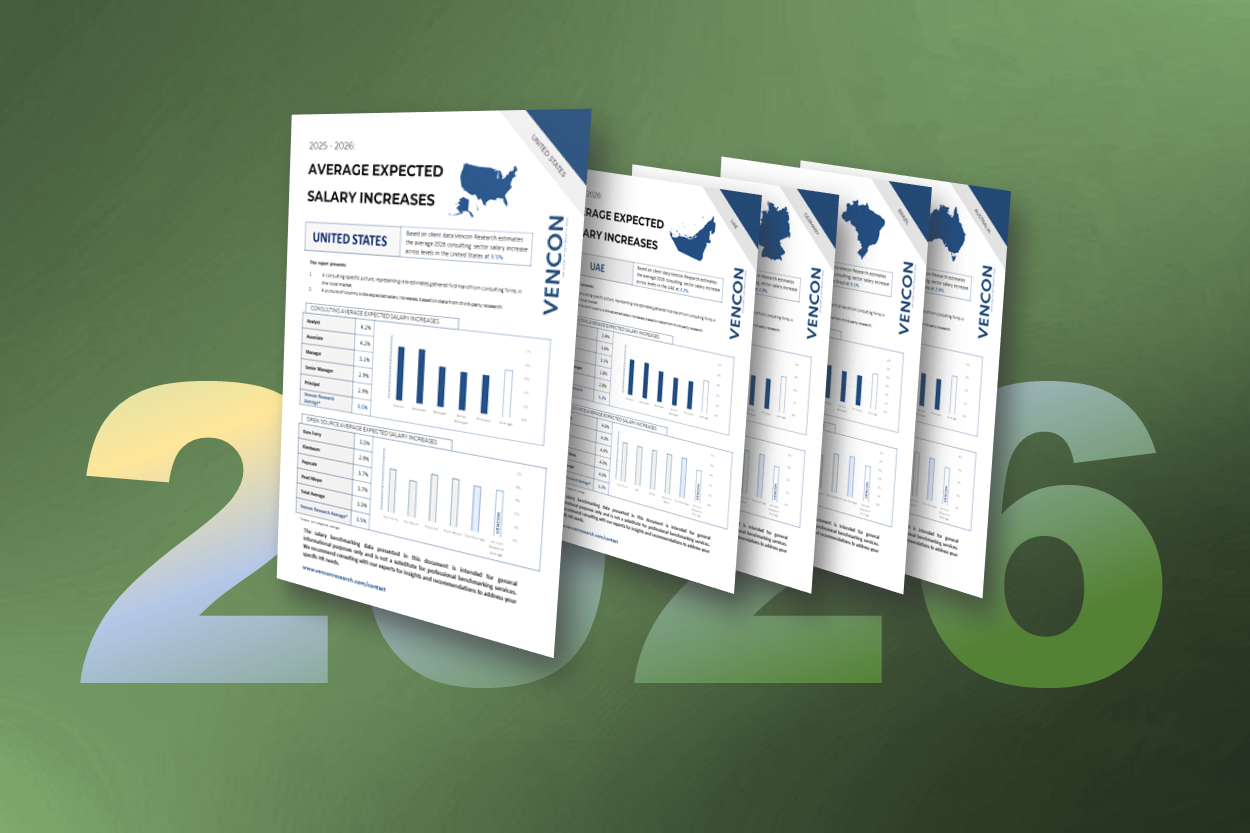
Download: 2026 Expected Salary Increases in the Consulting Industry
2026 Expected Salary Increases in the Consulting Industry
These concise overviews provide:
- A consulting-specific picture, representing real estimates gathered first-hand from consulting firms in the local market.
- A picture of country wide expected salary increases, based on data from third-party research.
Vencon Research conducts compensation benchmarking studies for over 70 countries worldwide. Should you require further information on the summaries included or additional data for different countries, please contact us.

Consulting Faces Intensified Talent Competition from Tech and Finance
By Mik Bodnar - Business Development
Consulting firms are facing unprecedented competition for talent as tech companies and financial institutions lure top candidates with lucrative packages. Entry-level analysts, digital specialists, and data experts are increasingly weighing opportunities outside consulting, forcing firms to rethink compensation, career development, and workplace flexibility to attract and retain the best professionals.
Rising Salaries Reflect Market Pressure
The competition for talent between consulting firms and the tech and financial services sectors has intensified in recent years. Vencon Research data shows that consulting salaries, particularly for entry-level analysts and specialist roles, are being adjusted upward to remain competitive with the lucrative packages offered by technology companies and investment banks.
While consulting firms traditionally attracted graduates with the promise of diverse project exposure and rapid career progression, they now face direct competition for the same pool of quantitative thinkers, digital strategists, and subject matter experts who are equally sought after in fintech, data science, and corporate strategy roles. Boutique consultancies, unable to match the largest firms or banks on base pay, are differentiating through culture, flexibility, and work-life balance, positioning themselves as attractive alternatives for professionals seeking purpose and autonomy.
Roles Most Affected by Talent Mobility
The roles most likely to transition from consulting into tech and finance are entry-level analysts and mid-level managers with specialized expertise in areas like data analytics, cybersecurity, and financial modeling. Senior partners and managing directors, by contrast, tend to remain within consulting due to the unique equity and client-ownership structures of the profession.
Recruitment trends highlight how consulting, finance, and tech are converging on similar talent pools. We see this trend relfected in demand for benchmarking across sectors. Consulting firms are expected to increase full-time and internship hiring in 2025 after a slowdown in 2024, reflecting renewed demand for advisory services. Finance firms, meanwhile, are rethinking recruitment by broadening strategies to digital platforms and specialized networks to attract candidates with both technical and ESG expertise. Tech companies continue to lead in skills-based hiring, with focus on critical skills such as AI, data analytics, and cybersecurity, but consulting firms are also investing heavily in these candidates.
Across industries, flexible work arrangements and strong employer branding are now essential to attract candidates, with hybrid and flexible models becoming decisive factors in recruitment success.
Global Talent Hubs Intensify Competition
Geographically, the competition is most pronounced in global talent hubs such as the United States, the United Kingdom, Germany, and Singapore, where consulting firms, banks, and tech giants all recruit from the same elite universities and professional networks. In these markets, the challenge for consulting firms is not only to match compensation benchmarks but also to craft a compelling narrative of career development and cultural differentiation that resonates with a new generation of professionals.
Beyond pay, consulting firms can deploy non-financial levers such as hybrid work models, sabbatical programs, and transparent promotion criteria to appeal to talent who value stability and culture as much as compensation. Thus benefits packages are increasingly in focus, and we see a corresponding uptick in benchmarking for these non-financial rewards.
Compensation Remains a Central Battleground
Ultimately, compensation remains a central battleground. Tech and finance firms often lead with higher base salaries, equity participation, and performance bonuses, while consulting firms emphasize structured career paths, training, and international mobility. Strategies for consulting firms include raising entry-level packages to prevent attrition to tech startups or offering retention bonuses for mid-level managers with digital expertise.
For consulting HR leaders, the implication is clear: To compete effectively, market data must be used to identify critical pay gaps, selectively adjust pay scales for critical roles, and emphasize non-financial differentiators such as culture, flexibility, and career development. Partnering with a specialized benchmarking provider like Vencon Research can ensure your firm attracts and retains the right talent while staying ahead of industry trends.

Consulting in Latin America: A Market Defined by Operational Depth and Emerging Specialisations
By Gonzalo Lavín Alfaro - Business Development Manager
While consulting has developed along broadly similar lines worldwide, each region exhibits distinct strengths shaped by its economic structure, client base, and regulatory landscape. Western Europe and North America remain established centres for general management and strategy consulting, and regions such as Eastern Europe and India are recognised for their focus on IT and implementation. In contrast, Latin America stands out for a more diverse consulting landscape — one defined by operational depth, regulatory complexity, and accelerating growth in emerging service areas.
In this overview, we take a closer look at the consulting landscape across Latin America — highlighting where firms are most active, how service lines are evolving, and what this means for compensation trends across the region.
Sustainability and ESG Advisory
Sustainability and ESG consulting are emerging as dynamic growth areas, particularly in energy, mining, and agriculture. As local regulations evolve and investor expectations rise, demand for advisory work in sustainability reporting, carbon management, and responsible supply chains is increasing rapidly.
Operations and Efficiency Improvement
Latin America’s consulting sector has traditionally centred on operational excellence. Many local and regional firms built their reputations on helping clients optimise processes, reduce costs, and improve supply chain performance. This remains a key focus area across industries such as manufacturing, logistics, and energy, where operational improvements often deliver faster, more tangible returns than strategic repositioning.
Finance, Risk, and Regulatory Advisory
The complexity of local tax and compliance environments — particularly in countries such as Brazil and Argentina — has driven consistent demand for consultants who can navigate these challenges. Advisory work in corporate governance, internal controls, and financial risk management continues to represent a significant share of consulting activity in the region.
Implementation and Digital Transformation
Implementation-oriented consulting has expanded rapidly, driven by growing investment in technology and automation. Multinational firms increasingly view Latin America not only as a delivery base but also as a developing market for digital services, with strong momentum in ERP implementation, process automation, and data analytics.
Human Capital and Organisational Consulting
Human capital consulting plays an important role, particularly within large domestic conglomerates and subsidiaries of global firms. Engagements often focus on organisational design, compensation, and talent management — reflecting the region’s focus on workforce adaptability and productivity.
Strategy Consulting
Strategy consulting, while smaller in overall scale, is concentrated in the region’s largest and most internationally connected economies: Brazil, Mexico, and Chile. Here, companies are more likely to invest in strategic transformation, international expansion, and market-entry projects.
Expected Salary Increases in Latin America
Despite higher inflation than the OECD average, Latin America’s consulting industry continues to show steady growth. With relatively limited geopolitical disruption compared to other markets, countries such as Colombia, Mexico, and Brazil are leading salary growth projections — expected to exceed 5.3% in many cases. This reflects the region’s rising demand for skilled professionals and sustained investment in expanding service lines such as ESG, digital transformation, and implementation.
Nearshoring and Delivery Centres
The region, particularly Mexico, has become an important hub for nearshoring and delivery centres serving North America and other markets. The transfer of business operations to nearby, lower-cost locations has long been associated with India and Eastern Europe, but Latin America is increasingly capturing this activity. Proximity to clients, time-zone alignment, and cost advantages are driving consulting firms to establish or expand delivery centres in the region, creating new opportunities for talent and service delivery.
Understanding how consulting work is distributed across lines of business is essential when assessing compensation levels. Even within the same country, firms may vary widely in focus and service mix, influencing both pay structures and career paths.
Vencon Research’s benchmarking products capture these distinctions by matching roles precisely by line of business, level, and local market context. This enables consulting firms to make accurate, meaningful comparisons when reviewing compensation within their market.
Explore Vencon Research’s benchmarking services ›

Consultant Pay vs. Cost of Living in Germany’s Major Cities: 2025 and Beyond
By Irina Kvirikadze & Makar Evdokimov
Consultant pay is often used as a benchmark for career and business decisions, but headline figures alone rarely tell the full story. Pay may look similar across Germany at first glance, yet local costs mean the real value of a consultant’s salary can vary widely.
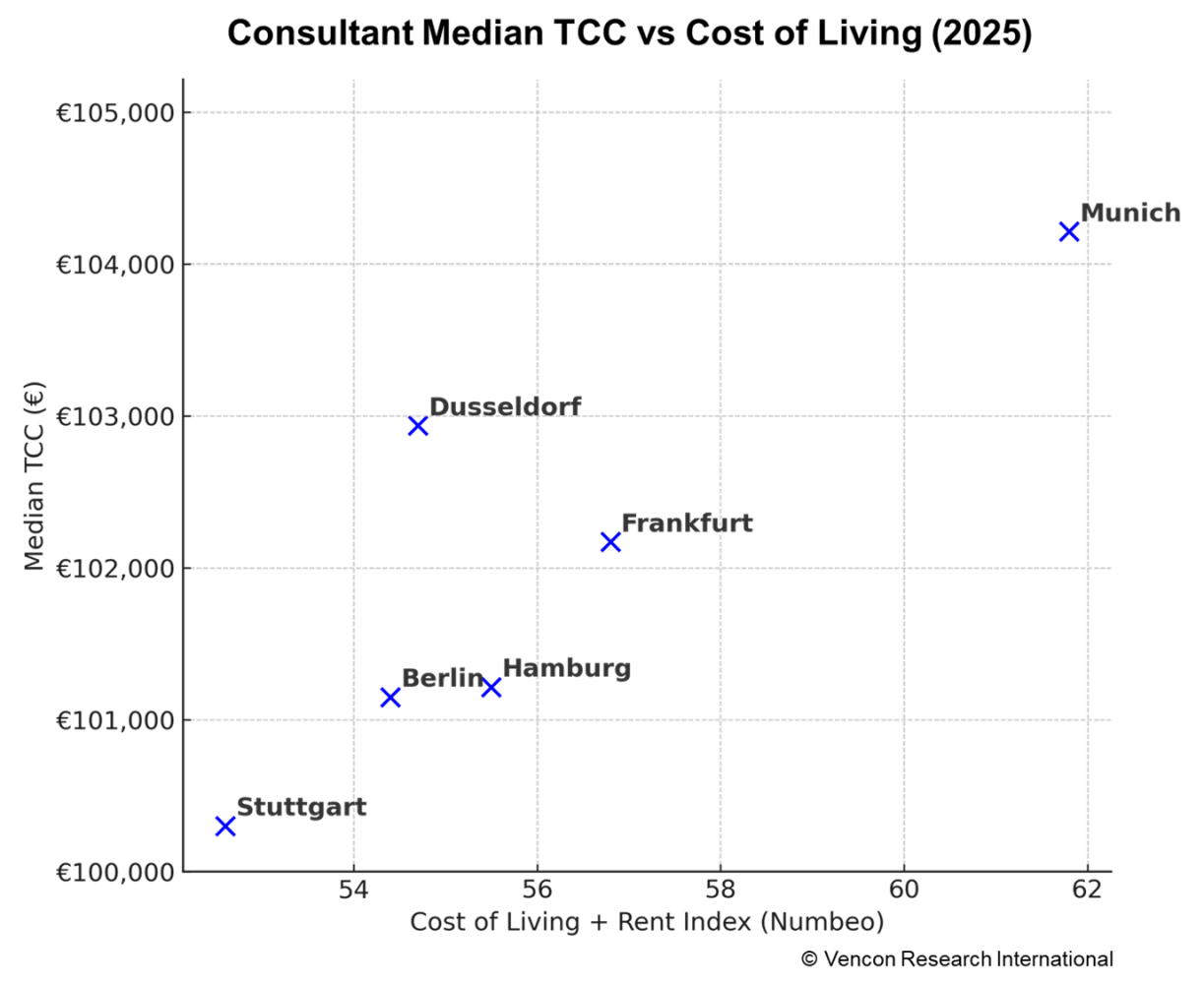
Based on Vencon Research’s compensation data, we benchmarked consultant compensation across six major German cities: Berlin, Düsseldorf, Frankfurt, Hamburg, Munich, and Stuttgart. We used our firm-weighted dataset that captures both base salary and bonus (Total Cash Compensation or TCC). To make comparisons more meaningful, we adjusted salaries against the Cost of Living + Rent Index (Numbeo), which reflects the true purchasing power of a consultant (all levels excluding partners) once local expenses are considered.
The results highlight striking differences in how far consultant pay really goes across Germany.
Key Findings
Munich: high pay, high cost
Consultants in Munich earn the most, with median TCC across all levels excluding Partner at just above €104,000. But with a cost index of 62, the steepest in Germany, much of this headline advantage is consumed by living expenses. Munich remains attractive for its prestige, corporate headquarters, and concentration of top-tier firms, but it is far less compelling when measured by net take-home value.
Düsseldorf: the sweet spot
With median compensation of €103,000 across all levels and a relatively modest cost index (54.5), Düsseldorf offers the most attractive balance between earnings and affordability. It consistently ranks as the strongest city for consultants seeking both competitive earnings and reasonable living costs.
Frankfurt: strong pay, middling value
Frankfurt consultants earn a median TCC of €102,200, but the city’s cost index (56.8) places it squarely in the middle of the pack. As Germany’s financial capital, Frankfurt provides stability and opportunity but doesn’t shine in relative value once affordability is factored in.
Berlin vs. Hamburg: a convergence story
Both Berlin and Hamburg cluster at €101,000 median pay with cost indices between 54–56. This is significant: Berlin was historically far more affordable, but rising rents and living costs have nearly eliminated its affordability edge, bringing it level with Hamburg.
Stuttgart: the hidden value play
Stuttgart ranks lowest in consultant pay (€100,200 median across levels), but also lowest in cost index (52.8). For consultants seeking to maximize savings rather than prestige, Stuttgart offers a compelling case as the most cost-efficient city in this comparison.
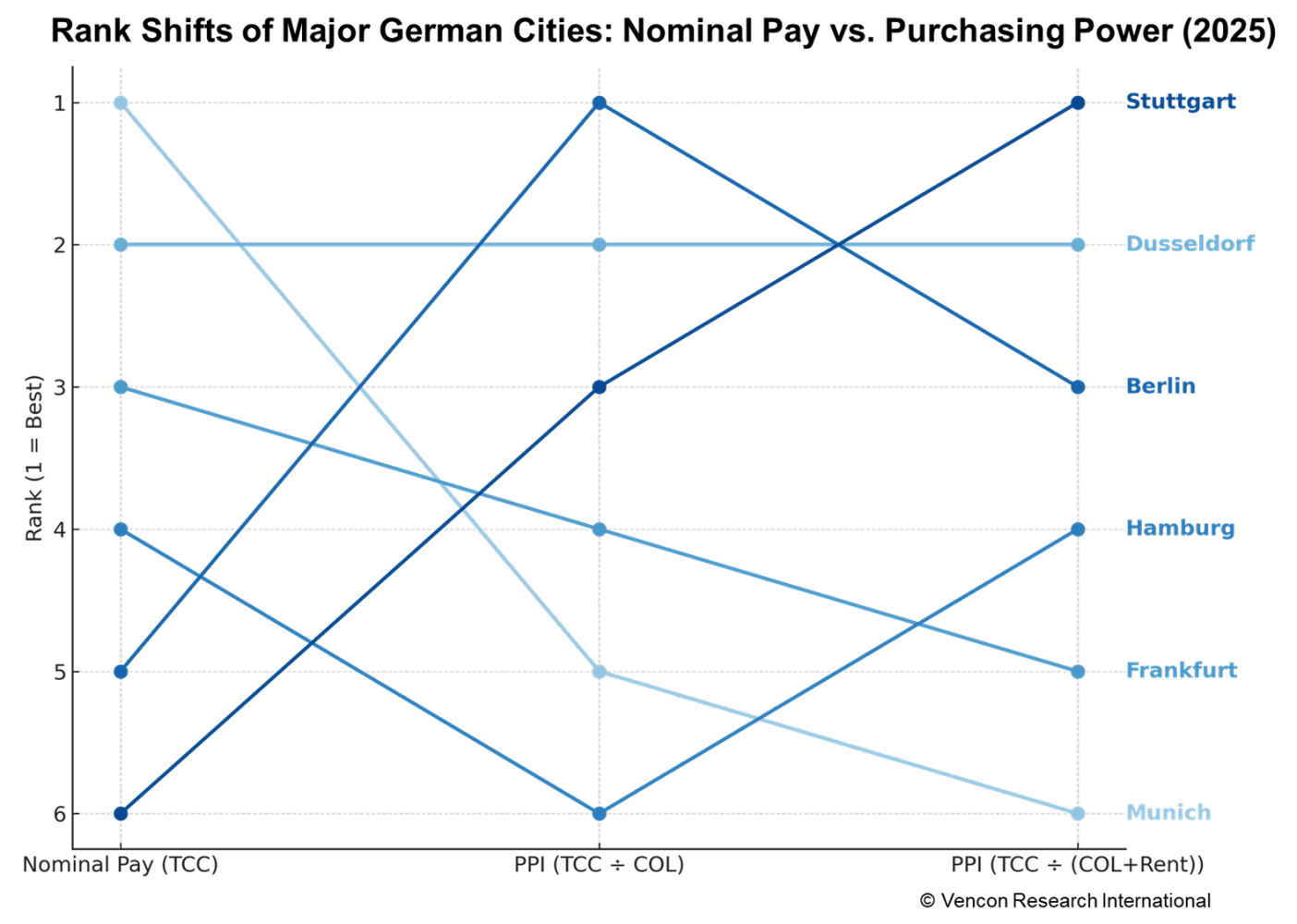
Real Purchasing Power Perspective: The Rankings Flip
Looking beyond nominal pay to purchasing power (PPI 2025) adjusted for cost of living and rent, the rankings shift dramatically:
- Munich drops from #1 in nominal pay to last place (#6) once high costs are included.
- Frankfurt follows a similar decline, slipping down the ranks when affordability is considered.
- Düsseldorf remains the most balanced, combining high pay with manageable costs.
- Berlin and Hamburg are now nearly indistinguishable in value.
- Stuttgart emerges as the clear winner, ranking #1 when adjusted for both cost of living and rent.
Why These Differences Exist: It’s More Than Just Numbers
Several dynamics explain why salaries and affordability have evolved the way they have:
- Munich continues to attract global headquarters and top-tier consulting firms, especially in strategy and technology. This prestige drives up both salaries and housing costs, creating a high-pay, high-cost profile.
- Berlin, once seen primarily as a creative and start-up hub, has evolved into a magnet for global consulting firms. The city attracts young, international talent with expertise in digital, analytics, and technology—skills that are increasingly critical as client projects shift toward transformation and digitalization. This demand is pushing salaries up, but it's also making the city more expensive for everyone.
- Frankfurt remains Germany’s financial centre. Driven by the banking and financial services sector, demand for finance, risk, and regulatory expertise fuels robust compensation and a steady, high-pay, high-cost environment, however with less explosive growth than tech-centric hubs.
- Stuttgart reflects its regional profile: fewer top-tier consulting firms and more moderate salaries, but far more manageable living costs.
The Future of Consultant Pay (2025-2030)
Looking ahead, several dynamics are likely to reshape consultant pay and affordability across Germany’s major cities:
- Housing market pressures will intensify. Demand for urban housing in cities like Munich, Berlin, and Frankfurt will remain high, keeping the cost of living elevated.
- Remote and hybrid models may redistribute talent. As consulting firms adopt more flexible working models, consultants may increasingly live in lower-cost regions while remaining attached to high-paying city offices. This could weaken the traditional pay–location link over time, especially in costlier locations like Munich.
- Sector shifts will influence city attractiveness:
- Munich and Frankfurt are likely to maintain premium pay due to strategy and finance concentrations.
- Berlin should keep climbing as digital, data, and transformation work become core revenue drivers for firms.
- Stuttgart’s automotive focus could face headwinds if industrial transformation accelerates, potentially limiting salary growth unless diversification occurs.
- Generational and lifestyle choices will shape preferences. Younger consultants continue to value cultural vibrancy and international exposure (Berlin, Hamburg), while mid-career professionals with families may gravitate toward more balanced, affordable environments (Stuttgart, Düsseldorf).
- Purchasing power gaps may narrow further. As costs rise everywhere, the real purchasing power of salaries will become more similar across cities. By 2030, take-home pay could become less of a differentiator between locations
Implication: For consulting firms, this means compensation strategy will need to be more finely tuned to role, level, and specialization, not just location. For professionals, location choice may increasingly be driven by family status, lifestyle and sector focus, as the pure financial trade-offs between cities gradually flatten.
City-Level Dynamics and the Future of Pay
Understanding city-level dynamics is essential for consulting firms when shaping talent strategies, setting competitive pay, and maintaining internal equity. Over the next five years, rising housing costs, remote work, and shifting sector dynamics are expected to narrow city-to-city differences making lifestyle, specialization, and career goals as important as pay when choosing where to work. Firms will therefore need to refine compensation strategies beyond geography.
To stay competitive in this evolving market, deeper insight into level-specific pay, performance-linked rewards, and benefits will be critical. Our detailed country reports provide the intelligence consulting firms and professionals need to make informed, strategic decisions.

Consulting in the Middle East: Competitive Employee Benefits
By Irina Kvirikadze - Senior Manager Data Integrity Lead
The Middle East has become a key region for consulting firms, attracting both international players and regionally focused specialists. Compensation practices in the region often include generous benefits and lifestyle-related perks—frequently exceeding what’s typical in Western markets. These offerings reflect a long-standing emphasis on making roles in the region attractive to both local and expatriate talent.
Based on Vencon Research survey data, we present an overview of the key hard and soft benefits shaping the consulting talent landscape across the region—particularly in the UAE and Saudi Arabia.

Hard Benefits: Solid Foundations
Almost all surveyed firms offer a robust suite of hard benefits. Here’s a breakdown:
1. Health & Insurance Coverage
All surveyed firms provide mandatory health insurance, with most extending additional coverage, including:
- Private medical insurance (beyond statutory requirements)
- Long-term disability insurance
- Life and business travel insurance (offered by select firms)
2. Housing & Transportation
- Housing allowance is provided by the majority of firms
- Transportation allowance is very common, payment varying by seniority.
3. Retirement & Financial Growth
- None of the surveyed firms offer supplementary pension plans or investment options for foreign employees—representing a potential gap in long-term financial benefits that are increasingly regarded as important by global talent.
Soft Benefits: Enhancing the Employee Experience
1. Professional Development
All firms invest in employee growth through:
- MBA sponsorships (select firms)
- Postgraduate education support (limited PhD funding)
- Language courses, sabbaticals, and exchange programs
- Structured professional development programs (universally available)
2. Lifestyle & Wellness Perks
- Subsidized or free lunches
- Daily snacks and fruits (standard)
- Sponsored social events (annual retreats, team-building activities)
- Health club memberships or in-house gyms (limited availability)
- Generous paternity leave (5 days to 6 weeks, depending on the firm)
MENA-Specific Benefits: Relocation & Family Support
1. Relocation Assistance
All firms cover company-related relocation expenses, including:
- Visa processing
- Temporary housing/hotel accommodation (budget varies by family size and seniority)
2. Children’s Education Allowance
This benefit is typically available to:
- Managerial-level employees (majority of the firms)
- All staff (in some firms), subject to conditions (e.g., number of children, residency status)
3. Annual Home Leave
This benefit is typically available to:
- All levels, including and immediate family members
Tailored Benefits for a Dual Workforce
A notable aspect of the regional talent strategy is the distinction between local and foreign employees. Many Middle Eastern countries enforce nationalization policies, requiring firms to maintain a certain percentage of local employees. As a result, benefit structures often differ between groups:
- Local nationals typically receive state-supported benefits, reflecting the government's broader role as a welfare provider.
- Foreign employees rely more on private services and are offered firm-sponsored benefits to bridge the gap.
To meet regulatory quotas and remain attractive to both groups, consulting firms are strategically leveraging tailored benefits offerings that appeal to locals and expatriates alike.
A Competitive Edge in Talent Attraction
Consulting firms that stand out are those that go beyond compensation—offering holistic, well-structured benefits that align with both regional expectations and global best practices. While surveyed firms provide strong support in areas such as healthcare, housing, and professional development, one notable gap is the absence of retirement or long-term investment options for foreign employees. Addressing this area could represent a valuable opportunity for firms looking to further differentiate themselves and enhance retention.
With generous core benefits, tailored expatriate support, and a commitment to career growth, consulting firms in the Middle East continue to position themselves as employers of choice.
Contact us for customized benchmarking to support your talent strategy. We offer detailed valuation of each benefit component, comparative analysis of benefit scope across market tiers as well as quality assessment of total rewards offerings.


Données utiles et fiables
Pour prendre des décisions éclairées sur les packages de rémunération dans votre secteur, vous avez besoin des données les plus récentes à portée de main.